TL;DR
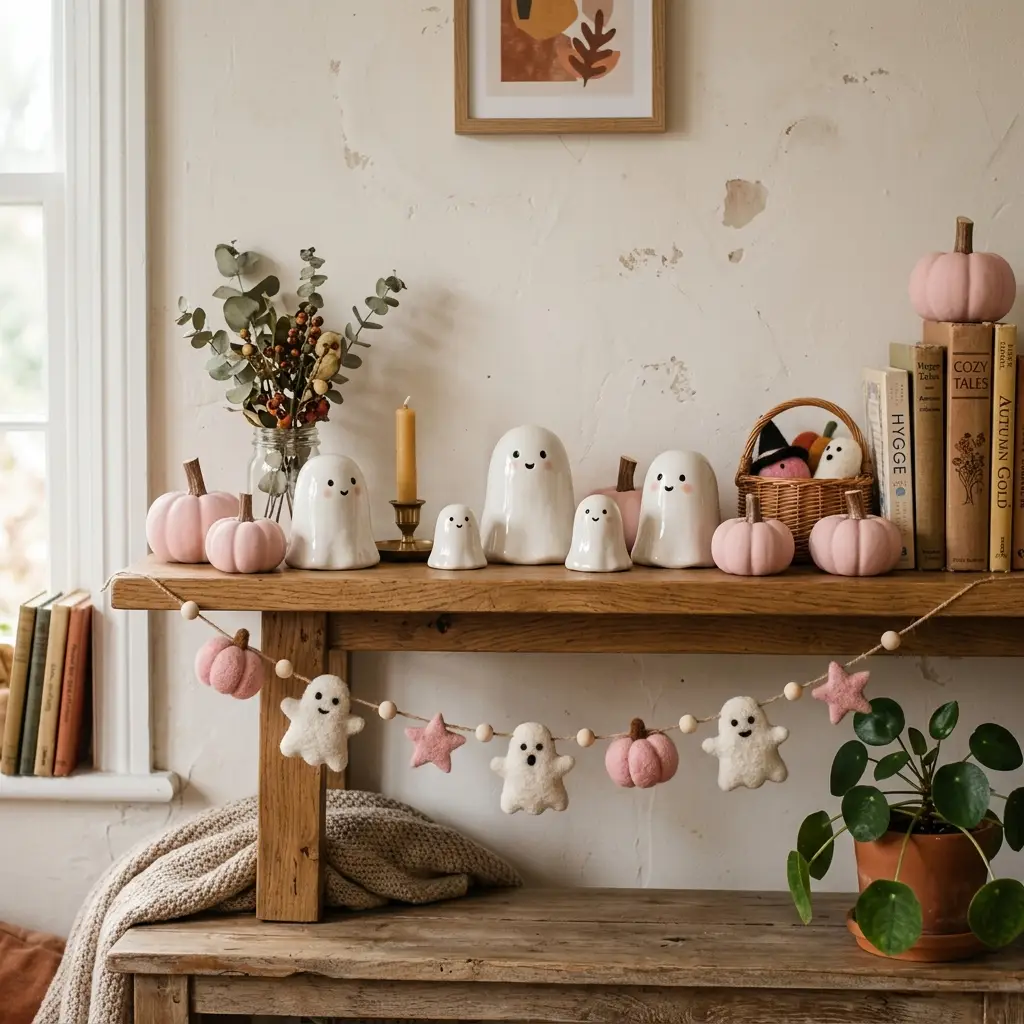
- Shape: Rounded silhouettes replace pointed ones. No fangs, no claws, no sharp angles anywhere.
- Proportion: Oversized head, large eyes set low in the face, short thick limbs, plump body.
- Expression: The mouth turns up or disappears completely. An open mouth with teeth cancels everything else.
- Contrast: Tones sit close together, with no true black and no deep shadow.
Two Ghosts, One Shelf
Two ghosts sit side by side in the same shop, on the same shelf, at the same price. One is a white shape with two black holes for eyes and a wide open mouth. The other is the same white shape at the same size, with two round dots and no mouth at all. A four-year-old will pick one up and walk away from the other without thinking about it for a second.
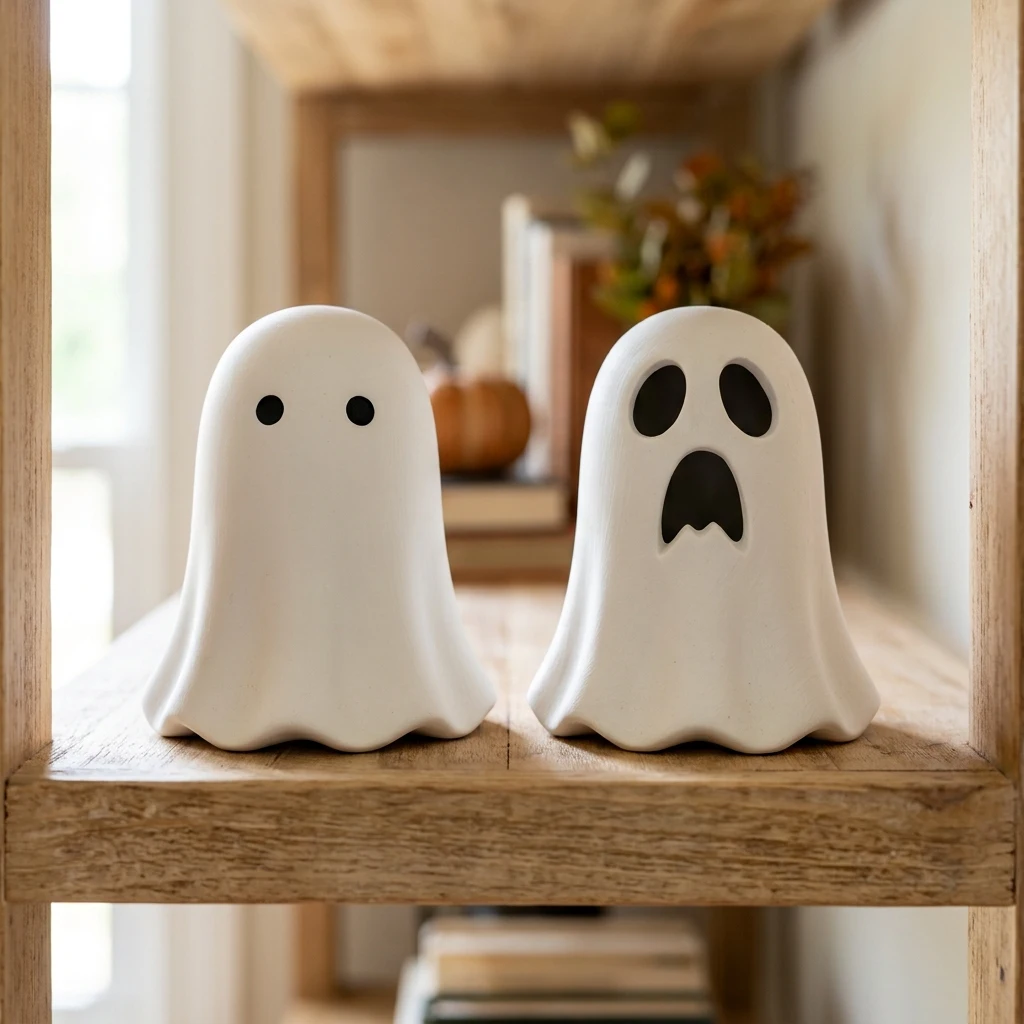
Nothing separates them except a handful of small decisions the manufacturer made. That is the useful part, because it means cute Halloween decor is not really a shopping category at all — it is a short list of changes applied to the same motifs everything else in the season uses. Learn the list and you can tell in about a second whether a piece will actually land, which beats browsing our home decor inspiration with a vague feeling about what looks sweet.
The other half of the argument is less obvious. A display made entirely of soft, smiling, rounded things stops looking like Halloween somewhere around the fourth object and starts looking like a toddler’s birthday. Cute needs something to push against. One genuinely eerie item in the room is what keeps the rest of it in the season.
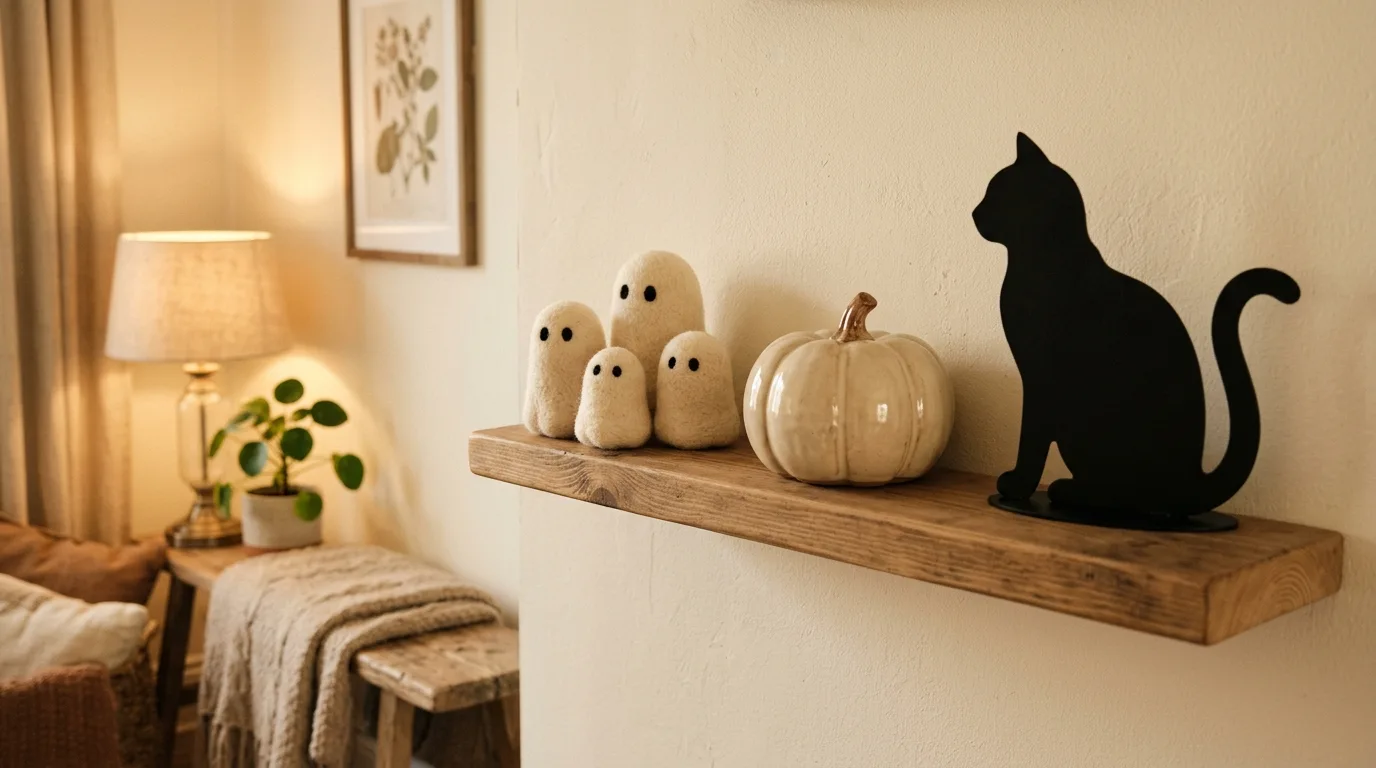
Editorial field note: a shelf holding five smiling felt ghosts and one plain black cat silhouette almost always looks more like Halloween than the same shelf holding six smiling felt ghosts, and the change costs about ten dollars. The rest of the season’s styles are covered across our Halloween decorating archive, and cute is the one that needs the most care.
What Actually Makes Something Cute Instead of Scary?
Four changes do almost all of the work, and every one of them is reversible. Take a classic scary motif — a spider, a bat, a skull, a ghost — and apply all four, and it comes out cute. Apply two of the four and it comes out somewhere in between, which is where most disappointing purchases live. This is the whole mechanism, and it is worth knowing before spending anything.
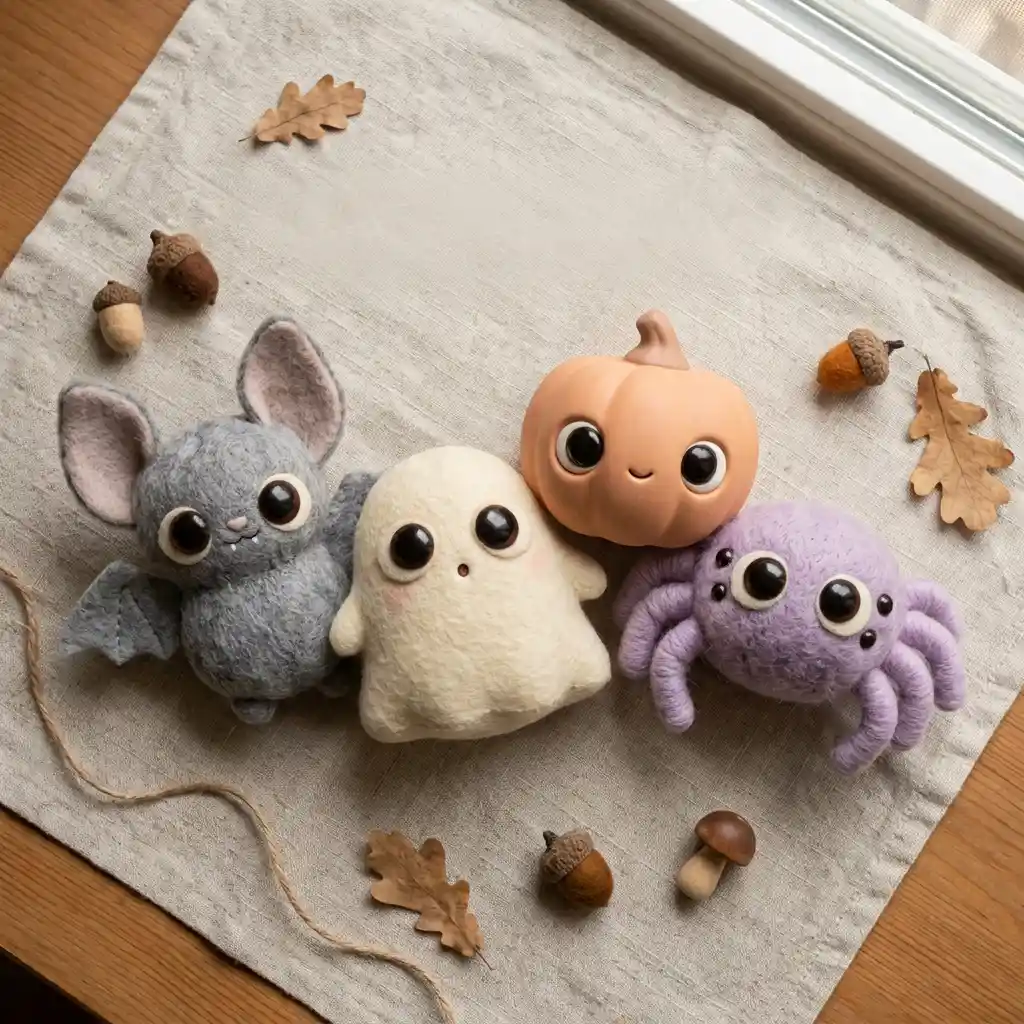
The four moves below sort by what the manufacturer changed, not by what the object is. A black cat exists in every Halloween style; these are the specific edits that decide which one it belongs to. Which finish family a piece falls into is a separate sort that the wider styles guidance handles, and this list sits underneath it.
Move One — Round Replaces Pointed
Every threatening feature on a Halloween motif is a point. Fangs, claws, spider legs, bat wings, the tips of a witch’s hat and shoes, the jagged teeth cut into a pumpkin. Round every one of them off and the threat leaves the object entirely.
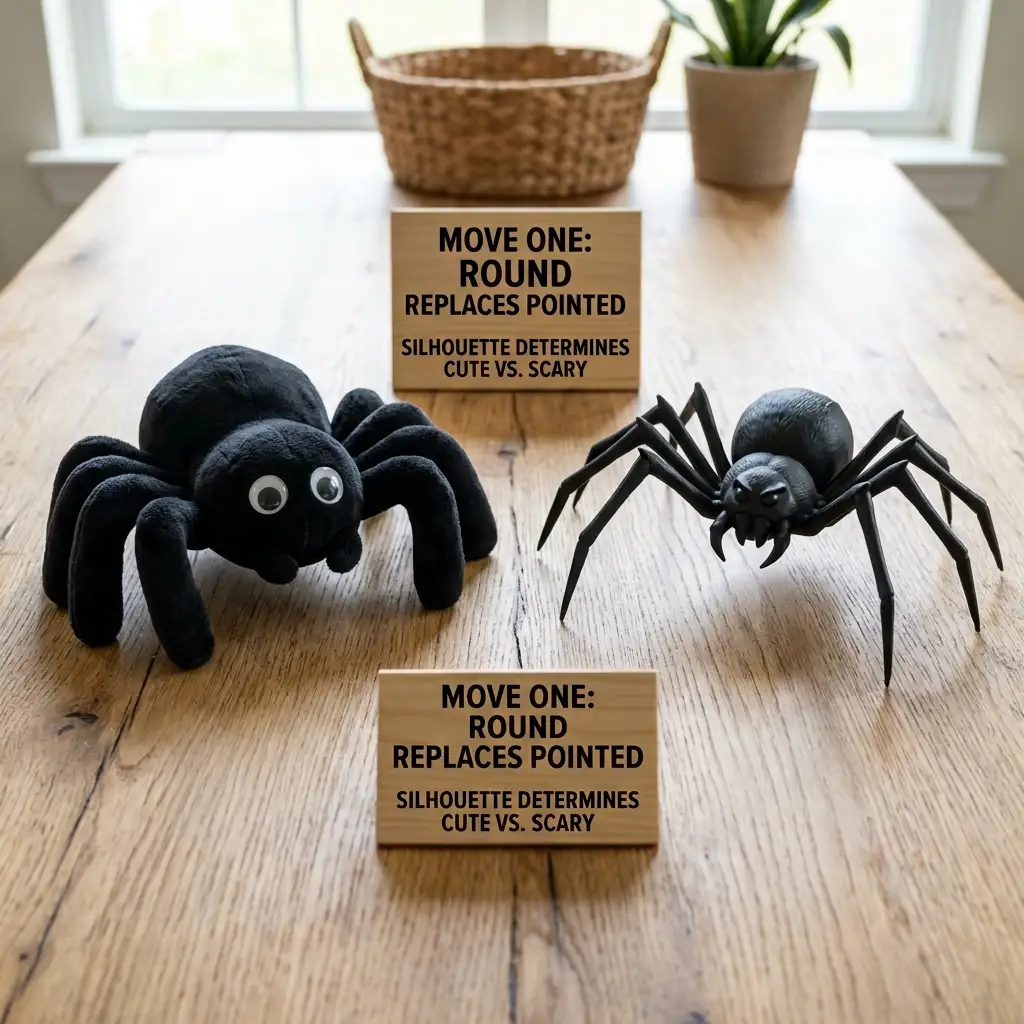
Look at the silhouette first, before anything else. A cute spider has eight stubby rounded legs and no visible fangs. A scary one has eight thin angular legs that come to a point. Same creature, same colour, same size — the outline alone decides it, and you can check the outline from across a shop.
Move Two — Big Head, Big Eyes, Set Low
This one has actual science behind it. The ethologist Konrad Lorenz described a set of infant features he called the baby schema, and a recent review of the concept lists them precisely: a large head, a domed protruding forehead, eyes that are large and set below the centre of the skull, short thick limbs with large hands and feet, rounded body shapes, a soft elastic surface, and round chubby cheeks.
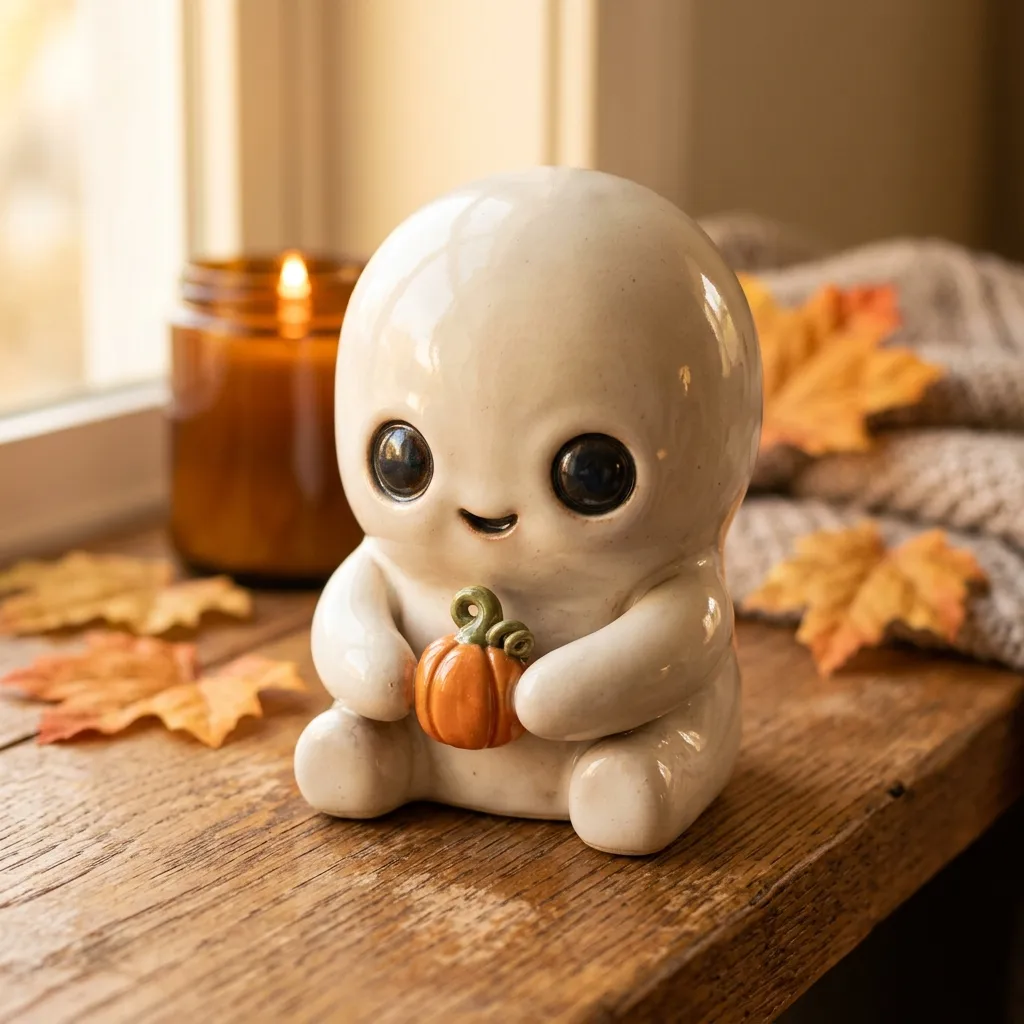
That is a specification, not a vibe. The same review notes the effect carries beyond human infants to animals and even to artificial objects such as cars, which is exactly why it works on a ceramic pumpkin. The single most useful detail is the eye placement: eyes set low in the face, below the midpoint, are the difference between a friendly character and a blank one. Hold two pieces up and check where the eyes sit.
Move Three — The Mouth Turns Up or Disappears
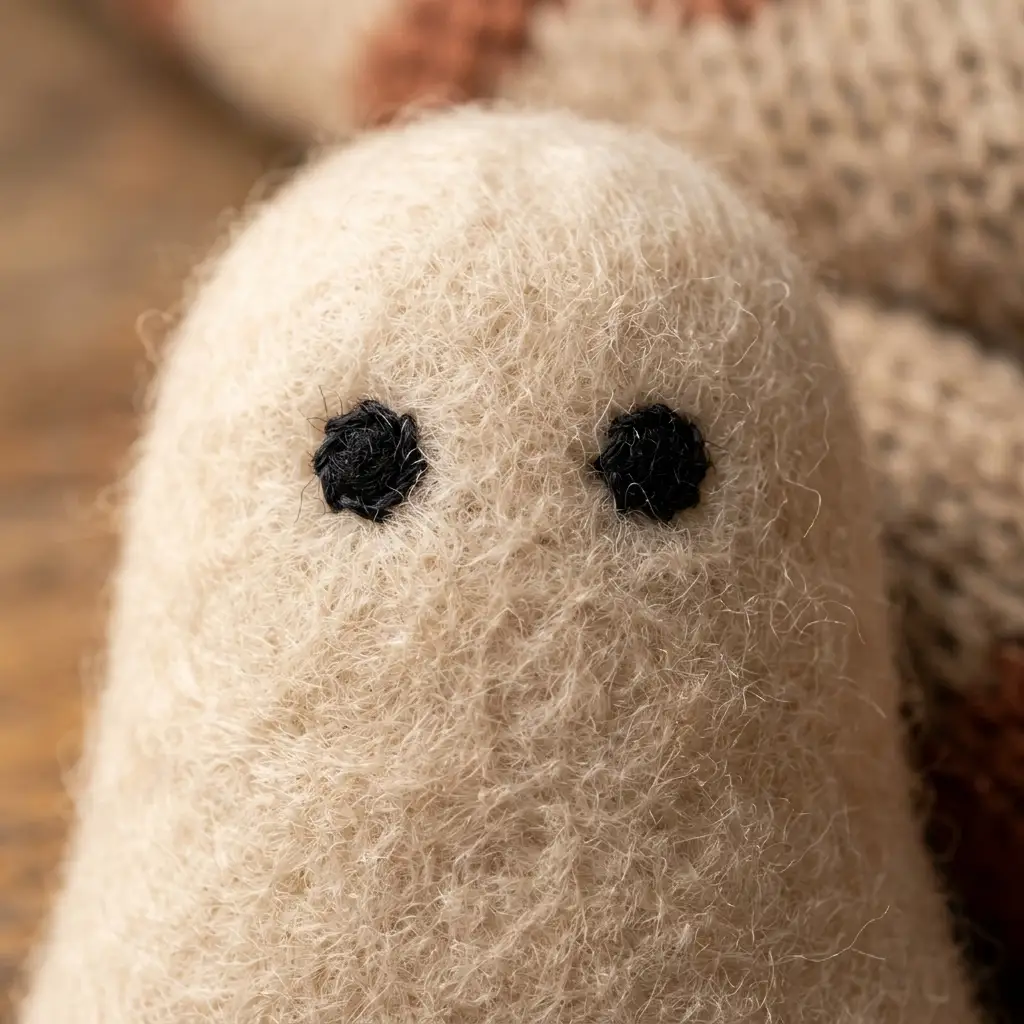
An upturned mouth is friendly. A straight one is neutral and still fine. A downturned one, or an open one showing teeth, cancels every other cute feature on the object no matter how round and soft the rest of it is.
The strongest version is often no mouth at all. A ghost with two dots and nothing else lets the viewer supply the expression, which is why so many of the best-looking pieces in this style are almost featureless. Designer Tip: when a piece has a printed face you dislike, check whether it is printed on or stitched on — printed faces on fabric can sometimes be replaced with two small felt circles, and that one change fixes more bad purchases than anything else.
Move Four — Take the Contrast Out
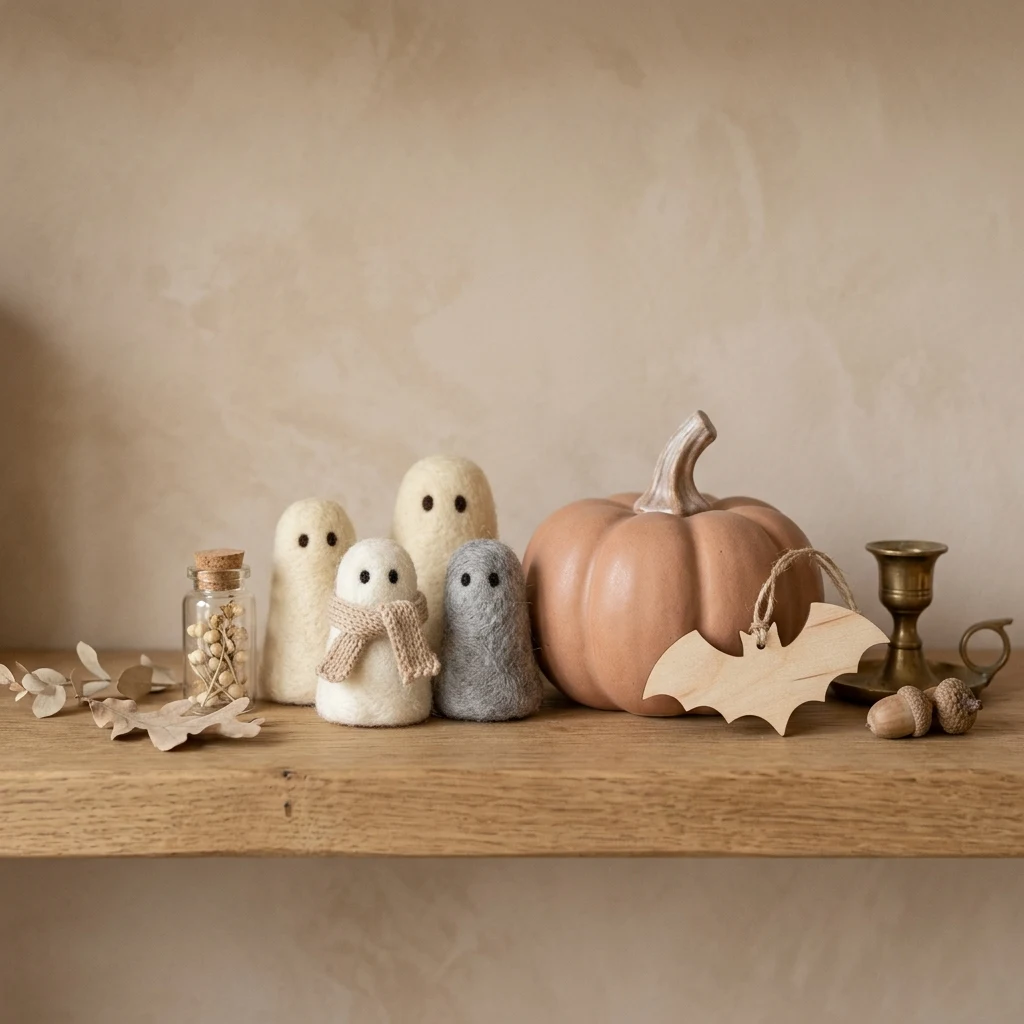
Scary depends on contrast. Deep shadow, true black against white, hard edges between light and dark. Cute lives in the middle of the range, where every tone sits close to its neighbour and nothing casts a hard shadow.
This is about how light and dark are distributed, not about which colours you pick — the actual palette question, and how far into pastel to go, belongs with the dedicated pink and pastel guidance rather than here. What matters at this level is that a soft rounded ghost photographed against a black wall in raking light stops looking cute immediately, and the object never changed.
| Quick Takeaways | |
|---|---|
| Shape | Check the silhouette first — round every point and the threat leaves. |
| Proportion | Big head, large eyes set below the midline, short thick limbs. |
| Expression | Mouth up or absent. Teeth cancel everything else on the piece. |
| Contrast | Keep tones close together. No true black, no hard shadow. |
| Material | Felt, wool, ceramic, wood or paper reads cute. Bright plastic reads childish. |
| The anchor | Exactly one genuinely eerie object in the room. One, never two. |
| Placement | Eye level, indoors, close range. The details vanish past about fifteen feet. |
Cute or Childish? Material Decides
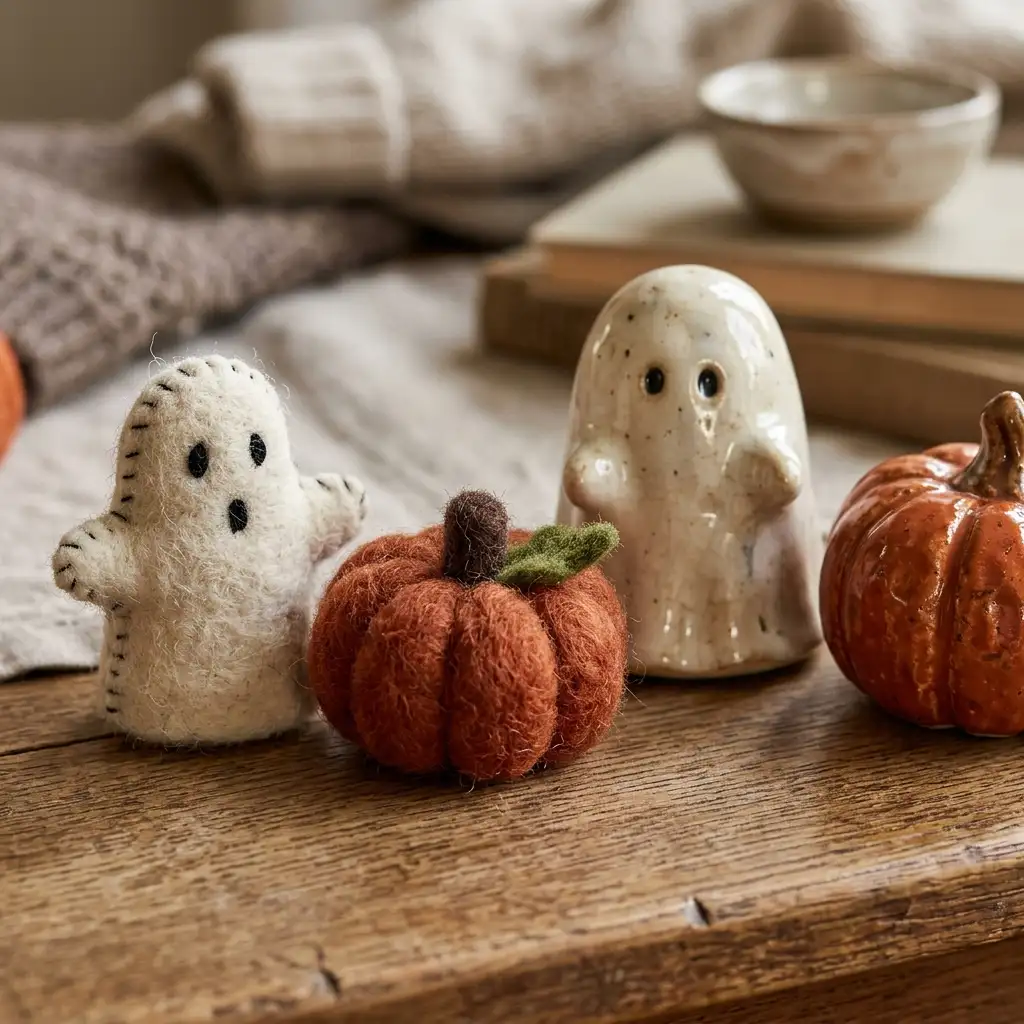
Here is the line almost everyone crosses by accident. Cute and childish use identical shapes, identical proportions and identical faces. The thing that separates them is what the object is made of, and nothing else.
Put the four moves into felt, wool, ceramic, unfinished wood, paper or glass and you get something an adult is happy to look at. Put the exact same four moves into bright molded plastic and you get a toy. The shape did not change. The surface did. This is why a hand-stitched wool ghost and an injection-moulded one at the same price sit in completely different rooms, and it is also why sweet palettes survive in grown-up spaces when the materials are good — our sophisticated pink bathroom designs make the same case in a permanent room.
Texture does the heavy lifting because it is the one thing a photograph of a cheap object cannot fake. Felt has visible fibre. Ceramic has a glaze that varies. Wood has grain. Moulded plastic has a uniform surface, a mould seam and a shine, and all three of those read as manufactured from a foot away. Handmade seasonal pieces are the easy version of this — our felt Christmas decorations show what the material argument looks like in December.
Why Does a Fully Cute Display Feel Like a Birthday Party?
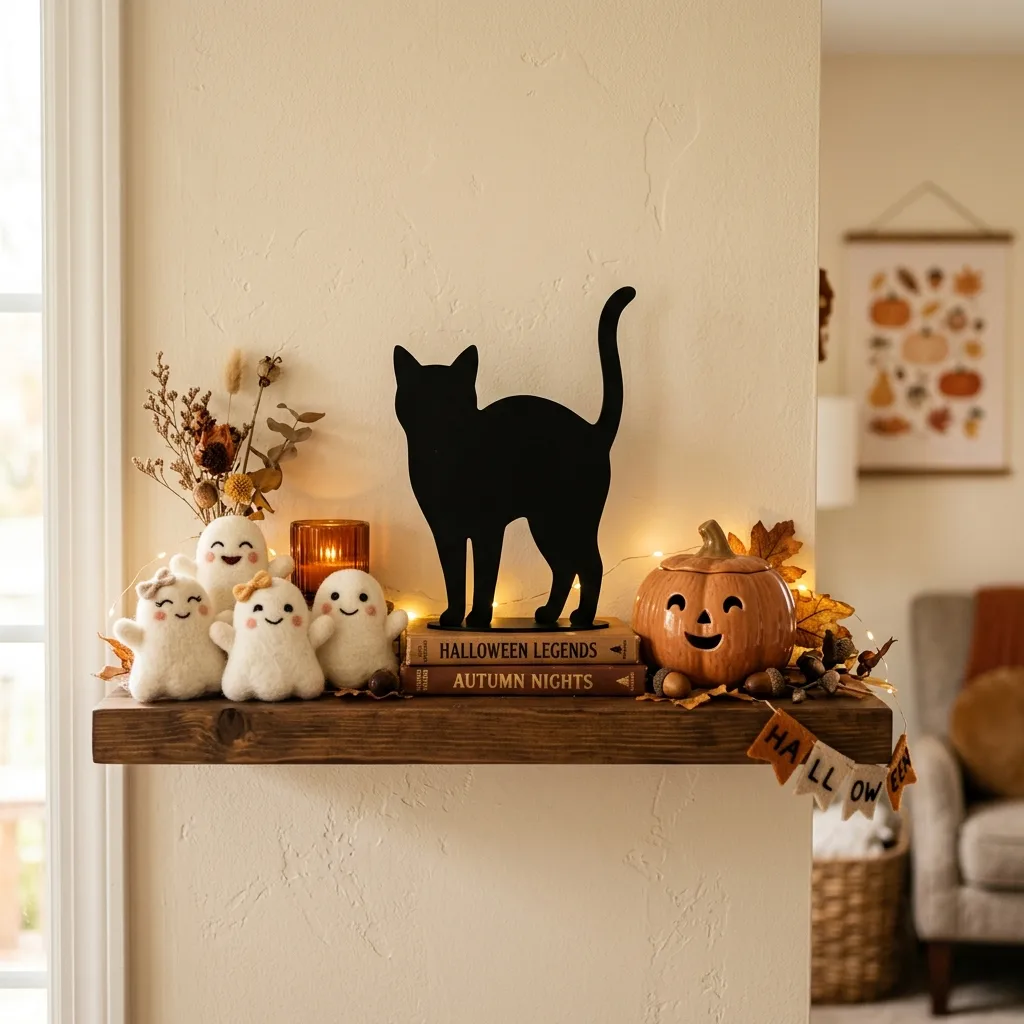
Because Halloween’s job is to unsettle, and cute declines that job completely. Remove every trace of the eerie and there is nothing left telling anyone which holiday this is — you have a soft, smiling, pastel arrangement that would work equally well for a christening. The season disappears somewhere around the fourth smiling object.
The fix is one object, and it has to be genuinely a bit eerie rather than a cute version of something eerie. A plain black silhouette with no face. A single deep-shadow corner where a lamp does not reach. One length of real cobweb texture. One dark, unsmiling shape among all the friendly ones. That single piece does all the work of putting the display back in October.
The cap matters as much as the rule. One anchor works. Two starts a competition between the two moods and the room ends up neither. Other sweet-leaning seasons run on exactly the same logic — see how our romantic Valentine’s tablescape ideas hold their edge without tipping into saccharine.
Where Do Cute Halloween Decorations Actually Belong?
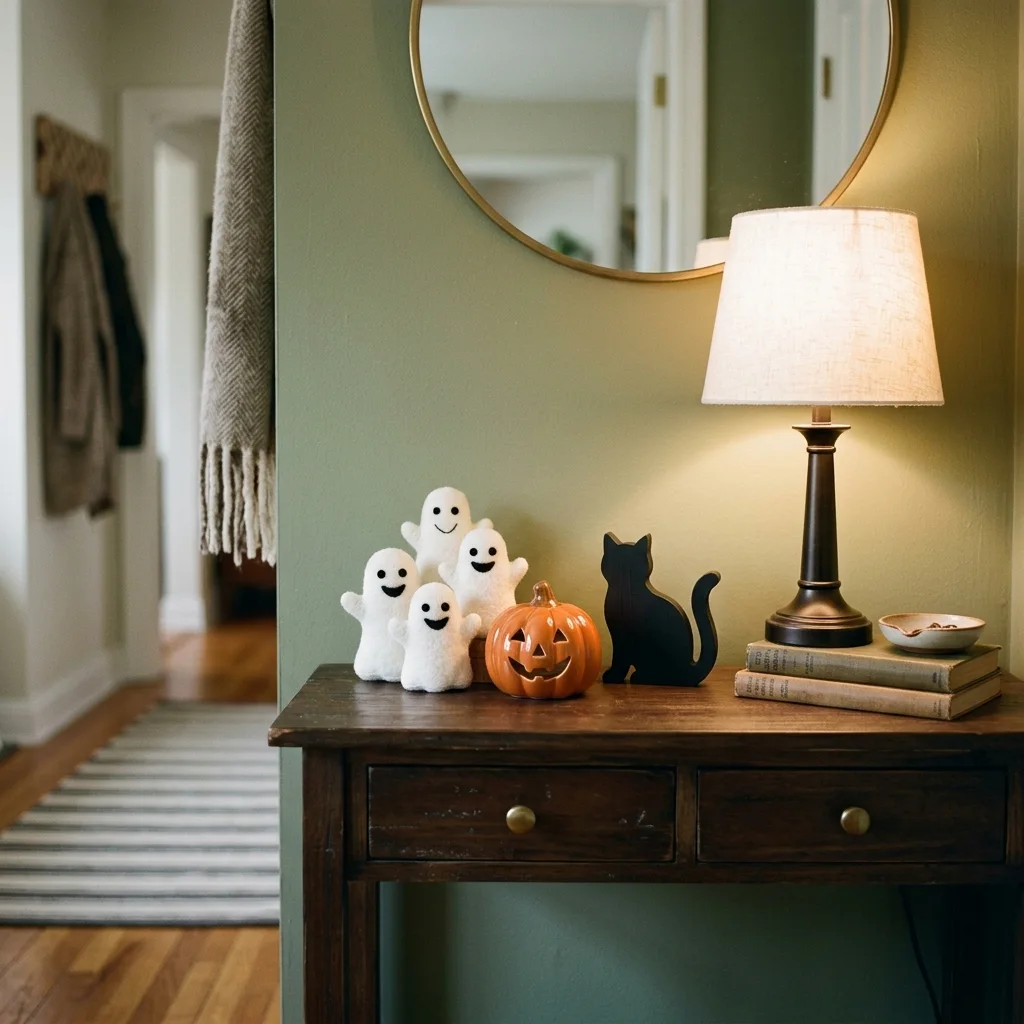
Indoors, at eye level, on surfaces people stand close to. That is not a style preference — it follows directly from the four moves. Every feature that makes an object cute is small: the curve of a mouth, the position of two eyes, the rounding on a leg, the fibre in a piece of felt. All of it disappears past roughly fifteen feet, and all of it disappears in the dark.
So a cute piece on a front lawn is just a pale blob after sunset, which is why the yard, the roofline and the street belong to the Halloween styles built on scale and silhouette. Cute earns its place on a console table, a kitchen shelf, a mantel, a bookcase, a windowsill you pass daily, or the hall table right by the door. Close-range surface styling is its own craft, and our coffee table decor ideas cover the grouping side of it.
Cute Halloween decorations also do something no other style in the season manages: they survive being in a room you actually use. A spooky display in a kitchen is a strange thing to eat breakfast next to for six weeks. A small rounded ceramic ghost beside the kettle is not, and that is a real advantage rather than a consolation prize. The broader seasonal calendar sits in our seasonal decorating ideas archive.
Cute Has Nowhere to Hide
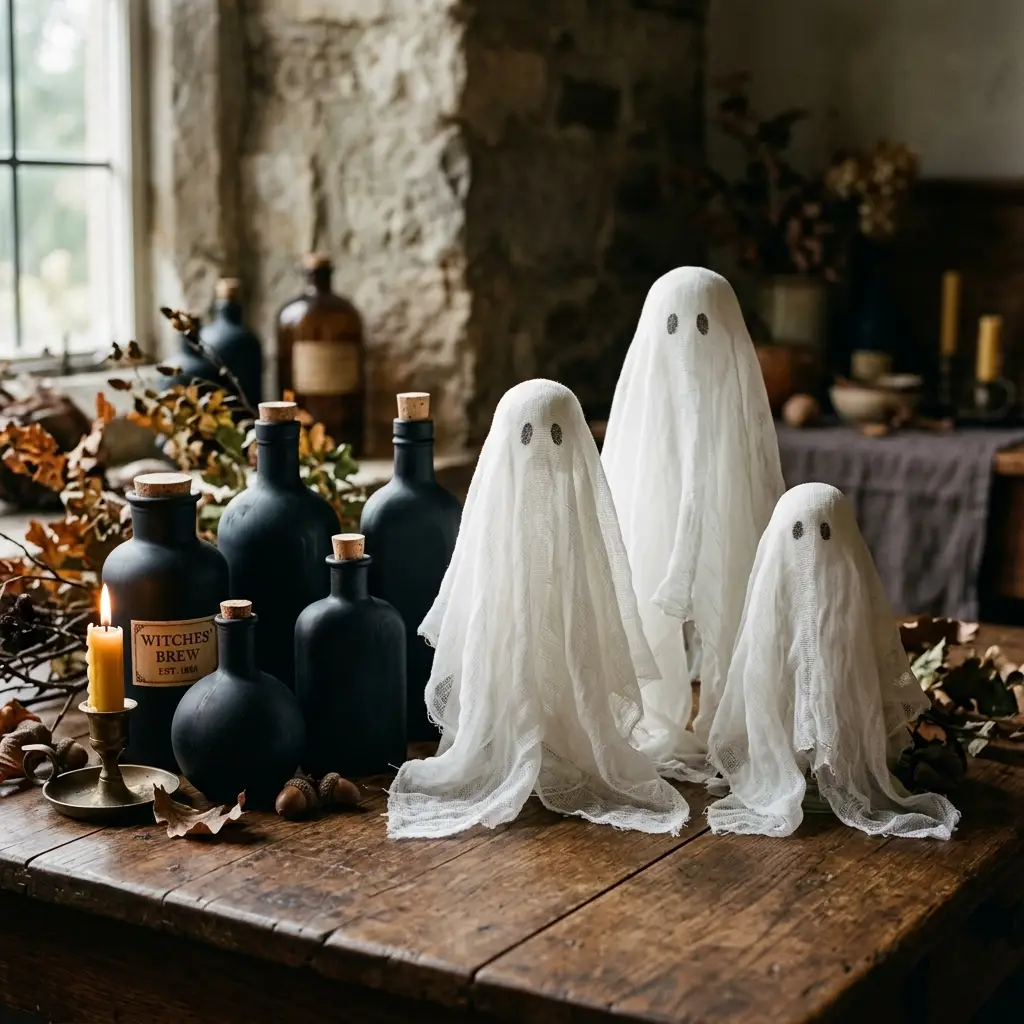
Spooky is a forgiving style because of where it gets used. It is viewed at distance, at night, in low light, often from a moving car — conditions that hide a mould seam, a rough paint edge or a thin material. Cute is viewed indoors, under lamps, from two feet away, in daylight, for weeks. It is the hardest viewing condition in the whole season.
The practical consequence is that the same twelve dollars buys a convincing spooky prop and an unconvincing cute one. Money in this style has to go into material and finish rather than into size or effect, because size and effect are exactly what cute is not doing. Buy fewer, better, smaller pieces. Handmade work is the reliable route, and the same instinct runs through our felt flower craft ideas.
This is a different point from checking an outdoor prop in daylight for manufacturing tells, which is about sun exposing what a molded object is made of. Here the issue is the viewing distance the style commits you to: cute is always seen up close, so there is no distance doing you any favours.
The Audience Ages Out. The Objects Don’t.
If cute is in the house because a small child is in the house, the buying logic changes in a way nobody warns you about. The objects will last a decade. The audience will not. Somewhere around seven or eight, most children start actively preferring the scary version, and the friendly ghost collection becomes a thing they tolerate for your sake.
There is a real reason cute exists for this age group. Michigan State University Extension points to research in the British Journal of Developmental Psychology finding that children aged three to five could tell real characters from fictional ones only 40% of the time. A scary decoration is not a fun scare at that age, it is simply a scary thing in the hallway, and the extension’s suggested response is to name the fear and then show the child the object is plastic.
So split the budget by lifespan. Character pieces — the faces, the smiling things, the named characters — get bought cheap, because they belong to a phase. Faceless pieces carry the money: a garland, a table runner, a set of plain pumpkins, a wreath with no expression on it. Those survive the child growing up and keep working for the adults afterwards. Nurseries face exactly this problem, which is why our timeless minimalist nursery decor guide is built around the same split.
Designer Rule of Thumb: if a piece has a face, assume you have three good seasons with it. If it does not, assume ten. Buy accordingly, and let the child pick the cheap ones.
What About Grown-Ups Who Just Like It?
A large share of the people buying this style have no children in the house at all, and the advice usually written for them is patronising. There is nothing childish about wanting the season without the dread. Plenty of people simply do not want to look at gore, hanging figures or anything genuinely unsettling in their own living room for six weeks, and cute is the only lane that answers that.
For this reader the material rule is not optional, it is the entire brief. Everything above about felt, ceramic, wood and glass applies twice as hard, because there is no child in the room to explain the plastic. Buy small, buy few, buy well made, and keep the one eerie anchor so the shelf still belongs to October.
The other adjustment is quantity. Without a child to delight, the case for volume disappears, and three good objects on one surface will do more than fifteen spread through the house. That is closer to how a well-judged cozy winter decor scheme works than to a typical Halloween haul.
Where Cute Halloween Decor Goes Wrong
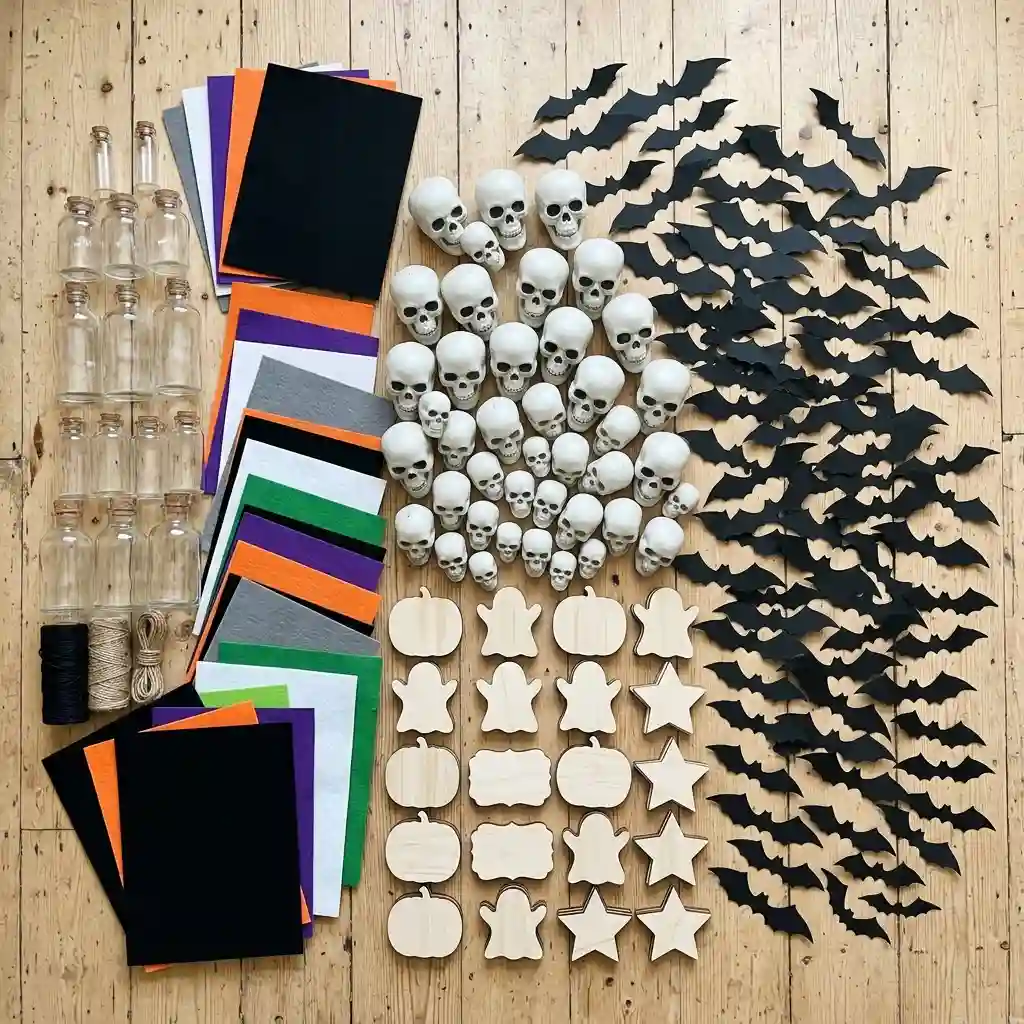
❌ Buying every piece in bright molded plastic → ✅ Put the same shapes in felt, wool, ceramic or wood, because material is the whole difference between cute and childish.
❌ Making the entire display cute with nothing to push against → ✅ Keep exactly one genuinely eerie object in the room so the shelf still belongs to Halloween.
❌ Putting cute pieces on the lawn or above head height → ✅ Keep them at eye level indoors, where the small features that make them cute are actually visible.
❌ Spending the budget on the character pieces → ✅ Buy the faces cheap and put the money into faceless items that outlast the phase.
Run This Before the Cute Stuff Comes Out
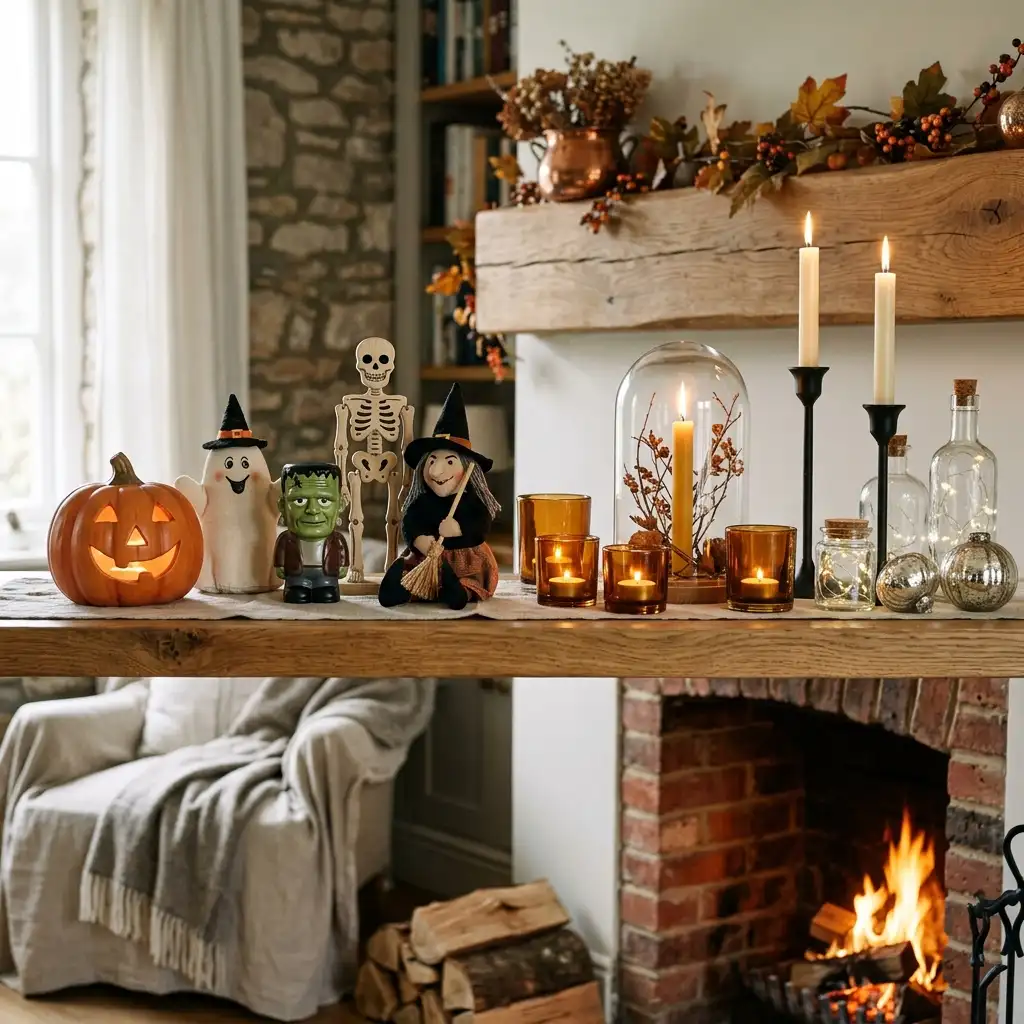
- Check the silhouette from six feet away before checking anything else — points mean it will not land as cute.
- Look at where the eyes sit; below the midline of the face is the difference between friendly and blank.
- Reject anything with an open mouth showing teeth, however round the rest of it is.
- Pick up the piece and feel the surface, since felt, ceramic and wood all pass and moulded plastic does not.
- Choose your one eerie anchor before buying a single cute object, so the display has something to sit against.
- Put everything at eye level on a surface people walk past, never on the lawn or above a door.
KEY TAKEAWAY: check the outline, the eye position and the material in that order — those three tell you in about two seconds whether a piece will read cute or just look cheap.
What a Cute Halloween Layer Costs
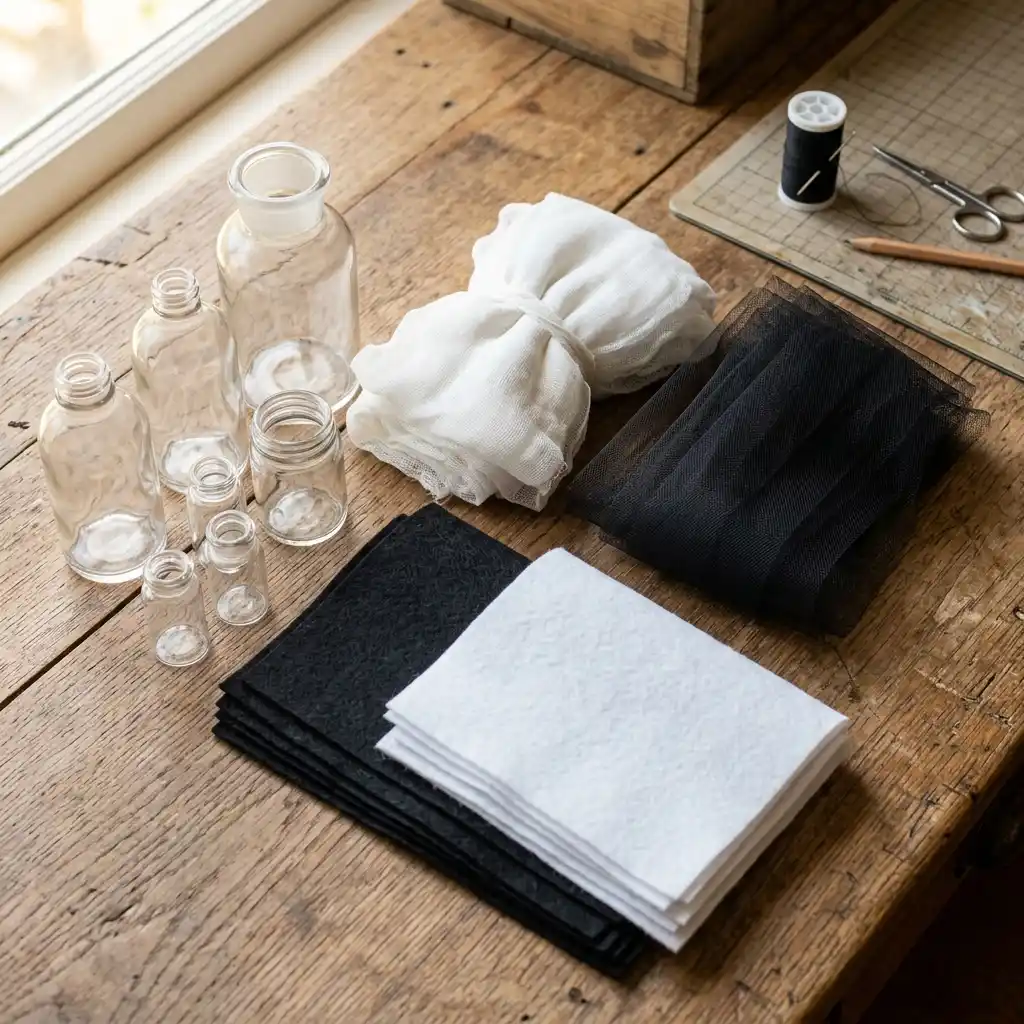
This is one of the cheaper styles to build, because it works best small and works worst in bulk. The figures below cover one room’s worth, which for this style is one or two surfaces rather than a whole house.
| Project | Estimated Cost | Impact Level |
|---|---|---|
| One eerie anchor — a plain black silhouette or a single dark shade | $8-$25 | High |
| A small set of soft-material characters in felt, wool or ceramic | $20-$55 | High |
| One faceless piece that outlasts the phase — garland, runner or plain pumpkin set | $35-$110 | Very High |
Best First Upgrade: the anchor, oddly enough. Buying the one eerie object before any of the cute ones stops the whole display drifting into party decoration, and it is the cheapest line on the list.
Skip for Now: large plastic character pieces and multi-piece themed sets. Both fail the material test, and the sets arrive with the faces you did not choose. A cheaper handmade route is worth trying first, and our budget seasonal DIY decorations show the general approach.
Is Cute Worth Committing To?
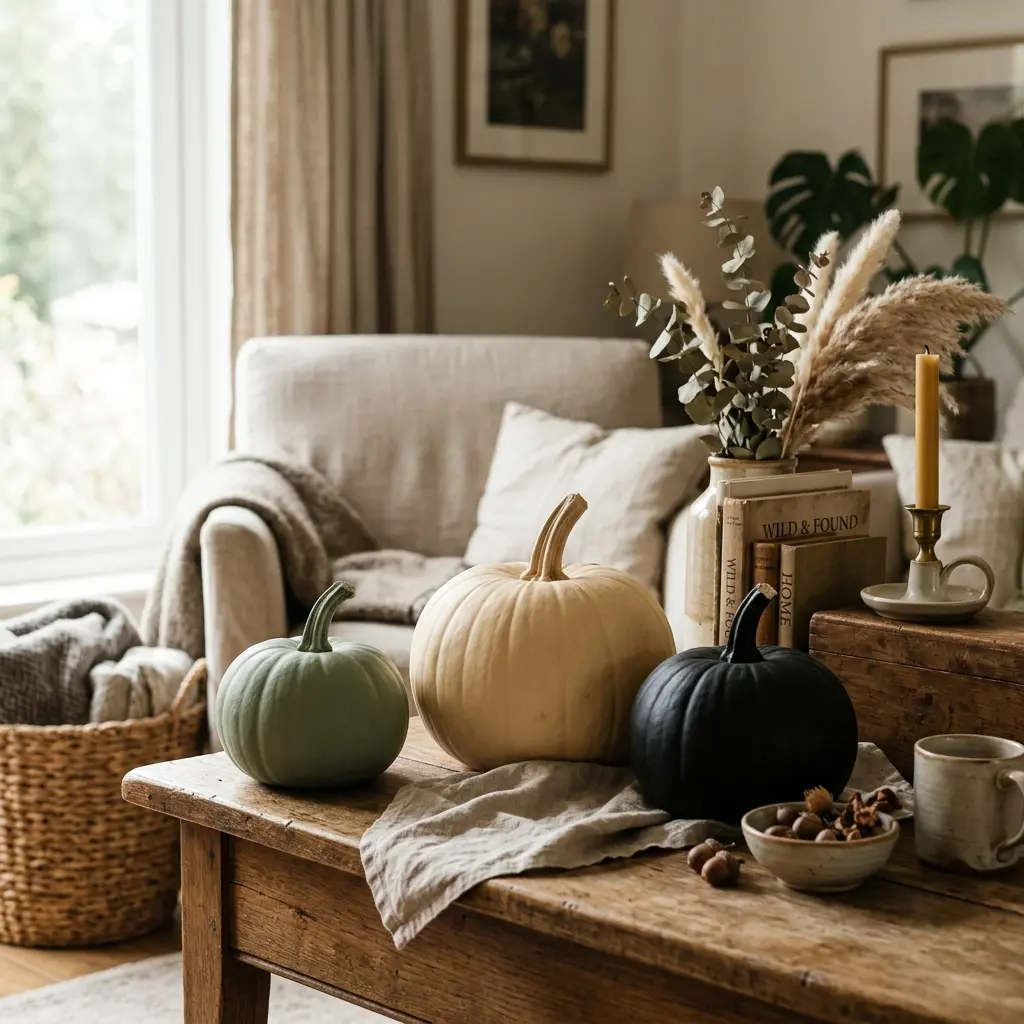
Designer’s Verdict: yes for households with young children, and yes for anyone who wants October in the house without the dread — but only if you accept that this is a small, close-range, indoor style and stop trying to make it do the street. Cute fails hardest when someone asks it to decorate a whole facade. It succeeds when it takes two surfaces and does them properly.
The honest limitation is that it dates faster than the rest. Character-led product follows whatever was popular that year, so a cute collection built in one season looks specifically like that season a few years later, in a way a plain paper cutout or a brass candlestick never will. Faceless pieces are the hedge against that, which is the same reason they are also the hedge against a child growing up.
Set against that, no other Halloween style is as easy to live with. Nothing here frightens a visiting toddler, nothing needs to come down before a dinner party, and nothing looks grim in the kitchen at eight in the morning. Households already doing kid-friendly seasonal decorating at Christmas will find the rhythm familiar.
What If You Have a Toddler and No Budget?
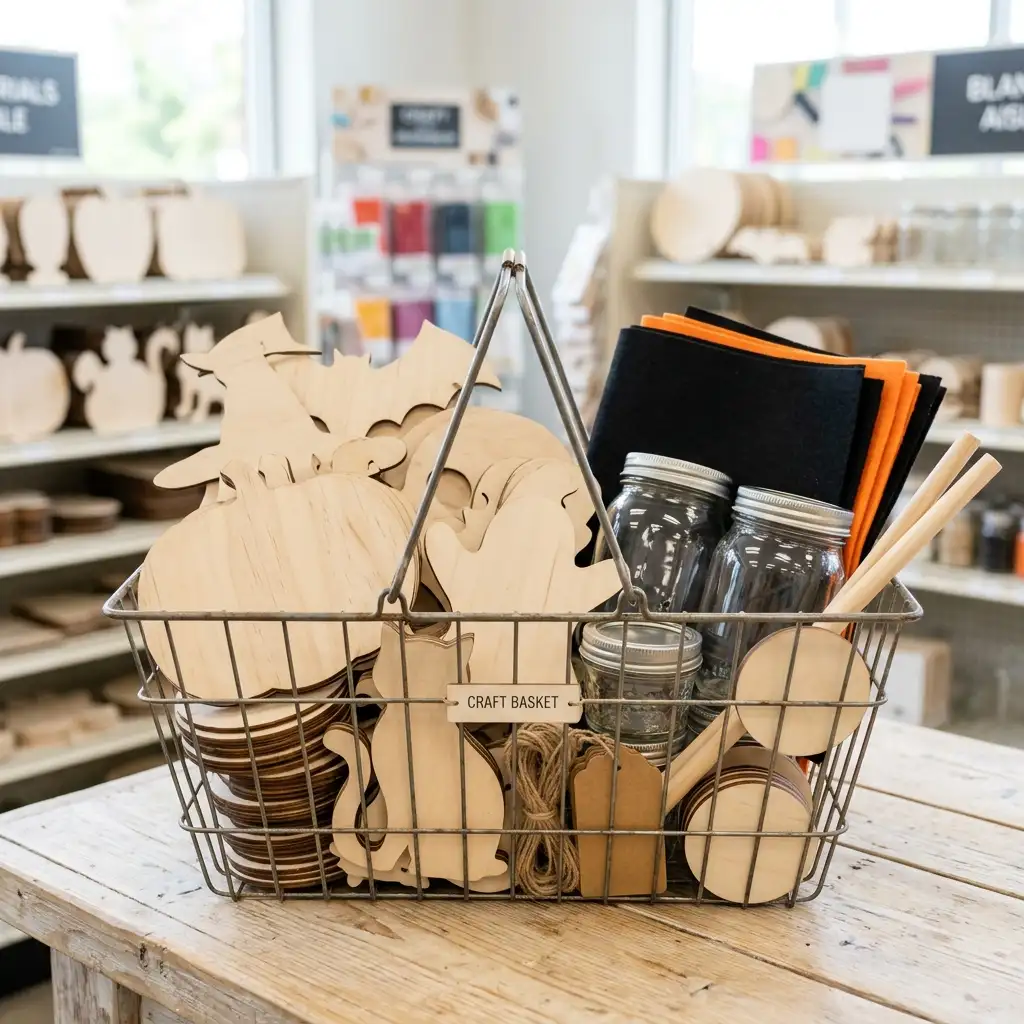
Then this style is the easiest one on the whole map to do properly, because its two strongest rules are free. Put everything at a height the child can see, which is lower than you think and lower than most adults decorate. Then remove anything with teeth, an open mouth or a downturned face, which costs nothing and does more for a nervous two-year-old than any purchase.
With almost no money, one surface done well beats a house done thinly. Take the hall table or a single kitchen shelf, put three soft objects and one plain dark shape on it, and stop. A whimsical, gentle approach to a child’s space works the same way in our enchanted forest nursery ideas.
Safety Note: keep small detachable parts, loose beads and long ribbon well out of reach of children under three, and skip anything with a battery compartment that opens without a screw.
If the room has to stay neutral for the rest of the year, keep the seasonal layer to objects rather than to anything fixed, and let a soft existing palette carry it — the approach behind our pink boho nursery ideas works with almost no seasonal spending at all.
Why Cute Keeps Gaining Ground
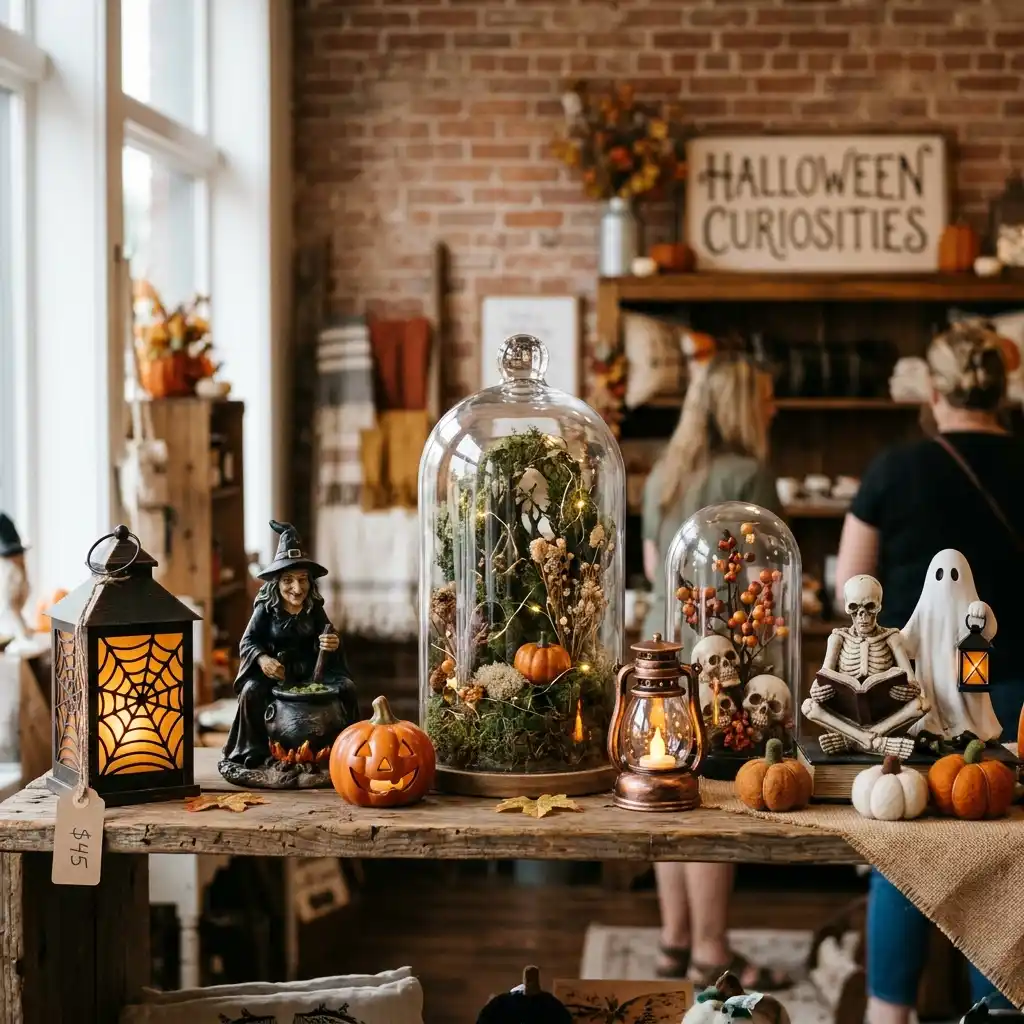
Signs This Is Catching On:
- Cute is the only Halloween lane with a genuine year-round audience beyond the season’s core, since a soft ceramic character is a much smaller commitment than a dark room or a yard full of props.
- Handmade and small-maker seasonal work keeps expanding, and this is the style that benefits most, because material quality is what the whole look rests on.
- Retail has separated cute from scary into distinct ranges rather than treating it as a children’s sub-section of the same aisle, which is what happens when a look grows its own audience.
- The wider move away from gore across seasonal decorating gives this lane room it did not have a decade ago.
Frequently Asked Questions
Conclusion
If your house has a nervous toddler, a tight budget, or no room for another storage bin, cute Halloween decor is the one style that asks nothing from you except care about the material — one surface, three soft objects, one dark shape, done. Editorial field note: the cute displays that look best are almost always the smallest ones, because this style is judged from two feet away where thin material has nowhere to hide. Start with the anchor, add the soft pieces slowly, and browse the rest of our home decor ideas for the surface it lands on.