
TL;DR
- Color: Soft white, warm greige, and muted clay outlast every trend and still read calm five years later.
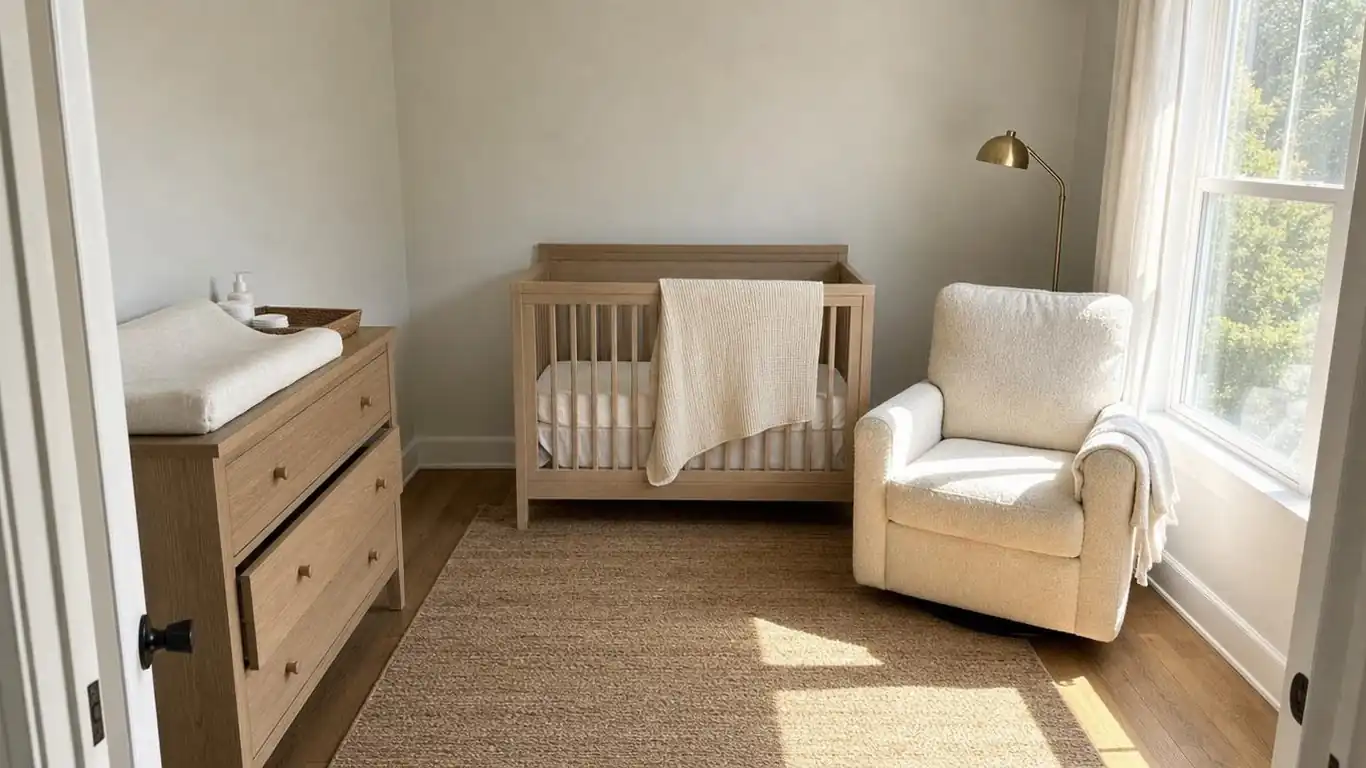
- Furniture: A convertible crib, a dresser, and a glider — those three pieces are the whole foundation.
- Textiles: Natural linen, raw cotton, and boucle add warmth and texture without visual noise.
- Lighting: A dimmable warm-toned lamp at floor or side-table height beats overhead fixtures for every nighttime feed.
- Storage: Wall-mounted shelves and built-in bins keep the floor clear and make a small room feel twice its size.
What Makes a Minimalist Nursery Feel So Right
Why does the same room feel calm in one home and chaotic in another — even when both have a crib, a dresser, and a glider? Most of the time, the answer is everything surrounding those three pieces. The extra bookcase. The novelty wall decals. The dozen stuffed animals. The mismatched baskets. Each one is harmless on its own. Together they turn a small room into visual noise.
A minimalist nursery solves this by treating the room as a system. Every piece has a purpose. The crib is for sleeping. The dresser holds clothes and handles diaper changes. The glider is for feeding. The lamp handles nighttime light. Nothing exists to fill empty space.
I worked on a minimalist nursery for a first-time mother in early 2024. She came in genuinely overwhelmed — months of Pinterest boards, fabric swatches everywhere, and still no clear direction. We stripped the plan back to four pieces: warm greige walls, a white oak crib, a cream boucle glider, and a single floating ash shelf. She cried when she saw it finished. “This is the first time I can actually picture the baby in the room,” she said. That’s what this approach does. It makes room for what matters.
For a wider look at nursery styles before you commit to a direction, 25 nursery room inspiration ideas you’ll actually want to use gives you a full range to compare. And for home decor ideas across every room, 101homedecor.com is always a good starting point.
Bookmark this guide for quick reference.
KEY TAKEAWAY: A minimalist nursery earns its calm by removing competition — not by removing comfort.
| Quick Takeaways | |
|---|---|
| Color | Soft white, warm greige, and muted clay hold their calm through years of use. |
| Furniture | Crib, dresser, and glider — nothing else is essential in the first year. |
| Textiles | Natural linen, raw cotton, and boucle add warmth without busyness. |
| Lighting | Dimmable warm-toned lamps at floor level beat overhead fixtures every time. |
| Storage | Wall-mounted shelves free the floor and keep the room feeling open and calm. |
What a Minimalist Nursery Actually Means
A minimalist nursery has one rule: every object in the room earns its place. The crib is the anchor — the room’s focal point. The dresser adds secondary structure. The glider is the high-use comfort piece. Everything else has to justify itself against that standard.
This design approach draws from Japandi principles — a blend of Japanese wabi-sabi and Scandinavian functionalism. Both traditions treat clear floors and honest materials as marks of good taste, not absence of effort. Wabi-sabi finds beauty in natural imperfection: a slightly uneven linen weave, a ceramic pot that isn’t perfectly round, wood grain that varies from piece to piece. Scandinavian design adds the functional layer: furniture that works hard, storage that disappears, proportions that fit the room rather than fighting it.
A minimalist nursery is not cold. Natural linen, boucle, and raw cotton make the room feel soft and safe. It’s not boring — texture and tone variation create visual interest without visual clutter. And it’s not difficult to maintain. Fewer objects means fewer things to clean around at 2am.
Minimalist nursery furniture stays close to natural finishes: white oak, ash wood, and solid beech are the most common choices. They age well, stay neutral, and look right whether the room is used for an infant or a three-year-old.
KEY TAKEAWAY: Minimalist nursery design uses Japandi principles — purposeful pieces, honest materials, and clear floors as the foundation.

Why a Minimalist Nursery Grows With Your Child
Most nursery decor has a built-in expiration date. Cartoon-character themes age out by two. Bright primary accent walls feel wrong by three. Novelty furniture — the oversized cloud shelf, the themed bookcase — looks odd once the child starts forming their own preferences. You end up redecorating, and spending again, earlier than you planned.
A minimalist nursery sidesteps this entirely. Soft white or warm greige walls stay neutral through every childhood phase. A white oak convertible crib becomes a toddler bed without looking like a compromise. A solid oak dresser works as a changing station now and a fully functioning bedroom dresser in three years. A cream boucle glider moves to the parents’ bedroom or a reading corner and still looks intentional there.
12 modern boy nursery decor ideas that grow with your child explores exactly this long-game thinking — pieces and palettes that evolve without requiring a full restart.
A minimalist nursery works as a system. The crib carries the most visual weight — it’s the anchor piece. The dresser adds secondary structure. Every other piece sits quietly in support of those two. When the room eventually needs to change, the bones stay solid and the additions layer in naturally.
KEY TAKEAWAY: Neutral tones and convertible furniture mean a minimalist nursery adapts to your child instead of being replaced by a new one.
How to Build Your Minimalist Nursery
A calm minimalist nursery comes together layer by layer. Work through these five foundations — walls and floor, core furniture, soft textiles, flexible lighting, and hidden storage — to build the room without visual clutter.
Start with the Walls and Floor
Soft white and warm greige are the two most reliable wall colors for a minimalist nursery. Benjamin Moore’s Chantilly Lace (OC-17) delivers a clean white without the blue undertone that reads clinical under lamp light. Farrow & Ball’s Elephant’s Breath is a warm grey-pink that holds beautifully under both natural and artificial light.
Avoid bright white — it photographs cold and feels sterile at 3am. Avoid deep accent colors in the first pass; they’re hard to reverse and tend to date quickly as the child grows.
For flooring, natural oak or ash hardwood works as the base material. A jute or low-pile wool area rug in warm cream or natural tan should measure at least 6 by 9 feet — large enough to anchor the crib zone and give you a soft landing during nighttime feeds.
12 minimalist bedroom ideas for 2026 that create a calming escape covers the same wall-and-floor logic for adult bedrooms — nearly all of it transfers directly to a nursery context.
The Furniture Core
Three pieces form the foundation: crib, dresser, and glider.
The crib is the room’s focal point. Position it against the longest wall, away from windows to avoid direct sun and cold drafts. White oak and ash wood cribs read as minimalist without feeling clinical. A quality convertible crib runs $300–$700 and becomes a toddler bed when the time comes.
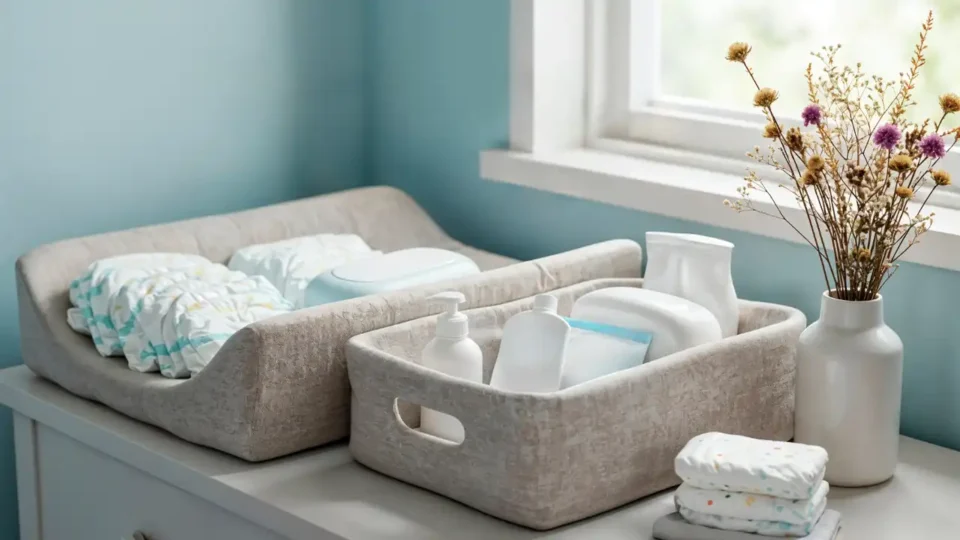
The dresser doubles as a changing station with a removable topper. Choose solid wood in warm white or natural oak — 4 to 6 drawers, wide enough to safely use as a changing surface. Budget $250–$600. The dresser stays with the room as bedroom storage once the changing pad comes off.
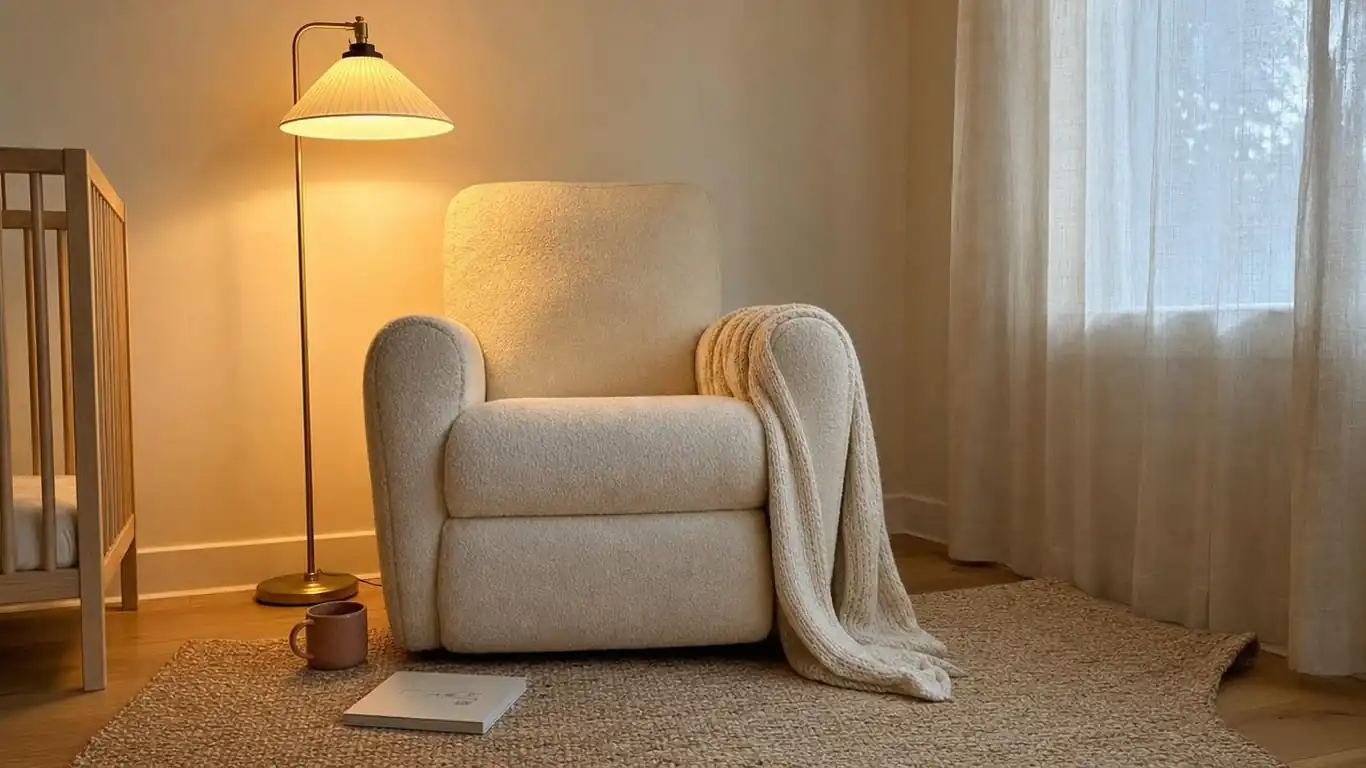
The glider is your endurance piece — you’ll sit in it for hours during feeds and through illnesses. Boucle or cream linen upholstery holds up well and stays neutral as the room evolves. A glider with a low-profile arm makes it easier to lower a sleeping baby without waking them. Budget $400–$900 for something worth keeping.
14 minimalist small bedroom ideas to de-clutter your space covers furniture proportion in tighter rooms — directly useful if your nursery is under 120 square feet.
Textiles and Layers
Textiles do the warming work in a minimalist nursery. The walls stay neutral. The furniture stays quiet. The textiles carry the softness.
Layer these:
- Crib sheet: washed linen or 100% organic cotton in warm white or muted clay
- Cellular blanket: natural cotton in cream or warm sand — safe for infants, textured enough to add visual depth
- Window treatment: sheer linen panels for daytime light, backed by blackout cellular shades for naps
- Floor rug: jute or wool in natural tan, at least 6 by 9 feet to anchor the feeding zone
Avoid patterned textiles in a minimalist nursery. Stripes, gingham, and large prints break the calm palette. Solid textures — boucle, waffle weave, and washed linen — give visual interest without noise.
The same layering approach works in any neutral bedroom: 12 cozy aesthetic small bedroom ideas that feel like a warm hug shows how to build warmth from texture alone.
Lighting That Works Day and Night
Overhead lighting is the single biggest mistake in nursery design. A ceiling fixture produces flat, harsh light — uncomfortable for a baby’s sensitive eyes and unpleasant for a parent at 3am.
A dimmable floor lamp or table lamp in warm-toned light (2700K–3000K) is what the room actually needs. It gives soft, directional glow for nighttime feeds without waking the baby fully. Position it behind or beside the glider — never aimed at the crib.
A brass swing-arm wall sconce near the glider is the designer’s choice for a minimalist nursery. Brass is warm. Wall-mounted keeps the floor clear. Swing-arm means you can angle the light precisely. For daytime, sheer linen curtains at full panel height filter natural light without blocking it.
11 earthy modern bedroom ideas that feel like a warm embrace shows how warm-toned layered lighting transforms neutral spaces — the same principle applies in any nursery.
Storage Without the Visual Weight
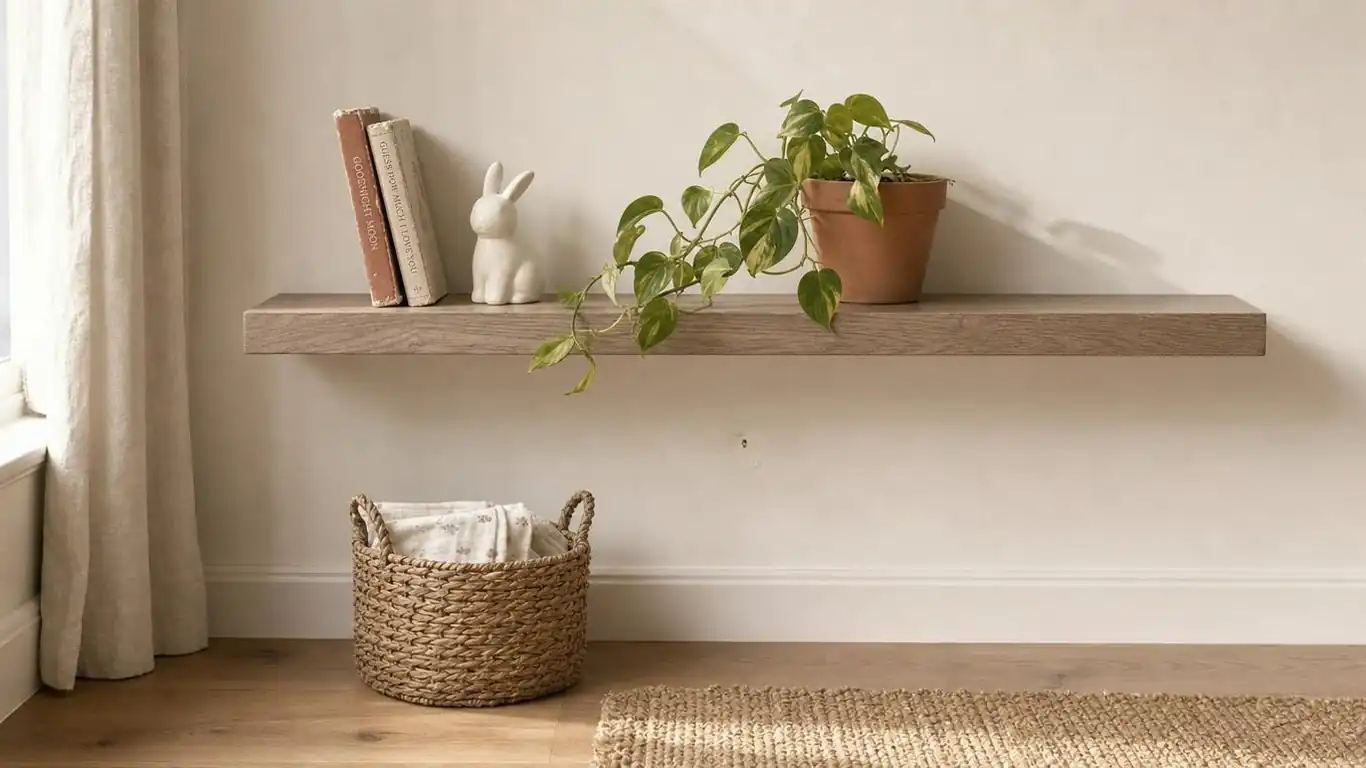
A minimalist nursery hides most of its storage. The dresser handles clothes and nappy supplies. A wall-mounted shelf at 50–54 inches holds three to five objects maximum — two board books, a small ceramic figurine, and one trailing plant in a terracotta pot.
Woven seagrass or jute baskets work inside open shelves: one basket per category, natural tan in tone, nothing overflowing. Avoid freestanding toy towers or open bin shelving in the first year — they become clutter magnets faster than anything else in the room.
For nurseries under 100 square feet, 7 effortless very small bedroom ideas that look designer-made applies directly — wall-mount first, floor-clear always.
12 smart small bedroom layouts to maximize your floor space also has strong layout guidance for compact rooms. And for shelf styling ideas that apply beyond the nursery, 12 spring shelf styling ideas for a modern and airy home refresh is a useful reference for the same restrained styling discipline.
DESIGNER TIP: Place the dresser-changing station on the wall adjacent to the crib — this creates a natural workflow: crib to change to glider without crossing the room in the dark.
KEY TAKEAWAY: Textiles, a dimmable warm-toned lamp, and wall-mounted storage do the heavy lifting in a minimalist nursery — the furniture just holds the structure.
A Recent Project:
Last autumn I worked on a 10-by-11-foot nursery in a 1980s townhouse. Low ceiling, one small window, a couple expecting their first child in six weeks. We chose warm white walls in a flat matte finish, a white oak convertible crib, and a low boucle glider in warm cream. A wall-mounted ash shelf at 52 inches held three board books and one small matte white ceramic rabbit. A dimmable brass floor lamp sat just behind the glider. Six weeks after the baby arrived, the father messaged to say it had become the calmest room in the house — and that they’d both started sitting in it during the day just to decompress.
What Most People Get Wrong
❌ Overloading the room before the baby arrives → ✅ Start with the core three pieces and add only when you feel a genuine need. Most decorative items added in the first month get removed by month three.
❌ Choosing bright white paint → ✅ Bright white reads cold under artificial lamp light — especially at night. Use warm white or soft greige instead.
❌ Relying on a single overhead light → ✅ Add a dimmable warm-toned floor lamp or wall sconce near the glider. Overhead fixtures stay off after the first week.
❌ Starting with patterned textiles → ✅ Stick to solid textures in natural tones. Patterns date quickly and compete with each other in a small room.
DESIGNER TIP: If you’re working with a tight budget, spend on the crib and the glider — you’ll use both every single day. Save on the shelf, rug, and decor objects.
For more budget-smart approaches, 10 smart design hacks for decorating a small bedroom on a budget covers principles that cross directly into nursery planning.
KEY TAKEAWAY: The most common mistakes in a minimalist nursery are adding too much too soon and painting with a bright white that reads cold under lamp light.
What You’ll Spend
A complete minimalist nursery runs $1,200–$3,000 for quality pieces, with most of the budget concentrated on the crib and glider.
| Project | Estimated Cost | Impact Level |
|---|---|---|
| Convertible crib (white oak or ash) | $300–$700 | Very High |
| Glider or nursing chair (boucle or linen) | $400–$900 | Very High |
| Dresser with changing topper (solid wood) | $250–$600 | High |
| Dimmable lamp and shade | $80–$250 | High |
| Jute or wool area rug (6 by 9 feet) | $120–$350 | Medium |
| Wall shelf and mounting hardware | $60–$180 | Medium |
| Textiles (sheets, blanket, curtains) | $100–$300 | High |
KEY TAKEAWAY: Prioritize the crib and glider in your budget — these are the two pieces that carry the most daily use and the most visual weight.
Decisions Worth Making Carefully
A few choices are worth pausing on before you commit. Here’s how to think through a shared room, the right time to add decor, and keeping the palette gender-neutral.
What if the nursery shares a room?
A minimalist nursery in a shared space — parents’ bedroom or a sibling’s room — needs even tighter editing. The crib is the only fixed piece; everything else must be mobile or wall-mounted. A compact dresser with a removable changing topper works well. Skip the glider and use a low upholstered chair that tucks flat against a wall. Keep the palette consistent with the existing room so the nursery zone reads as intentional, not temporary.
When should you add decor?
The honest answer: after month three. Newborns don’t see color clearly until around three months. Before that, the room serves the parent, not the child. Start with the essentials, observe how you use the space through the first weeks, and add objects only once you know what the room actually needs. Most parents find they need far less than they planned.
Is a minimalist nursery gender-neutral?
A minimalist nursery is naturally gender-neutral — warm greige, white oak, cream linen, and natural tan read as neither masculine nor feminine. This is one of the quiet advantages: the design holds through a second child regardless of gender, and through a rebrand to a toddler’s room without needing a fresh paint job. For a wider exploration of how the approach plays out across different room types, 25 tiny living room ideas that actually make space feel bigger demonstrates the same clear-floor, neutral-palette logic in a living room context.
KEY TAKEAWAY: The best time to add nursery decor is after the first three months — once you know how you actually use the space.
Frequently Asked Questions
Conclusion
A minimalist nursery does something most decorated rooms never quite manage: it stays beautiful as it changes. The warm greige walls don’t feel dated when the baby becomes a toddler. The white oak crib converts cleanly. The boucle glider moves to the bedroom and looks right there too. The room grows up with the child rather than fighting the transition.
Last spring, I went back to see the minimalist nursery I had finished for that first-time mother in early 2024. Her daughter was walking confidently by then. The room had one addition — a small low bookcase along the far wall — and that was it. Same warm greige walls. Same oak crib converted to a toddler bed. Same cream linen curtains. One room, designed once, still living without effort two years later. That’s what a minimalist nursery decor approach actually delivers: not a perfect room for a specific moment, but a calm foundation that adapts. If you’re ready to carry that approach through the rest of your home, 101homedecor.com has everything you need to keep going.