TL;DR
- You never stand still here. The wall is seen in motion from three positions, and it has to work at all of them.
- Split it into bands: what sits within arm’s reach needs detail, what sits high needs scale.
- Frames are not the only option. One tall piece, wall lights, or a textile often suit the space better.
- Check access before you choose anything. A stepladder cannot stand safely on stairs.
- Keep everything flat to the wall — nothing may project into the space people walk and grab through.
Why Is the Stairway Wall the Last One Anyone Decorates?
Most houses have one wall that stays bare for years after every other room is finished. It is almost always the stairway. If yours is still empty while the living room has been rearranged twice, that is the normal order of events rather than a personal failing.
Part of our guide to wall decor, this post covers that specific wall.
The reason is that a stairwell breaks the assumptions every other wall relies on. You cannot stand back and look at it. You cannot easily reach the top of it. It is usually badly lit, often narrow, and the wall itself runs at an angle to everything else in the house. So the normal method — pick something, hold it up, step back, judge — does not work, and the project quietly stalls.
Here is the direct answer. Good staircase wall decor is decided by viewing distance and access rather than by style. You see this wall from three positions and never from a standstill, and you can only safely install what you can reach without putting a ladder on the steps. Settle those two constraints first and the aesthetic choices become easy.
Editorial field note: A stairwell that has defeated two previous attempts usually has the same problem both times — pieces chosen at arm’s length in a shop, then hung where they are only ever seen from twelve feet below. The scale was decided at the wrong distance.
The Three Places You Actually See This Wall From
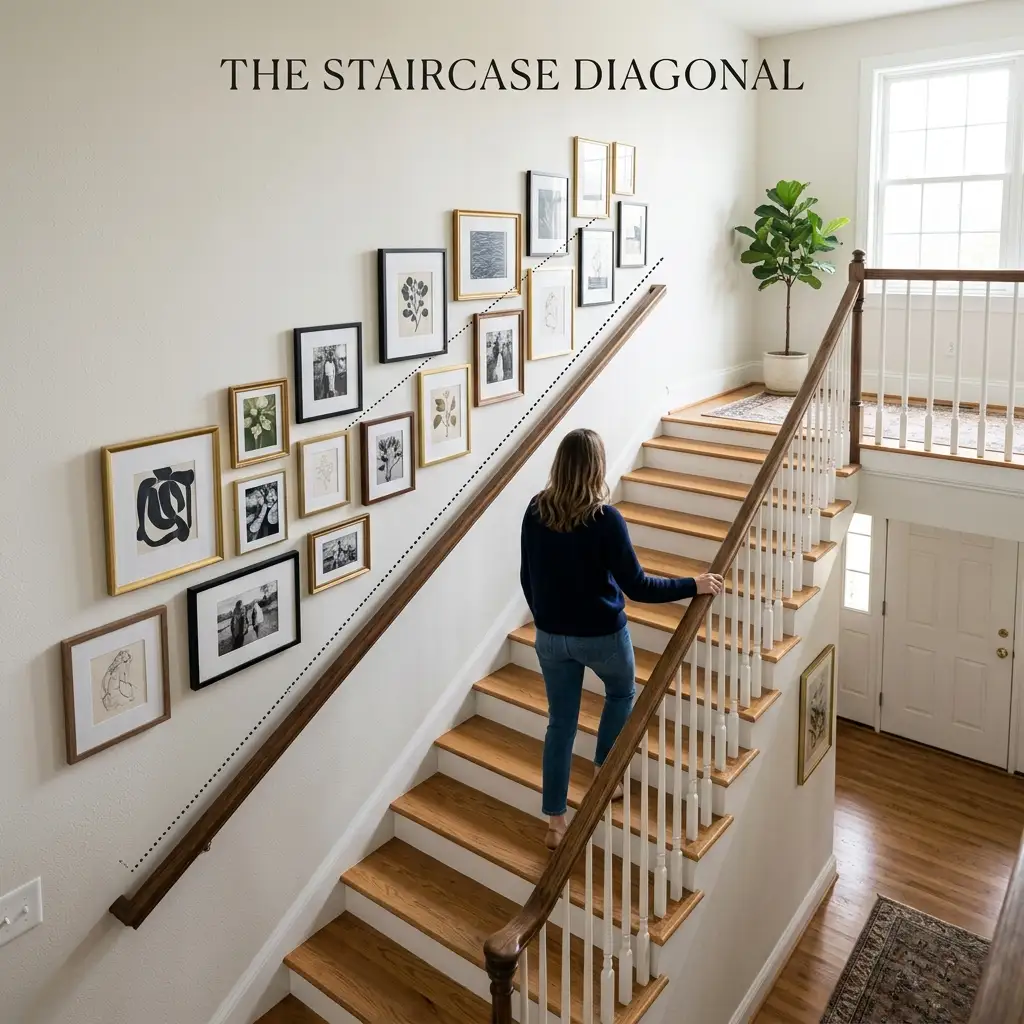
Every other wall in your home has one main viewing position. A sofa faces one wall, a bed faces another, a hallway is seen head-on as you enter. The stairwell has three, and they could not be more different from one another.
From the bottom of the flight you see the whole wall at once, from perhaps ten to fifteen feet away and at a steep upward angle. This is the view that decides whether the wall works as a composition, and it is also the view most people never check before hanging anything.
Mid-flight you are close enough to touch the wall, moving, with roughly two to three seconds of attention on any one spot. Nothing complicated survives this position. It is where small, detailed, tactile things pay off and where anything requiring study is wasted.
From the top looking down you see the wall foreshortened and mostly from above, which means you see the tops and upper edges of everything on it. Dust on frame tops, visible hanging wire and uneven top edges all show from here and nowhere else.
| Quick Takeaways | |
|---|---|
| Viewing | Three positions — bottom, mid-flight, top. Check the composition from the bottom. |
| Close band | Within arm’s reach: small, detailed, textural. Rewards a two-second glance. |
| Far band | High on the wall: fewer, larger, higher contrast. Detail is invisible up there. |
| Depth limit | Keep everything close to flat. Nothing projects into the walking or grabbing space. |
| Access | Decide what you can safely reach before choosing. Stepladders do not belong on stairs. |
What Works Up Close, and What Needs Distance
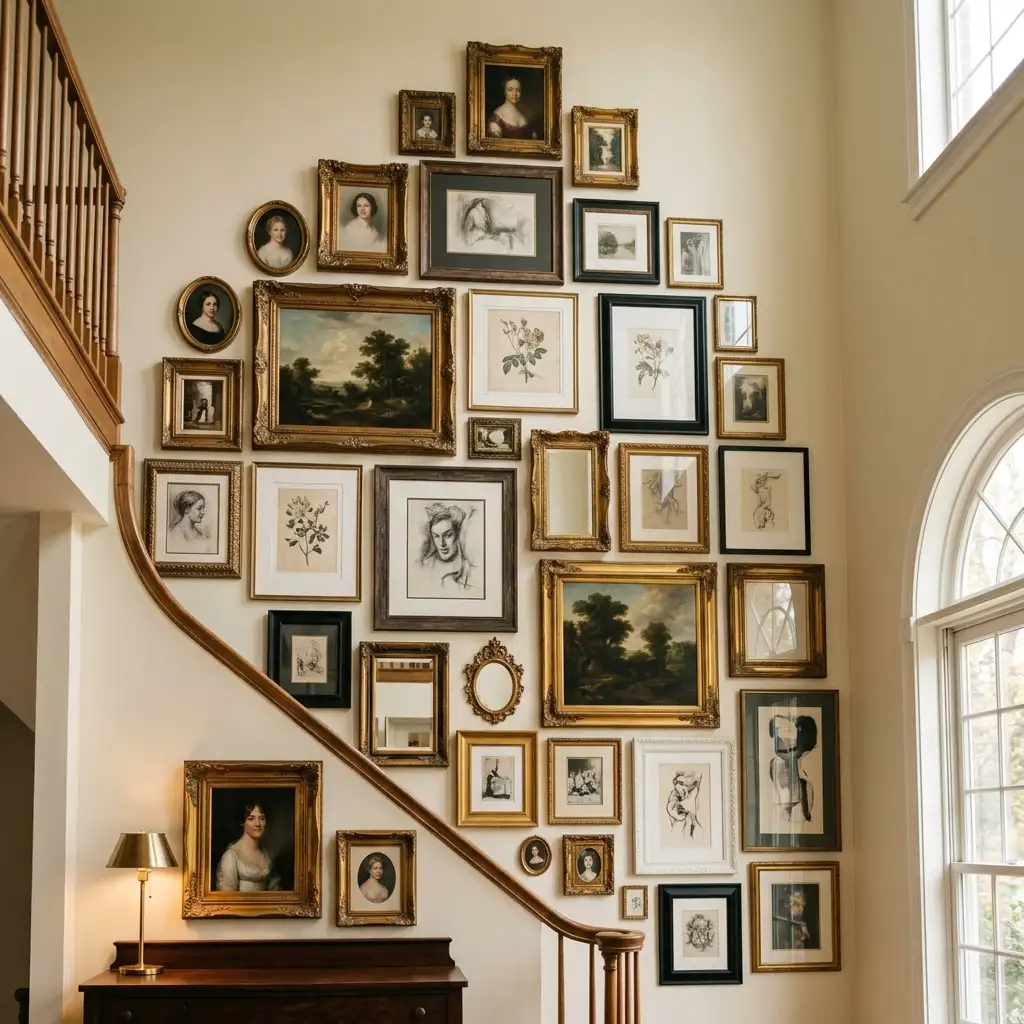
Divide the wall into two horizontal bands and treat them differently. Almost all successful staircase wall decor comes down to this one split. The lower band runs from about waist height to a little above your head as you climb — the part you pass within arm’s reach. The upper band is everything above that, which you only ever see from the bottom of the stairs.
Most disappointing stairwells put the same kind of thing in both bands. The result is detail nobody can see up high and oversized pieces looming at shoulder level.
The Close Band, Within Arm’s Reach
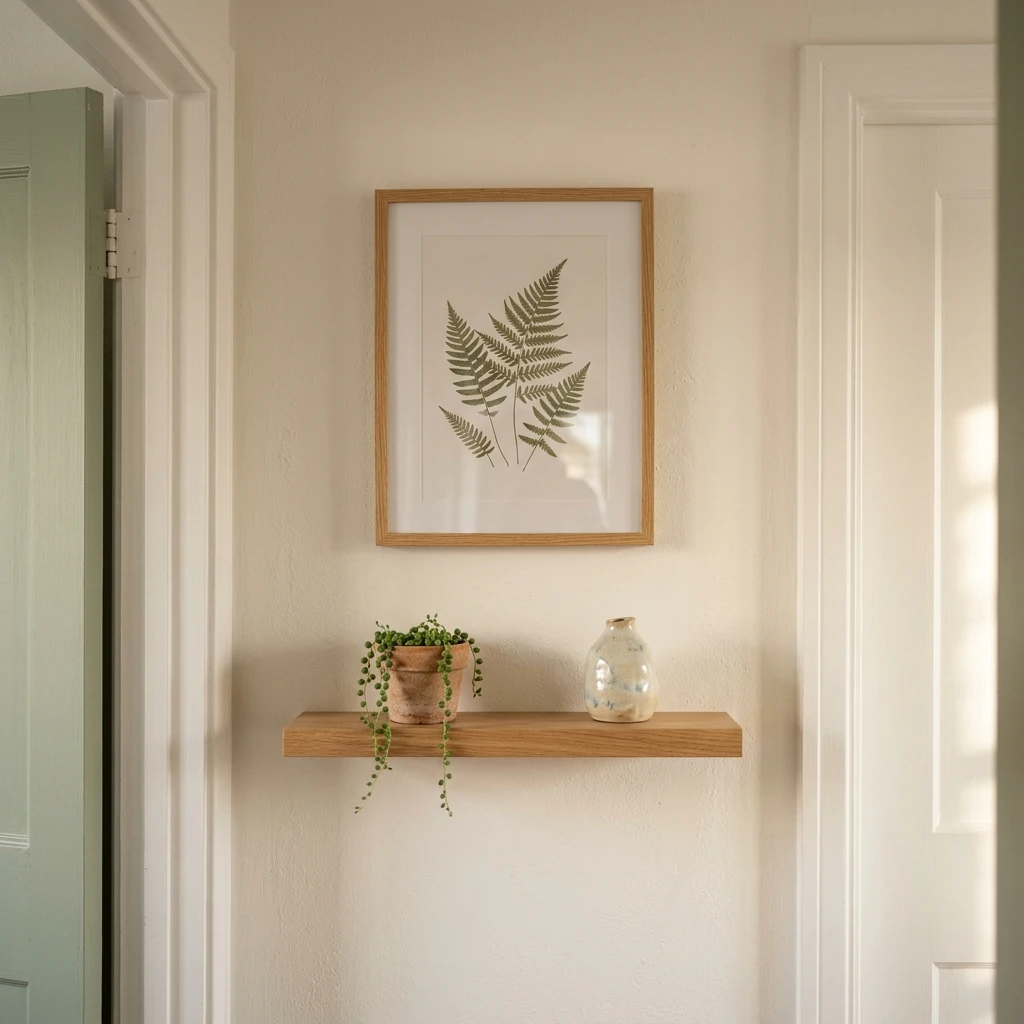
Everything in this band is viewed from roughly eighteen inches away, in motion, for two or three seconds. That is a real constraint and also an opportunity, because it is the only wall in the house where people routinely get that close.
Small pieces work here in a way they do not elsewhere. A postcard-sized print, a pressed botanical, a small framed textile or a tiny painting rewards the passing glance and would disappear on a living room wall. Texture matters more than image — anything with visible weave, brush marks or relief reads well at eighteen inches. Botanical and seasonal prints are among the cheapest ways to fill this band, and our spring wall art ideas cover that category.
Keep the depth down. A piece projecting more than about an inch and a half from the wall in this band will eventually catch a shoulder, a bag or a child. Flat frames, shallow panels and textiles are the safe choices, and bulky shadow boxes are not.
The Far Band, Read From the Bottom
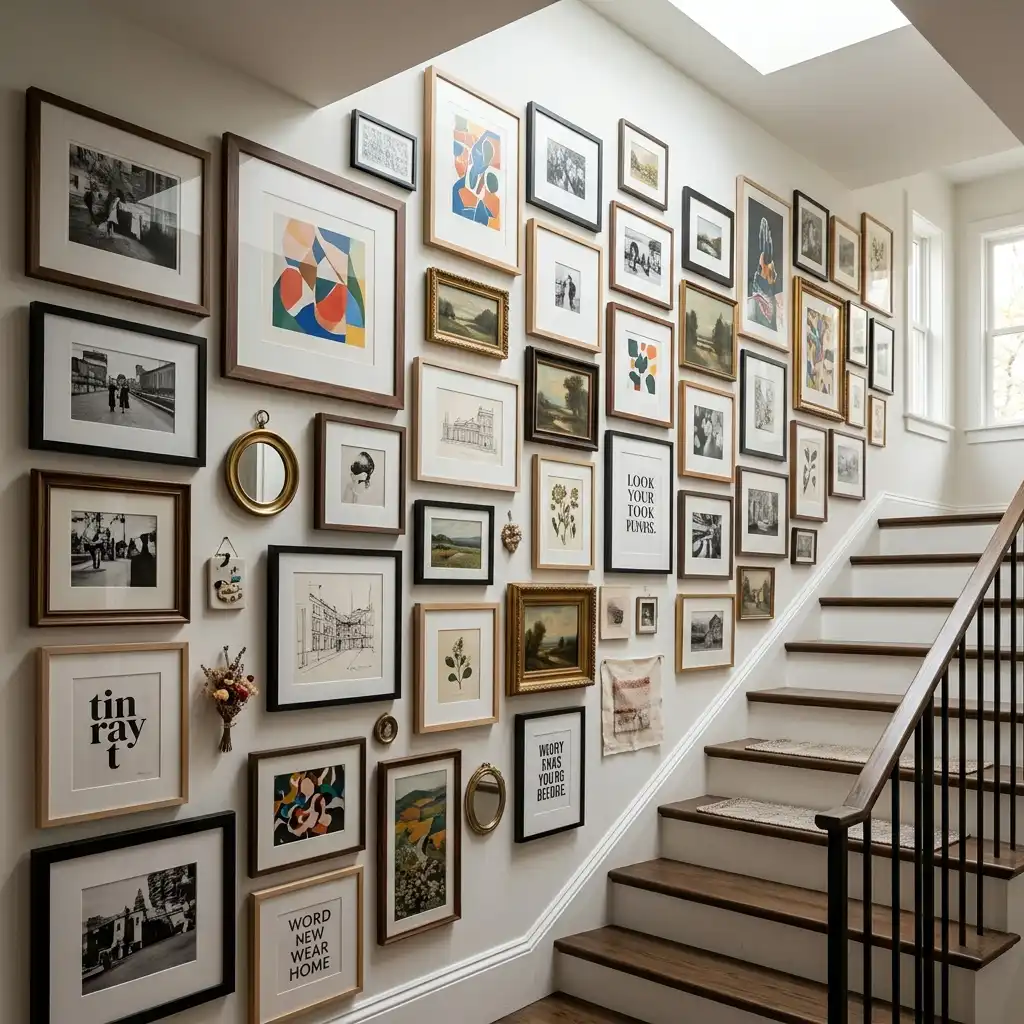
Above head height, detail stops being legible and only shape, scale and contrast survive. Anything you put up there is competing for attention from twelve feet away and a steep angle, which is a completely different job from the close band.
Fewer and larger is the rule. One substantial piece high on the wall does more than five small ones, and it is also five times less to dust in a place you cannot easily reach. High contrast helps too, since stairwells are usually dim and low-contrast work vanishes — the same reason a dark academia bedroom leans on strong tonal jumps rather than subtle ones.
DESIGNER TIP: Judge the upper band from the bottom step with your phone camera rather than from the stairs themselves. The camera flattens the perspective the way the eye does at distance, and it shows immediately whether a piece is carrying or disappearing.
What Else Goes on a Stairway Wall Besides Frames?
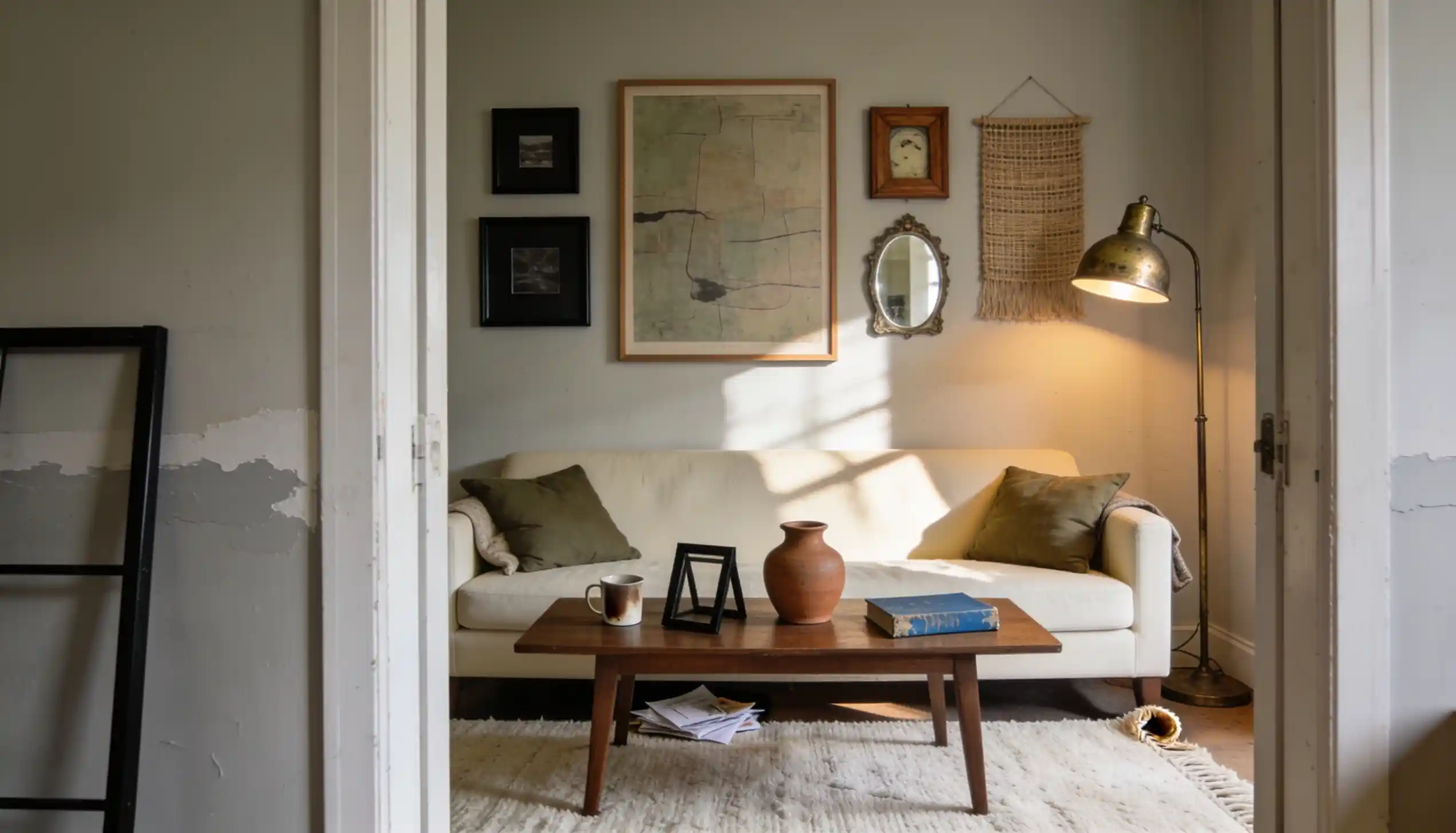
Framed art is the default answer and often the wrong one. A stairwell is dim, awkward to reach, and seen in motion — three conditions that suit several other options better.
One Tall Piece Instead of Many Small Ones
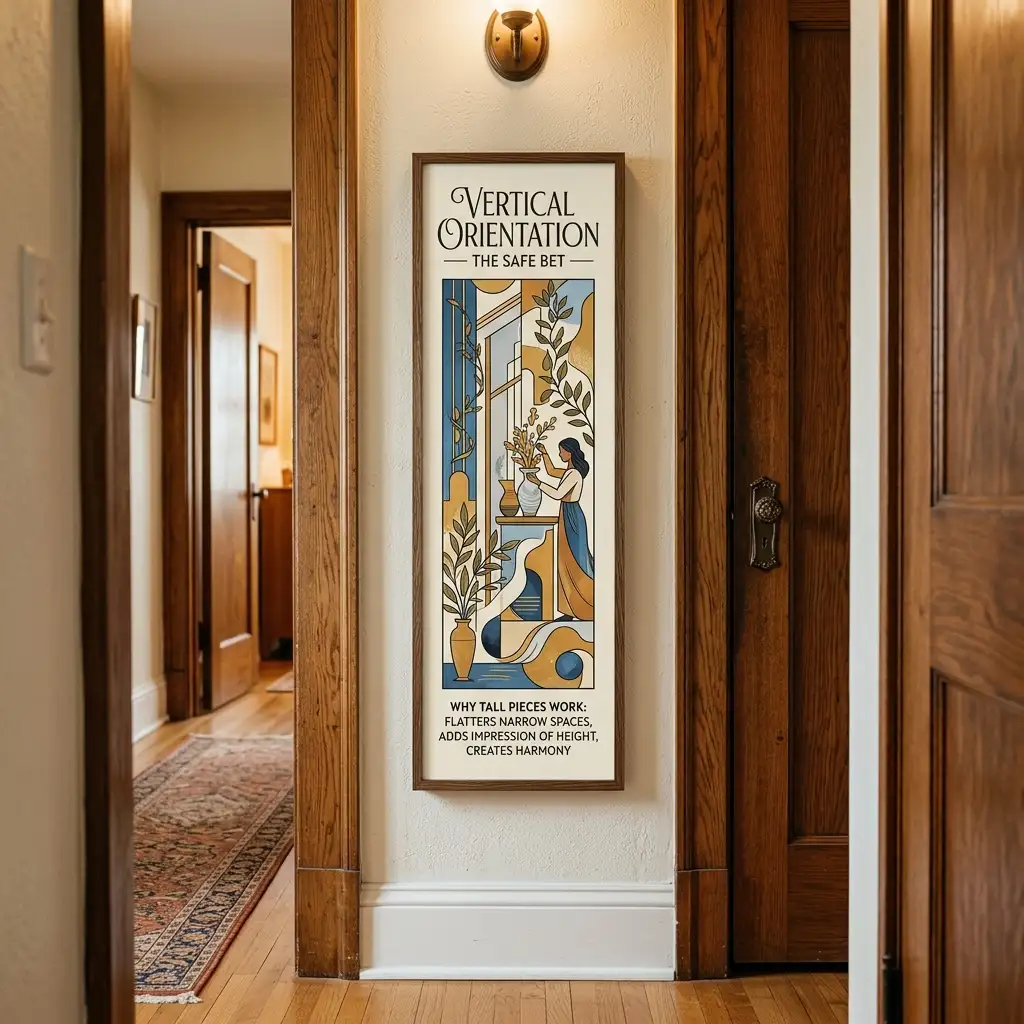
A single vertical piece running with the slope solves several problems at once. It reads instantly from the bottom, needs one fixing rather than nine, and there is nothing to realign when the house settles.
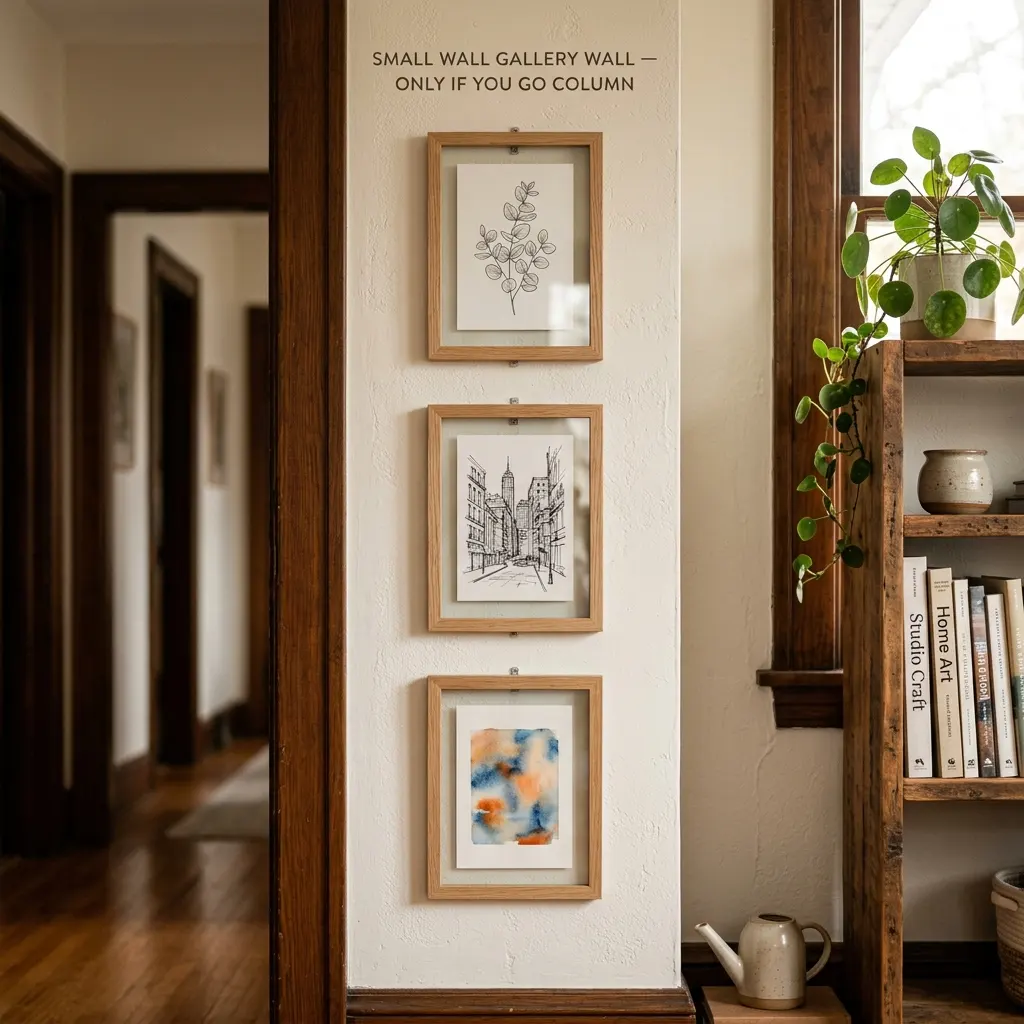
Tall narrow formats suit the space naturally — a vertical textile, a long mirror, a tall canvas, or a run of three stacked pieces treated as one object. In a narrow stairwell this is usually the correct answer rather than a compromise.
It also sidesteps the arrangement problem entirely. Working out how a group of frames should step alongside a rail is its own exercise, and if you do want that route our living room wall decor ideas cover grouping pieces at a scale you can judge properly.
Lighting as the Decoration
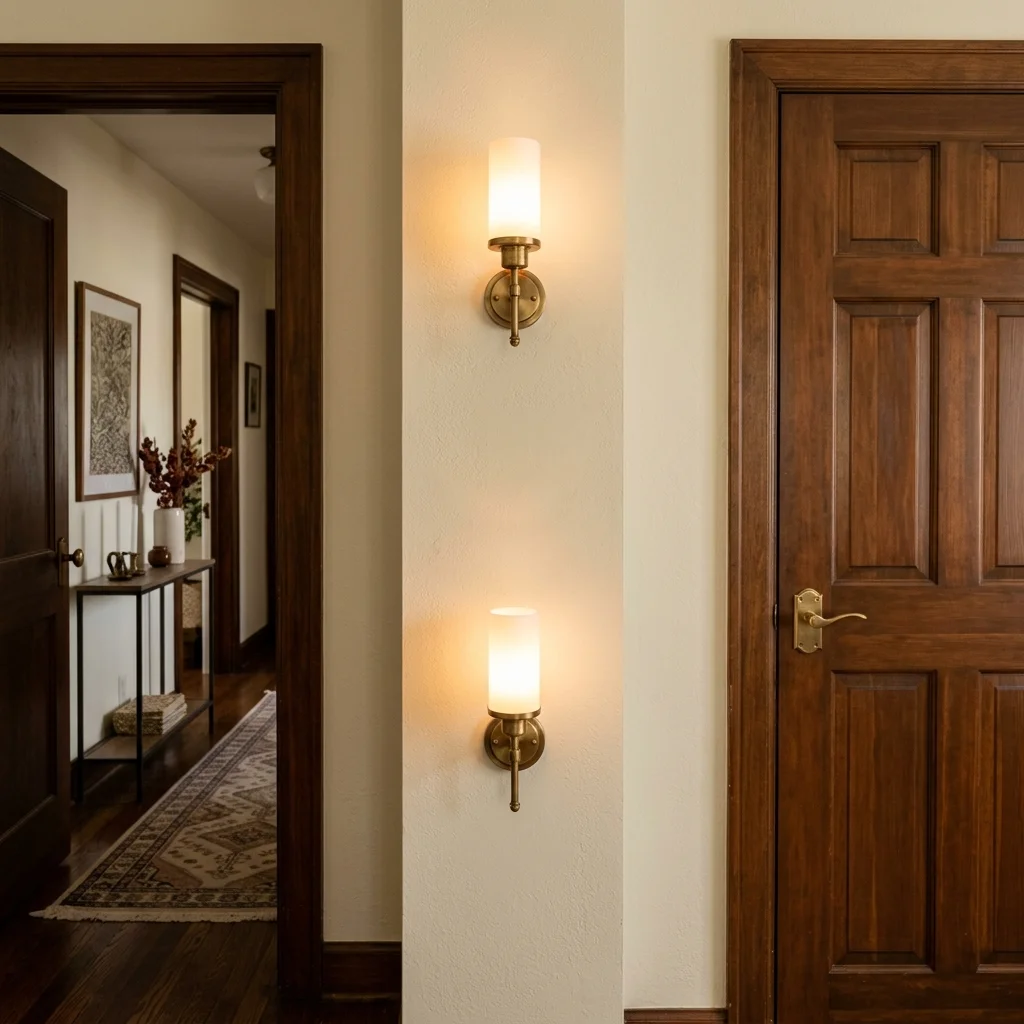
Stairwells are lit worse than any other circulation space in a house, usually by a single fitting at the top or bottom that leaves the middle of the flight dim. Wall lights fix the lighting and decorate the wall in the same move, which is unusually good value for one intervention.
Two or three sconces stepped up the wall at a consistent height above the stair nosing give even light along the whole flight and create a rhythm that reads well from below. Keep the fittings shallow and shielded so no bulb sits at eye level as you climb.
Warmth and layering matter here as much as anywhere else in the house, and our guide to layered lighting covers choosing bulbs that flatter a space rather than flattening it.
Safety Note: Any hard-wired fitting on a stairwell wall is electrical work in an awkward position. Use an electrician rather than balancing on the stairs, and keep every fitting outside the space a hand needs to travel along the rail.
Textiles, Plates and Mirrors
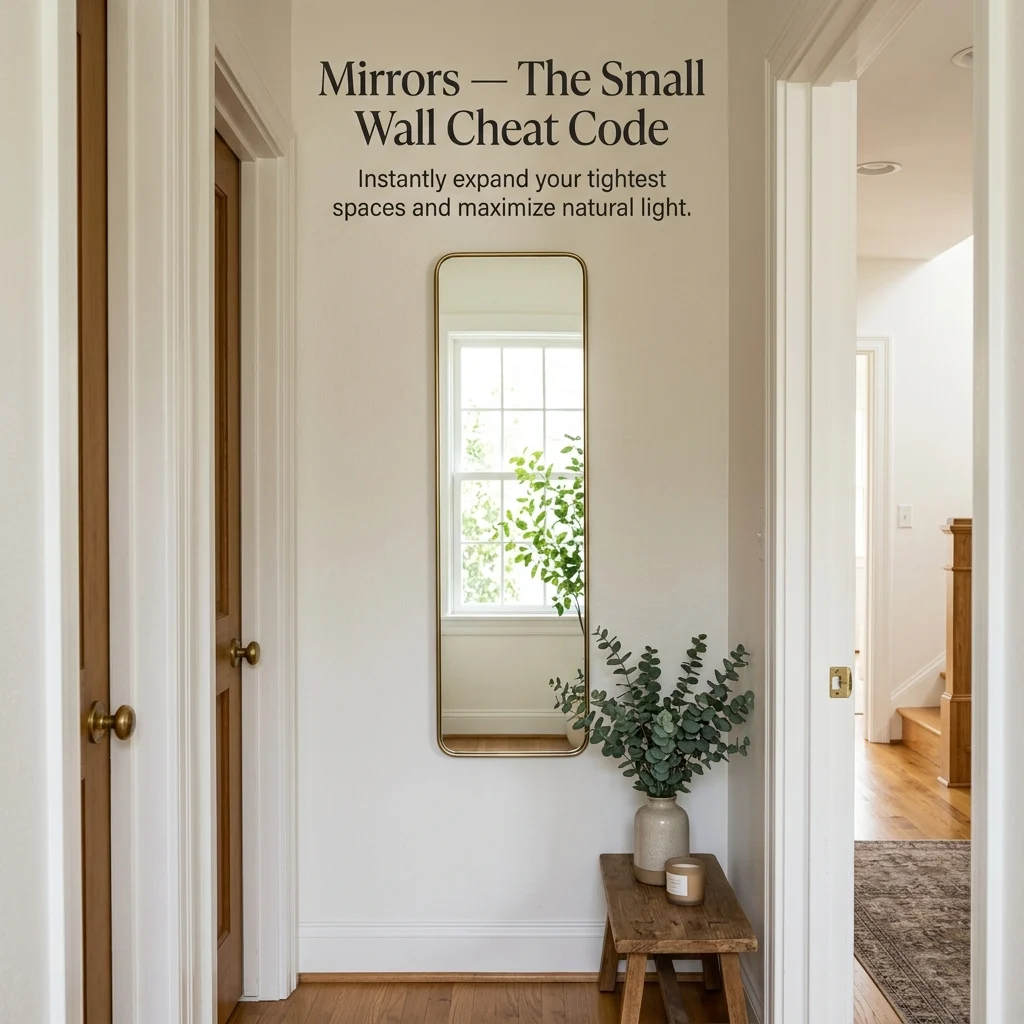
Soft and dimensional objects suit stairwells better than they suit most rooms. A woven hanging, a small rug, a run of ceramic plates or a group of baskets all read well at close range, dampen the echo these spaces usually have, and weigh little.
A mirror is the highest-impact single object you can hang here, because it moves light around a space that has very little. Place it where it reflects a window or a light source rather than the opposite blank wall, and keep it flat-mounted and firmly fixed.
Textiles are also the cheapest way to fill a large stairwell wall, and making one is straightforward — our guide to wall hanging craft ideas covers the methods.
Safety Note: Glass beside a staircase deserves thought. Keep mirrors and glazed frames out of the zone directly beside the walking line where a stumble could put someone into them, and fix anything heavy into structure rather than into plasterboard alone.
Can You Actually Reach It?
This is the question that should come first and almost never does. A stairwell wall is the hardest surface in the house to physically reach, and that constrains what you can install, straighten, clean and eventually take down.
The core problem is that stairs are not a level surface. OSHA’s ladder standard requires that ladders be used only on stable and level surfaces unless secured against accidental displacement. That is a workplace rule rather than a household one, but the physics is identical in your house, and a stepladder with two feet on a tread and two in the air is exactly the arrangement it exists to prevent.
The practical answers are a proper stair ladder with adjustable legs, a scaffold plank set between a stepladder and a tread, or simply not going that high. Most people should take the third option. Decide the highest point you can comfortably reach standing on a step, and treat everything above that line as off limits unless you are willing to hire the access.
That single decision solves the maintenance problem too. Anything you cannot reach, you cannot dust or straighten — and on a wall seen from above, dust and crookedness are the two things that show most.
If the Stairwell Is Narrow or Enclosed
Enclosed stairwells are common in older and smaller houses, and they change the rules rather than just tightening them — the same constraint-first thinking our small bedroom ideas apply to a whole room.
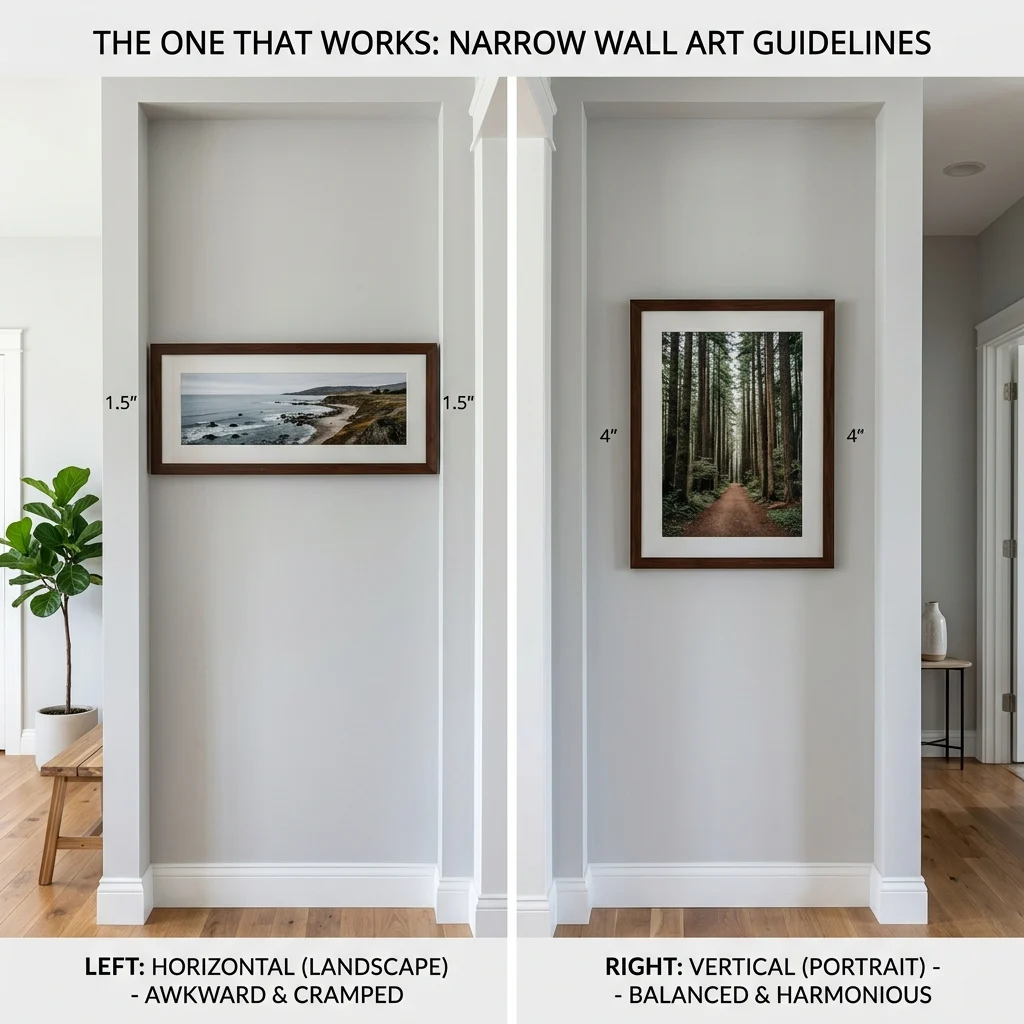
With walls on both sides there is no viewing distance at all. The bottom-of-flight view disappears, so the far band effectively stops existing and everything becomes close-range. Plan the whole wall as one long close band, use small pieces or a single narrow vertical run, and abandon anything that needs to be seen whole.
Depth becomes critical rather than advisable. In a stairwell under about a metre wide, keep everything within an inch of the wall and favour flat-mounted pieces, a narrow ledge, or paint and pattern over hung objects entirely. If the wall itself becomes the feature rather than what is on it, our accent wall ideas cover treating a surface as the decoration.
Renting complicates it further, since a stairwell is usually the last place you want to be patching holes on move-out. Favour a single fixing at a reachable height over any arrangement that needs nine, and keep the whole plan reversible.
Where Stairway Walls Go Wrong
The most common failure is choosing scale at the wrong distance. Pieces get selected in a shop, at arm’s length, then hung high on a wall that is only ever seen from twelve feet below. They look correct while you are holding them and vanish once they are up. Judge the upper band from the bottom step before committing to anything.
The second is treating the stairwell as an overflow wall. Because it is the last wall to be decorated, it tends to receive whatever did not fit elsewhere — a mismatched collection with no reason to be together, hung in a space where nobody can stand still long enough to make sense of it. A stairwell needs fewer and stronger pieces than a room does, not the leftovers.
The third is ignoring depth. Anything projecting into the flight will eventually be caught by a shoulder or a bag, and on stairs that is not a minor annoyance. Keep the walking and grabbing envelope completely clear, and accept that some otherwise lovely objects simply cannot go here.
Why Are Stairway Walls Suddenly Getting Attention?
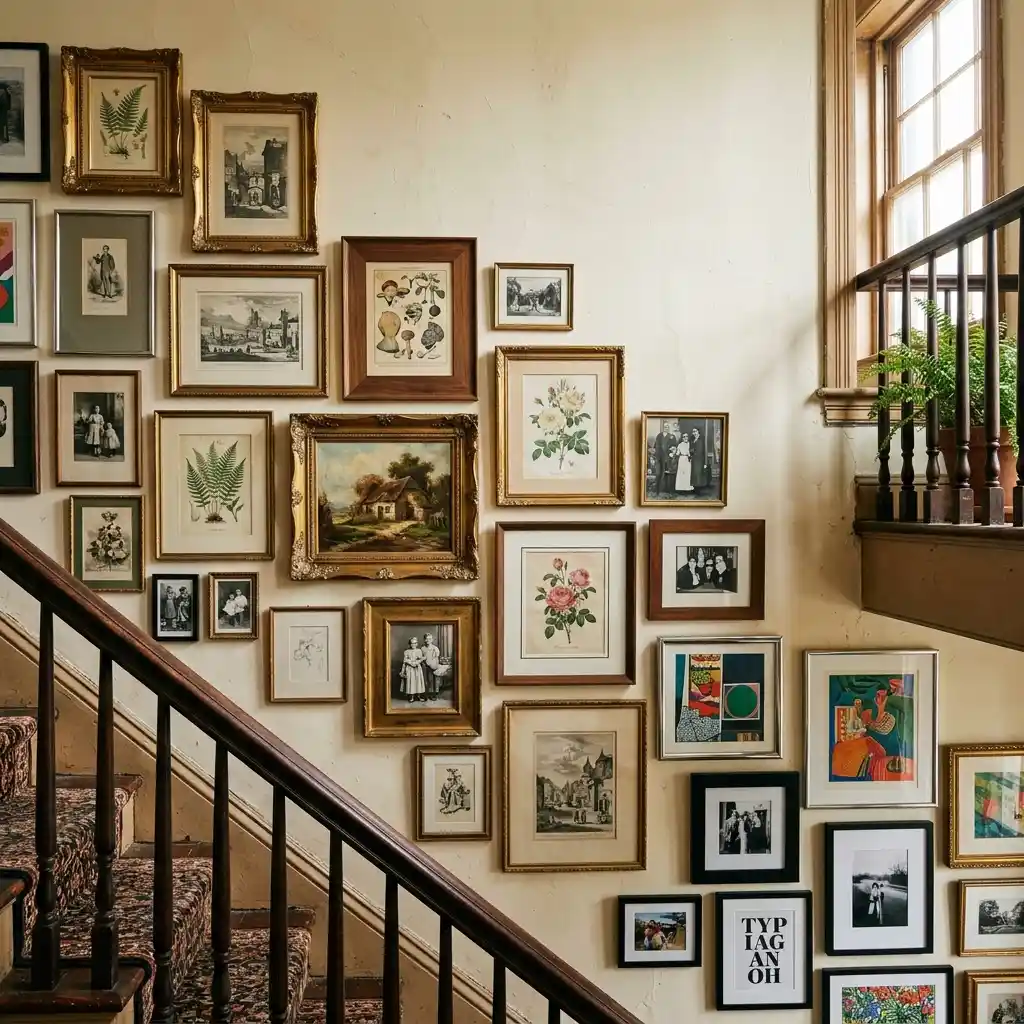
The stairwell used to be circulation space that nobody counted as a room. It is now treated as one, and the shift is visible across the way these spaces are being finished.
Signs This Is Catching On:
- Sculptural and layered wall lighting is being specified on stairwells rather than the single utility fitting that used to be standard.
- Textured surface treatments — wood slats, panelling, limewash, patterned wallpaper — are turning up on stairwell walls where flat paint was assumed.
- Mirrors are being used deliberately to move daylight into stairwells rather than purely as decoration.
- Narrow-stairwell advice has shifted from “leave it bare” to vertical arrangements and slim ledges that respect the width.
What connects those is that they all suit motion and dim light, which is what the space actually is. The stairwell is being decorated on its own terms now instead of being treated as a smaller version of a hallway. Slim ledges are part of that shift, and built-in style shelving shows the same idea handled permanently.
The Bottom Line
Designer’s Verdict: Treating the stairwell as a room worth finishing is the right call, and lighting is the intervention with the best return. It fixes a genuine functional shortcoming, decorates the wall, and works from all three viewing positions at once, which almost nothing else here manages. If you only do one thing to this wall, put light on it.
The approach to be sceptical about is the dense stairwell gallery. It photographs beautifully and it is built for a viewing position that does not exist on a staircase — nobody stands still long enough to read twenty frames, and every one of them is a fixing you will have to straighten and dust in a place you cannot safely stand. Fewer, larger and better lit beats more, every time, on this particular wall.
Circulation spaces reward this kind of editing generally, and our decor and styling ideas cover the surfaces between rooms that tend to get skipped.
What It Costs
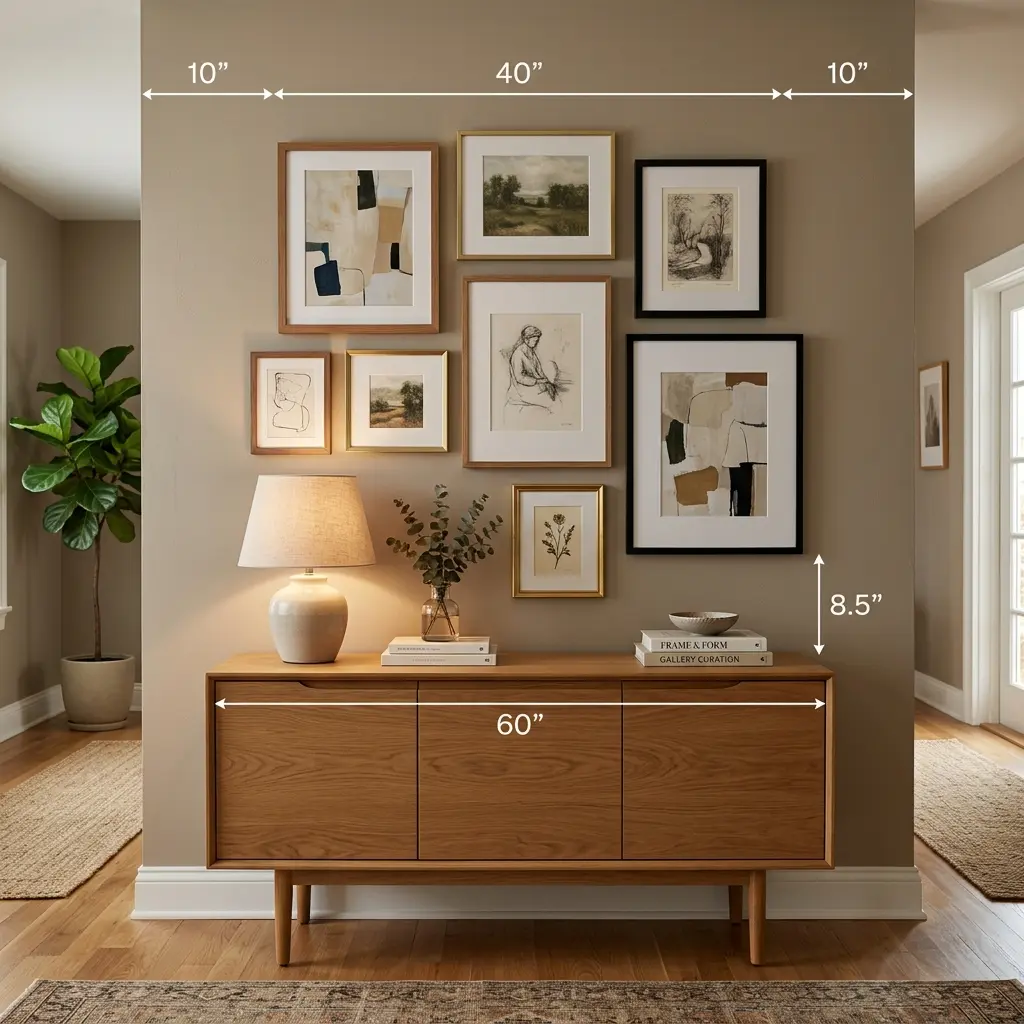
Stairwell projects are cheap in materials and expensive in access, which is the reverse of most decorating.
| Project | Estimated Cost | Impact Level |
|---|---|---|
| Woven textile or large hanging for the main wall | $40–$150 | High |
| One tall statement piece or full-length mirror | $80–$300 | Very High |
| Two or three plug-in wall lights, no wiring work | $60–$220 | Very High |
| Hard-wired stairwell sconces fitted by an electrician | $350–$900 | Very High |
At the budget end, a single large textile covers more wall than anything else per dollar and needs one fixing at a reachable height. In the middle, plug-in wall lights deliver most of the benefit of hard-wired sconces with no electrician and no holes beyond the brackets, which makes them the obvious route for renters — our rental bedroom ideas cover the same reversible logic elsewhere in the home. At the upper end, wired sconces are the only option that permanently fixes the lighting, and on a stairwell that is usually worth the spend.
Best First Upgrade: Light before art. A well-lit bare wall looks better than a dim decorated one, and the light improves everything you add later.
Skip for Now: Anything above the height you can safely reach from a step. You will not maintain it, and it will be visibly neglected from the top of the stairs.
Staircase Wall Checklist
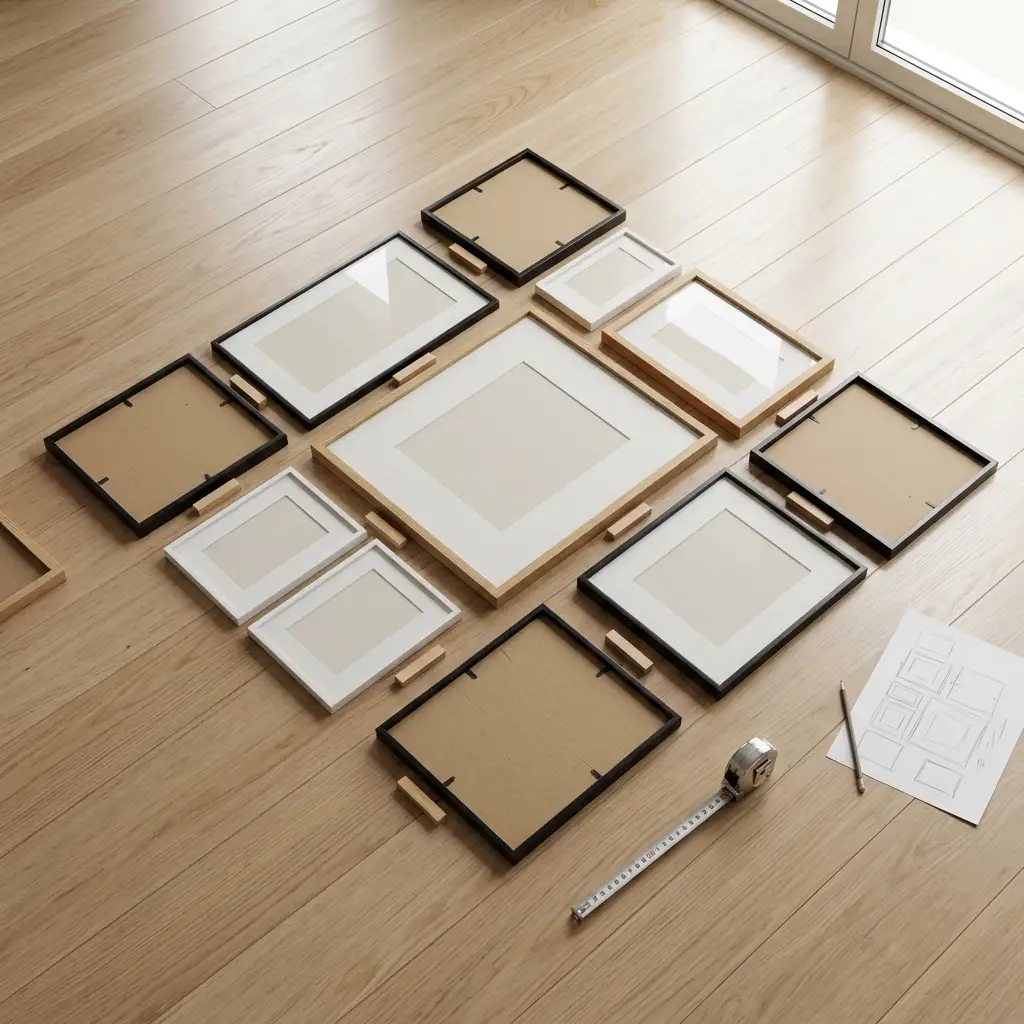
Before you buy anything for this wall:
- Stand at the bottom of the flight and photograph the whole wall — that photo is your composition, not the view from the stairs.
- Mark the highest point you can comfortably reach while standing on a tread, and treat everything above it as unavailable.
- Split the wall into a close band within arm’s reach and a far band above it, and plan different scales for each.
- Measure the clear width of the flight and set a maximum projection depth — an inch or so in a narrow stairwell.
- Check where the existing light falls and identify the dim middle section before choosing anything to put there.
- Confirm nothing will encroach on the handrail or the line a hand travels along it.
- Decide whether the wall itself should be the feature, in which case skip hanging objects entirely.
Frequently Asked Questions
Conclusion
If your stairwell is enclosed, unlit, or simply out of reach above the fourth step, take the version of this that fits rather than abandoning the wall — light the flight properly, put one good piece where you can actually reach it, and leave the top of the wall empty on purpose. Staircase wall decor rewards fewer and better choices than any other wall in the house, because it is the only one nobody ever stops to study. There is more on finishing the spaces between rooms across our home decor inspiration.