The Entry Table Is Doing Two Jobs at Once
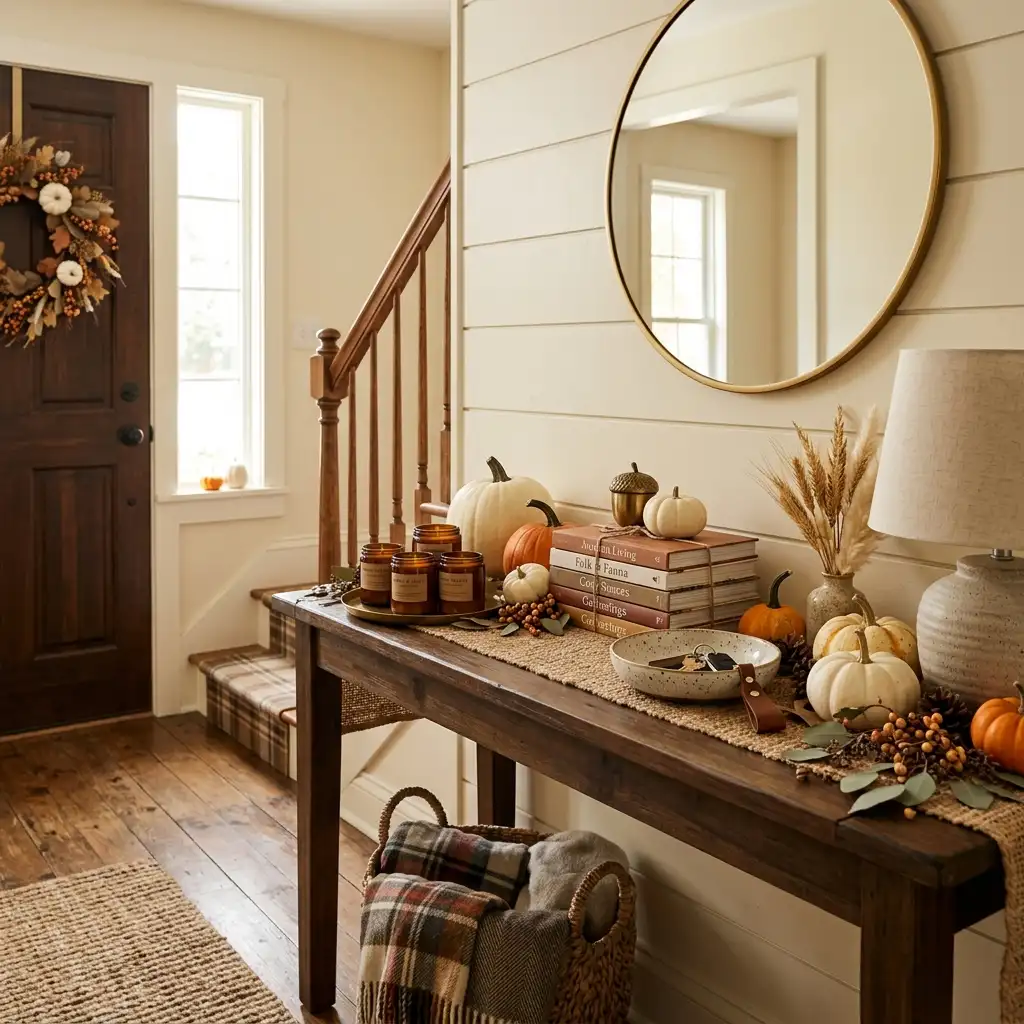
Open a front door in mid-October and look at the first six feet inside it. There is a console table, usually about 12 inches deep and four feet long. There is a bowl of keys. There is a stack of mail nobody opened. And now, sharing that same narrow strip of wood, there are three small pumpkins, a candle, a stack of books and a vase of dried stems.
Looking for more ideas? Explore our full guide to Fall Decor by Room.
Nothing on that table is a bad object. Fall entryway decor goes wrong here for one reason: all of it landed in the same 48 inches.
The entry is the only surface in the house doing two jobs at once. A dining table clears itself after dinner. A mantel holds nothing functional. An entry console holds your keys every single day, and then you ask it to hold autumn as well. Start with the whole-home plan in our creative fall and autumn decor ideas if you want the wider sequence first.
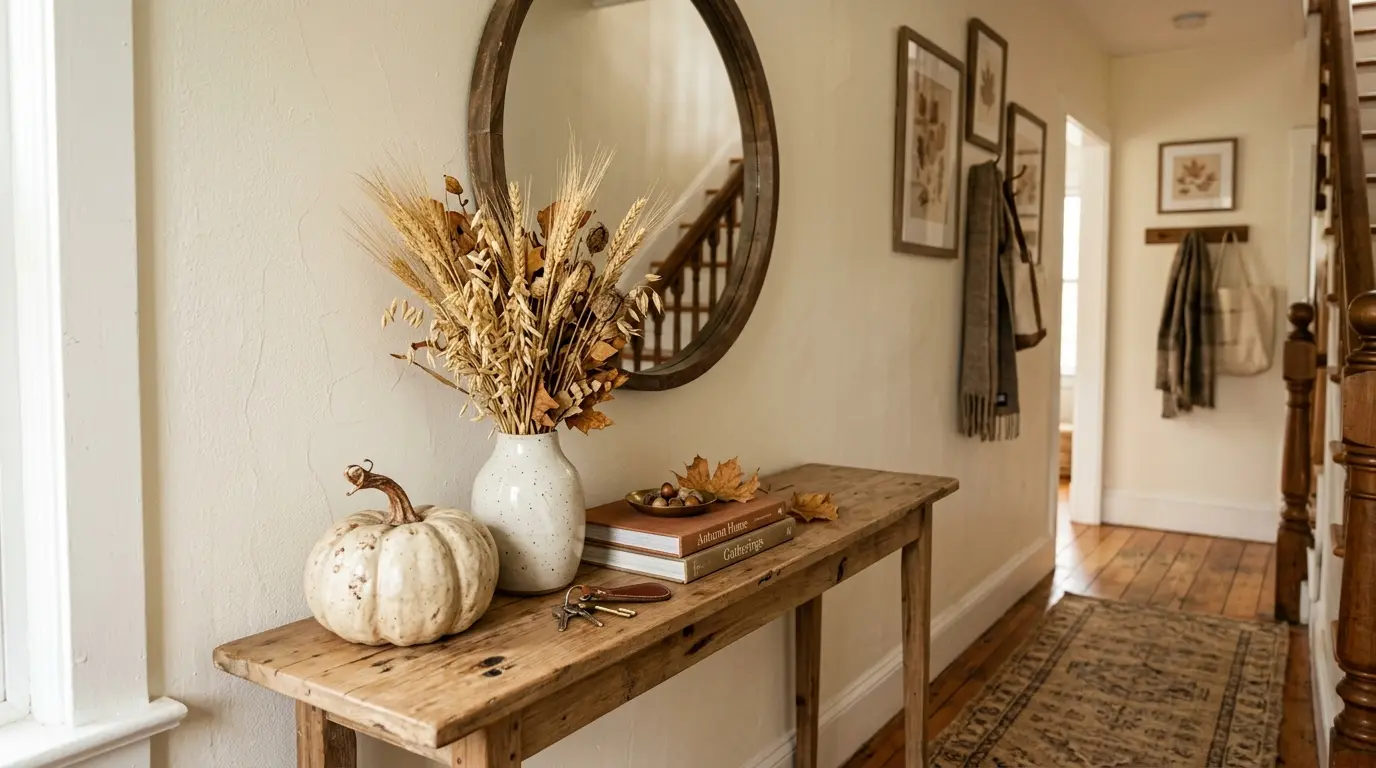
Here is the short version. Fall entryway decor works best when it takes about one-third of the console table and nothing more. The other two-thirds stay clear for keys, mail and sunglasses, because an entry table is a working surface before it is a display surface. Build height on the wall instead of the tabletop, repeat one material from the porch, and keep 36 inches of walking path open past the table.
Editorial field note: A narrow entry with a fully styled console usually looks messy within a week, even when the styling itself is good. Clearing the two-thirds nearest the door and pushing the seasonal objects to the far end fixes it before anything gets bought. The table looks styled instead of stacked, and the keys still have somewhere to land.
The Five-Minute Entry Checklist
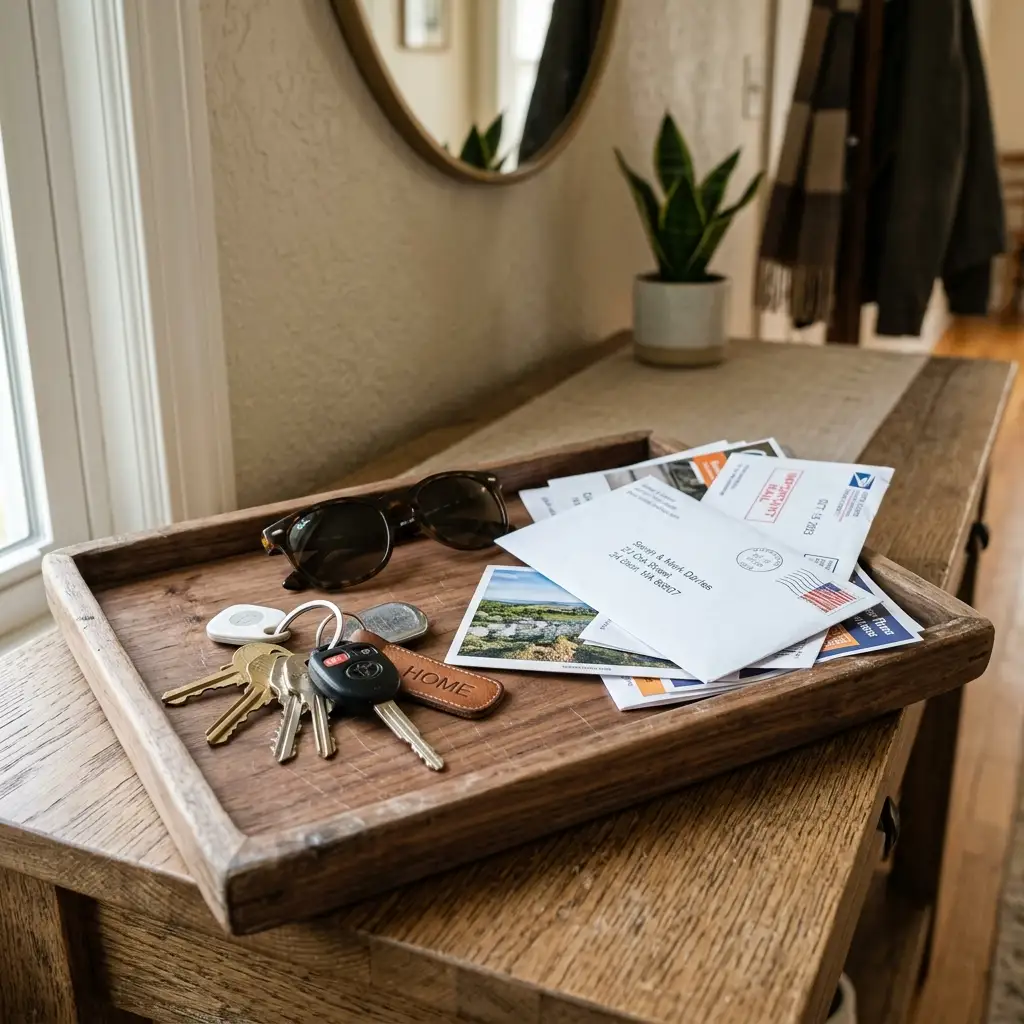
- Clear the console completely, then put back only the three things you touch daily.
- Measure the hall, subtract 36 inches of walking path, and cap the table depth at what remains.
- Give the drop zone a container — one tray or one lidded box — so clutter has an address.
- Move the tallest object to the third of the table farthest from the door swing.
- Hang or lean something above the table so the eye travels up instead of across.
- Add one floor object: a lidded basket, a stack of two pumpkins, or a rolled throw.
KEY TAKEAWAY: If the console is full before you add anything seasonal, the fall layer will always look like clutter, not decor.
Why the Entry Gets Overloaded Every October
The entry is the last place people decorate and the first place guests see. That gap creates panic buying. By early October the porch is done, the mantel is done, and the hallway suddenly looks bare by comparison — so it gets a full tablescape it was never sized for.
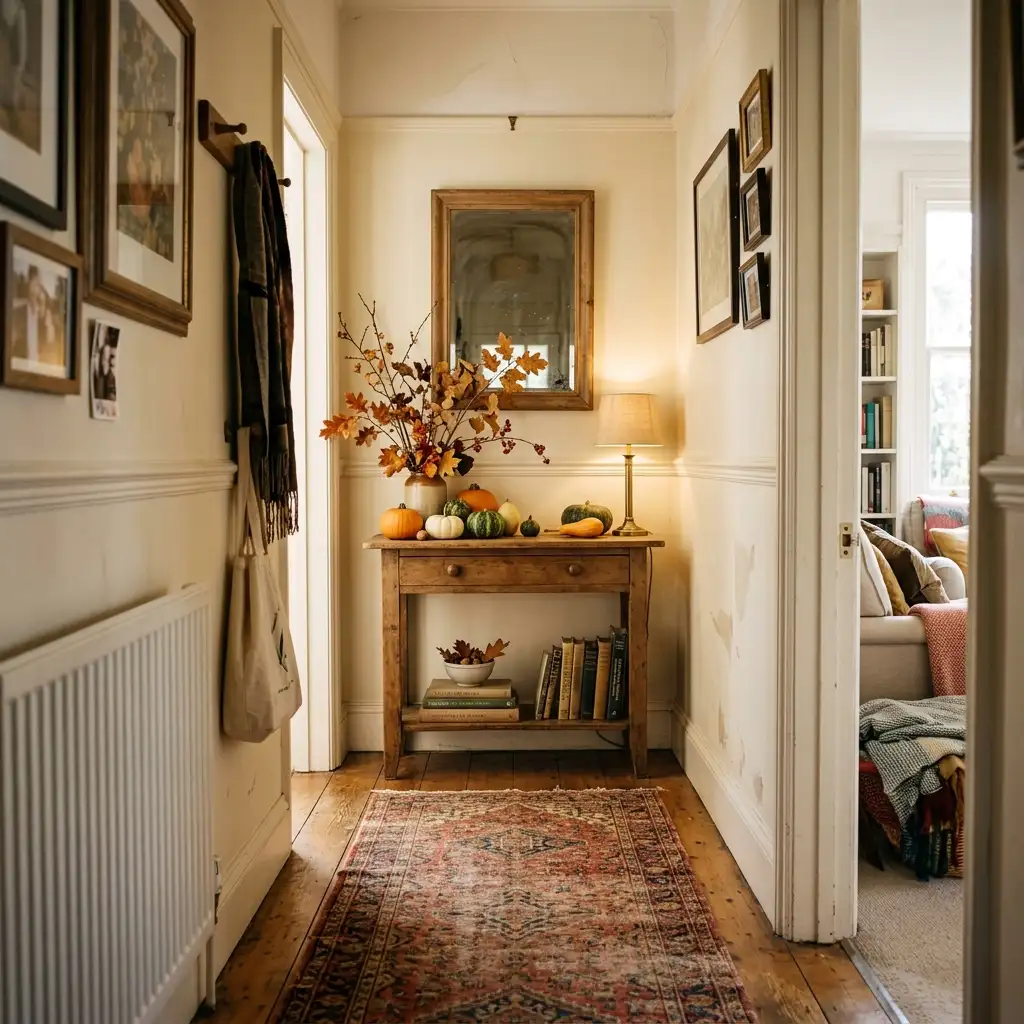
There is a second reason. Most fall styling advice was written for a dining table or a mantel, both of which are viewed from a seated position or from straight on. An entry console is viewed while walking past it, from a standing height of five to six feet, for roughly three seconds. Advice built for one viewing angle does not survive the other.
Signs This Is Catching On:
- Retailers now list console depth as a headline spec, and slim or demi-lune shapes under 14 inches deep have their own filters.
- Current catalog entry shots show two or three objects on the table and most of the work happening on the wall above it.
- Autumn roundups have shifted away from full door-side tablescapes toward one large object plus a floor basket.
You can see the same restraint appearing across the wider fall decorating archive — fewer objects, bigger ones, and more of the styling handled vertically.
What Fall Entryway Decor Looks Like Now
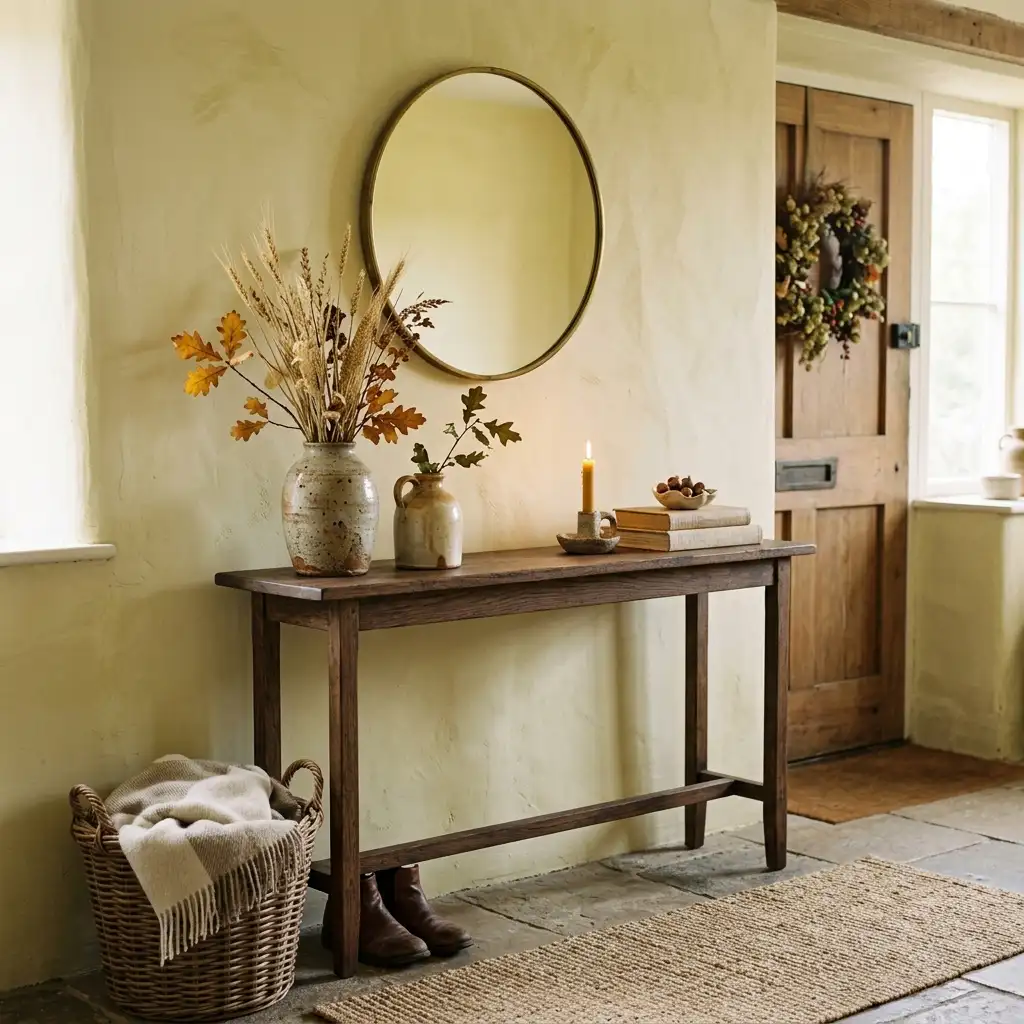
The current version of this look is quieter and taller than the 2019 version. Fewer objects. One real material instead of four printed ones. Warm brown and clay tones rather than bright orange. And critically, a table you can still use on a Tuesday morning.
What Does One-Third Actually Look Like?
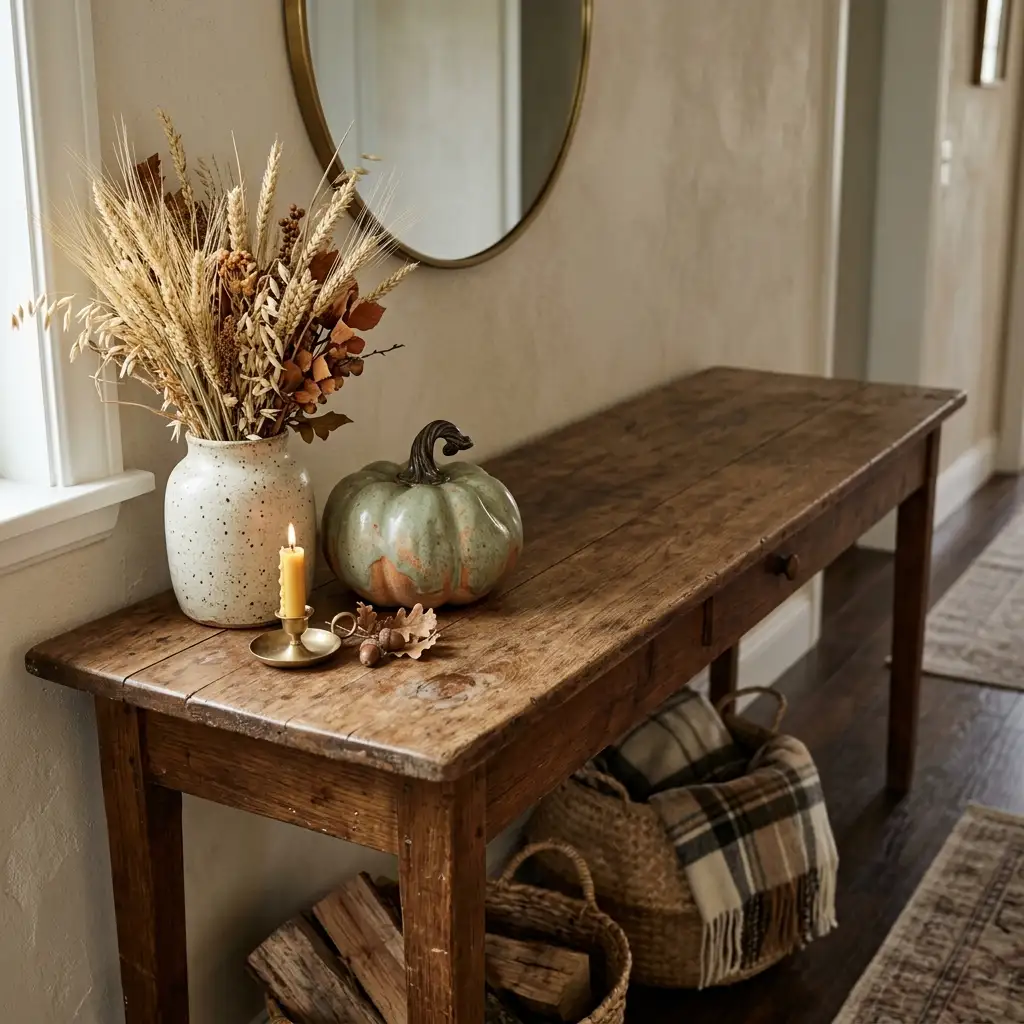
Fall decor should take roughly one-third of the console table — specifically the third farthest from the door. That leaves the near two-thirds for the drop zone, which is where hands naturally go first when someone walks in. On a 48-inch console, that gives seasonal objects about 16 inches of width to work in.
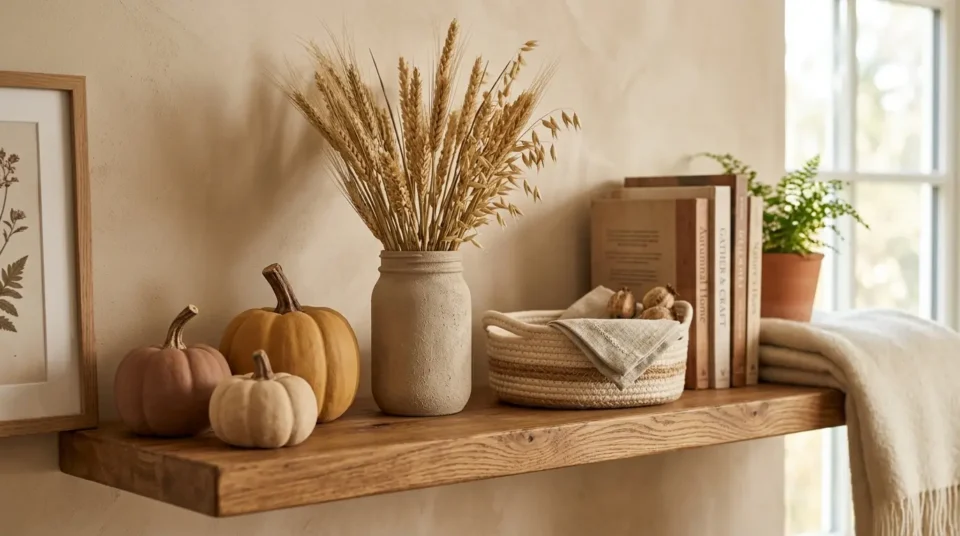
Sixteen inches is enough for three things, not eight. A ceramic vessel with dried wheat or oak stems. One uncarved heirloom pumpkin in warm cream or pale sage. One candle or a small stoneware dish. That is the whole styling brief.
The reason the split works is traffic, not taste. Objects placed within reach of the door get pushed aside, knocked over, or buried under mail within days. Objects at the far end sit untouched for the full season. Our spring entryway decor ideas use the same zoning with lighter materials, which makes the seasonal swap a five-minute job rather than a rebuild.
What Does the Porch Have to Do With the Hallway?
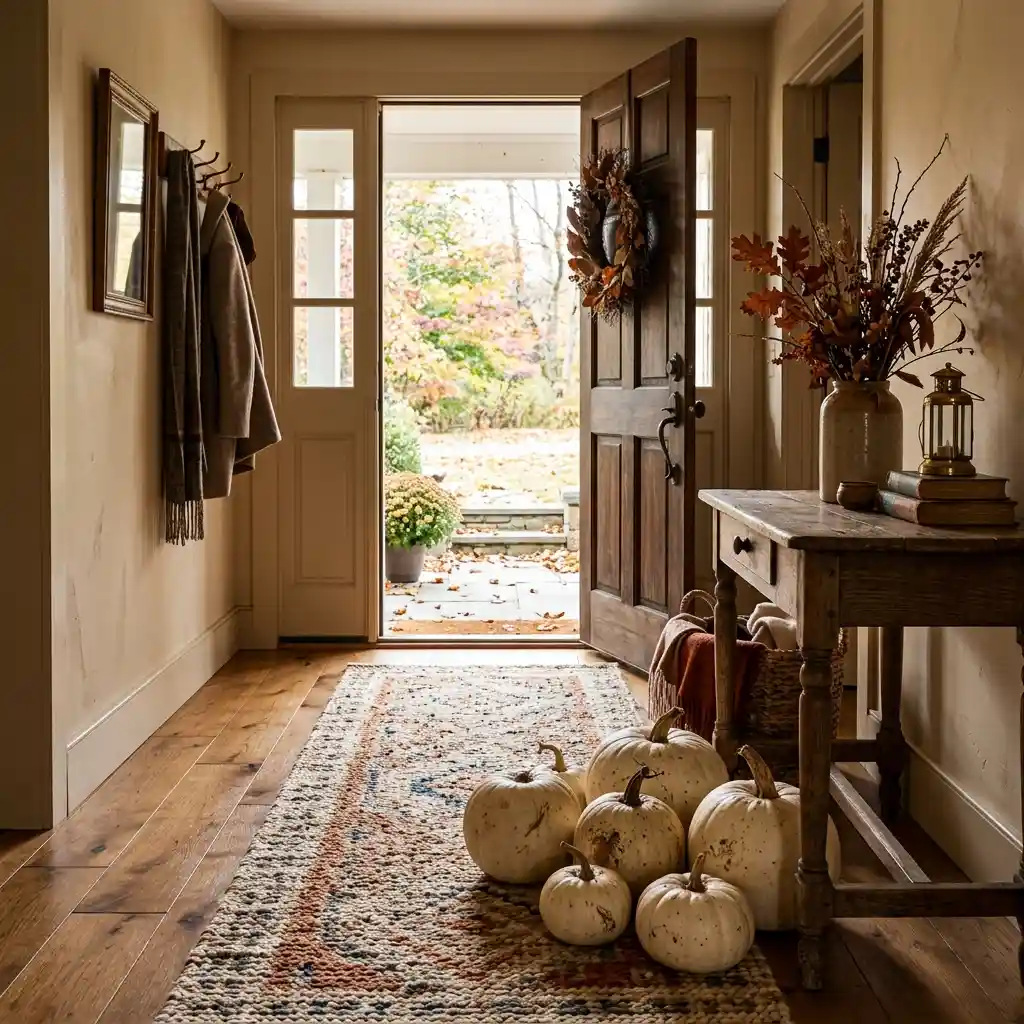
The entry is the only spot in the house where your outdoor fall and your indoor fall are seen within about four seconds of each other. Repeating exactly one material across the threshold is what makes both sides look like one house instead of two projects.
Pick one carrier and repeat it. If the porch has white pumpkins, put one white pumpkin inside. If the porch runs on dried wheat and grapevine, bring a single wheat bundle to the console. If the porch uses a rust ribbon, echo that tone in a runner or a tray. One repeat is enough — two starts to look matched, which is a different and worse problem.
Keep the door itself out of this. Wreaths, door mats and porch layers belong to the outside of the threshold, and the winter version of the same handoff is worked out in our cozy winter front porch decor guide. Inside the door, your job is the surface, the wall and the floor.
Why Do Flat Vignettes Disappear in an Entry?
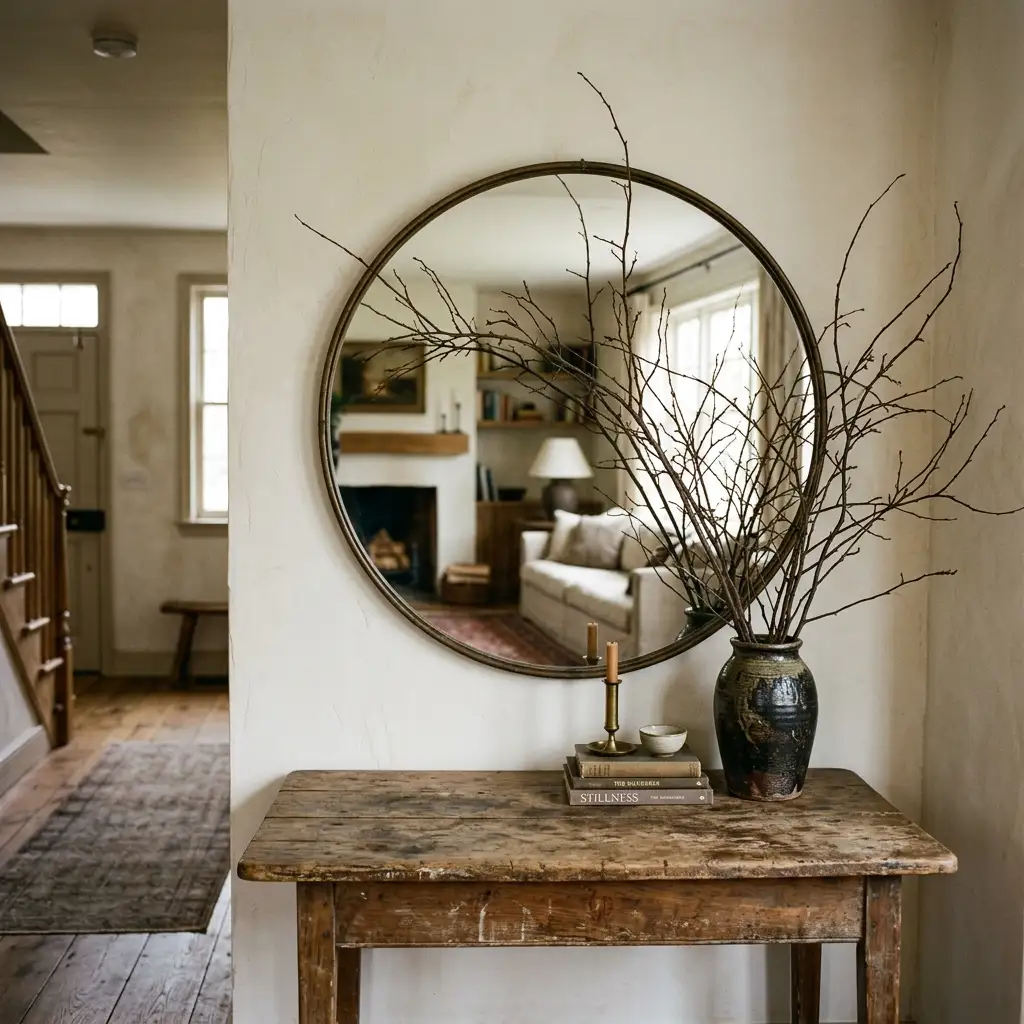
Flat arrangements vanish in an entryway because you never look down at one. A tabletop styled with three low objects — a tray, a small bowl, a folded stack — is designed for an overhead photo. Walking past at standing height, all three sit below your sightline and blur into one horizontal line.
Height fixes it, and the height has to be real. A 20-inch branch arrangement or a 24-inch mirror edge sits inside the band your eye actually scans. A four-inch candle does not.
Designer Rule of Thumb: In an entry, one object should reach at least half the height of whatever hangs above the table. That single tall piece does more than five small ones ever will.
This is also why the entry sightline matters. Most front doors open onto a view of the living room, so the palette on that console is seen against the sofa behind it. If the two clash, the entry looks wrong even when it is styled well — worth checking against your living room decor ideas before buying anything.
How Do You Style a Console Table Without Losing It?
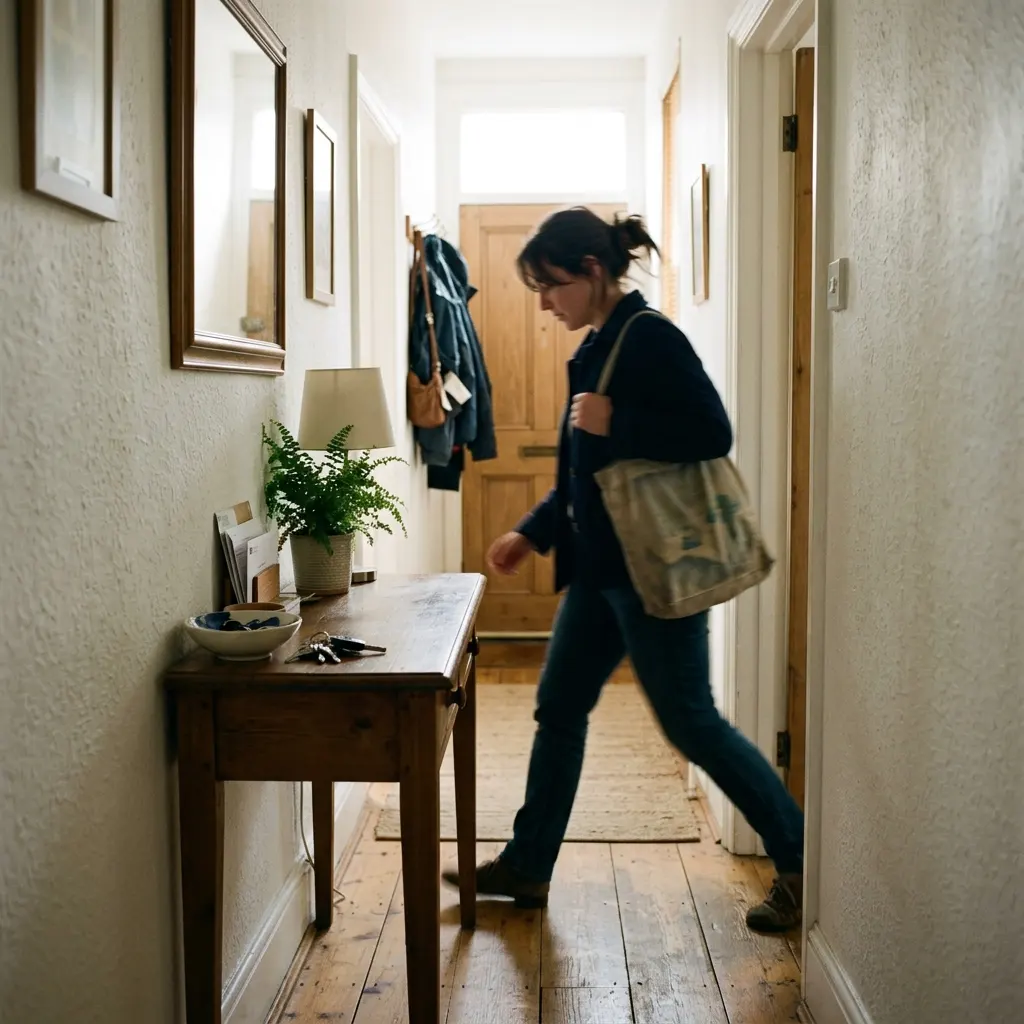
Four moves, in order. Measure, contain, build up, then add one thing at floor level. Do them in that sequence and the seasonal layer takes about twenty minutes. The year-round versions of these same moves sit in our entryway ideas archive.
Measure the Hall Before You Measure the Table
The table can only be as deep as the space left after the walking path. Measure the hall wall to wall, subtract the clear path, and whatever remains is your maximum console depth.
Source Note: The U.S. Access Board’s ADA standards set a 36-inch minimum clear width for walking surfaces, reducible to 32 inches for a length of no more than 24 inches.
Those numbers are written for accessible routes, not for hallways in your house, but they are the cleanest benchmark available for what a person actually needs to walk through comfortably. In a 48-inch hall, that leaves you 12 inches of table depth. In a 42-inch hall, you have six — which means a wall-mounted ledge or a demi-lune shape instead of a rectangular console. Slim consoles typically run 10 to 14 inches deep and 30 to 34 inches tall, so the math usually lands you at the shallow end. Our furniture styling archive covers how the same proportion rules apply to sideboards and sofa tables.
DESIGNER TIP: Buy the runner about two inches narrower than the hall rather than wall to wall. A runner touching both baseboards makes a narrow hall look tighter, and every shift shows as a crooked edge along the trim.
Give the Drop Zone a Container, Not a Corner
A drop zone without a container is just a pile with good intentions. One tray, one lidded box or one shallow bowl gives keys, mail and sunglasses a defined edge, and that edge is what keeps the near two-thirds of the console looking clear rather than merely un-decorated.
Choose the container in a fall-friendly material and it does double duty. A woven seagrass tray, an oil-rubbed bronze catchall or a matte stoneware bowl all count as seasonal texture while still being storage. More systems for the same problem live in our organization tips archive.
Build the Height on the Wall
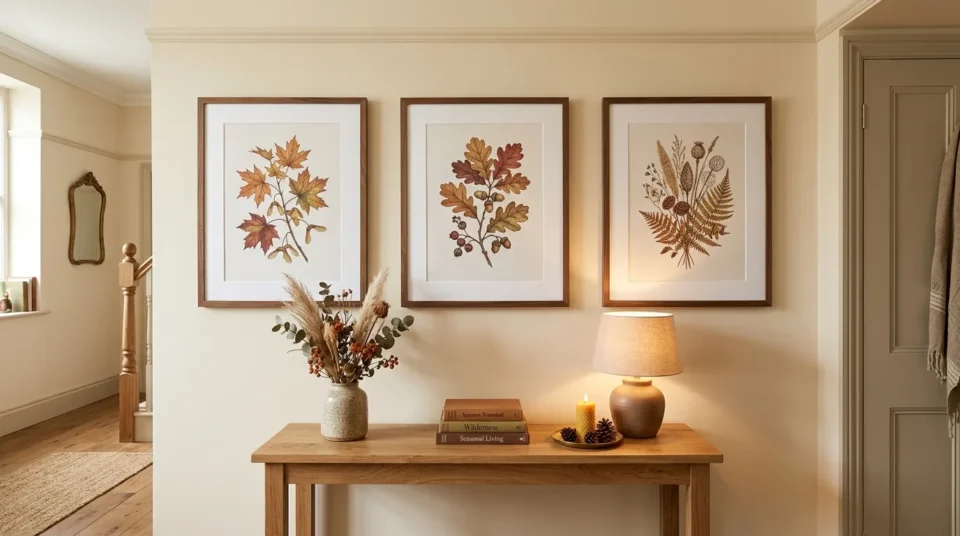
Wall space is the one thing entries have more of than surface. A mirror, a single large print, or a pair of hooks carries the vertical layer without taking an inch of tabletop.
A mirror is the strongest choice because it does three jobs: it adds height, it bounces daylight down a dark hall, and it gives people a last check on the way out. Center it roughly 57 to 60 inches from the floor and leave four to eight inches between its bottom edge and the table.
DESIGNER TIP: Set coat hooks at about 60 inches rather than at eye level. A coat hung on a 66-inch hook drapes across the bottom of the mirror; at 60 inches it clears the frame and the wall stays clean.
Rental Note: Use a French cleat on a picture-hanging strip rated above the mirror’s weight, or lean a floor-length mirror against the wall instead of drilling. More wall-layer options sit in our wall decor ideas archive.
Put One Thing on the Floor
One floor object finishes an entry and stops the console from looking like it is floating. A lidded basket for shoes. A tall vessel with dried grasses. Two uncarved pumpkins stacked at the table leg.
One. Not a grouping. The floor beside an entry table is walking space, and every extra object narrows the path you just measured.
Material Note: Uncarved pumpkins keep best between 50 and 60°F at 50 to 70% humidity, according to SDSU Extension, which also warns against storing them near apples, ripe pears or tomatoes because the ethylene those give off shortens shelf life. An entry hall at 68 to 72°F sits well above that band, so plan on weeks indoors rather than the two to six months good storage allows.
For an interior room where the same objects last longer and work harder, our fall bedroom refresh ideas show how the layer changes once daily traffic is out of the picture.
What Not to Put on a Fall Console Table
❌ Spreading fall decor across the full console → ✅ Keep it to the third farthest from the door and leave the rest working.
❌ Buying a deeper table to fit more objects → ✅ Measure the hall first; depth is capped by the walking path, not by your wish list.
❌ Styling only at tabletop height → ✅ Give one object real height, or hang something above so the eye travels up.
❌ Setting real pumpkins out in early September → ✅ Indoors they soften within weeks, so start them in October or use one faux heirloom you can keep.
No Hall, No Console: Where Does It Go?
Plenty of homes open straight into the living room with no hall and no console. The rules still hold, they just move to a different surface.
Use the first vertical surface instead. A slim wall-mounted ledge eight inches deep, a pair of hooks with a floor basket beneath, or the end of a sideboard nearest the door all work as the seasonal zone. The principle is unchanged: one-third seasonal, two-thirds working, height on the wall.
In apartments where the door opens into the main room, mark the transition with the floor rather than furniture. A 2 by 6-foot runner or a 3 by 5-foot wool rug creates a landing zone that works as an entry without adding a single piece of furniture. Our small apartment ideas cover more of these no-hallway workarounds, and the whole seasonal decorating archive shows how the same landing zone gets re-dressed through the year.
Pricing the Entry, Piece by Piece
Most people already own two-thirds of what this needs. The gap is usually a container and a floor object, not furniture.
At the budget end, $25 to $60 covers a restyle with what you have plus a few new pieces: three uncarved pumpkins at $4 to $8 each, one bundle of dried wheat around $12, and a taper candle or two. Mid-range, $90 to $220 buys the layer most entries are actually missing — a lidded seagrass basket at $45 to $90 and a jute or wool runner at $60 to $140. At the premium end, replacing the table itself runs $250 to $700 for a slim console 10 to 14 inches deep with a drawer, and that is the only line here that solves a problem the styling cannot.
| Project | Estimated Cost | Impact Level |
|---|---|---|
| Restyle what you own — tray, candle, three uncarved pumpkins, one stem bundle | $25-$60 | High |
| Add the missing layer — lidded basket plus a 2×6 ft jute or wool runner | $90-$220 | Very High |
| Replace the table — slim console 10-14 in. deep with a drawer | $250-$700 | Medium |
Best First Upgrade: The lidded basket — it removes the shoe pile that makes every other fix look pointless.
Skip for Now: A second console or a bench, unless the hall is over 48 inches wide and the walking path survives it.
Is the One-Third Split a Trend or a Rule?
The one-third split is not a trend, so it holds. What dates is the object list, and this year’s list is unusually durable: real materials, warm browns and clay tones, one large piece instead of six small ones. Dried stems, stoneware and woven baskets all carry into winter with a change of nothing but the pumpkin.
Designer’s Verdict: Spend on the container and the runner, restyle the tabletop for free each season, and treat the console itself as the last purchase, not the first. The same objects reappear in our cozy winter decor ideas once the harvest layer comes off in late November.
Frequently Asked Questions
Conclusion
If your hall is narrow, your door opens into the living room, or you have no console at all, the fix is the same one that works in a proper foyer: decide what the surface is for, then give fall entryway decor the leftover third. Everything else — the height, the container, the one floor object — costs less than a new table and survives the season better. More seasonal layouts and room-by-room plans are in our home decor ideas library.
Next Steps
- Clear the console completely and put back only the three items you touch every day.
- Measure the hall, subtract 36 inches, and write down your true maximum table depth.
- Buy or repurpose one lidded container for the drop zone before buying any decor.
- Pick one material from the porch and repeat it exactly once inside the door.
- Hang or lean one tall piece above the table so the styling works at standing height.