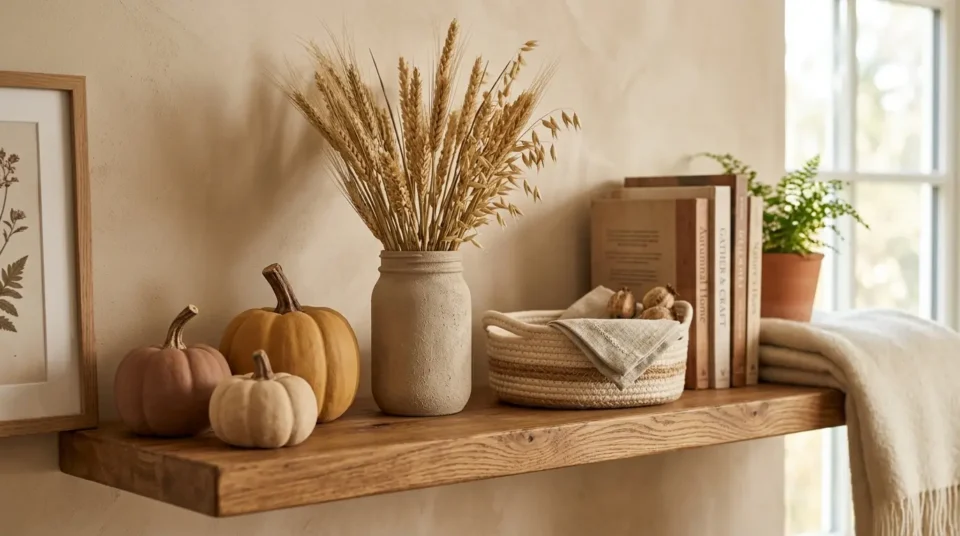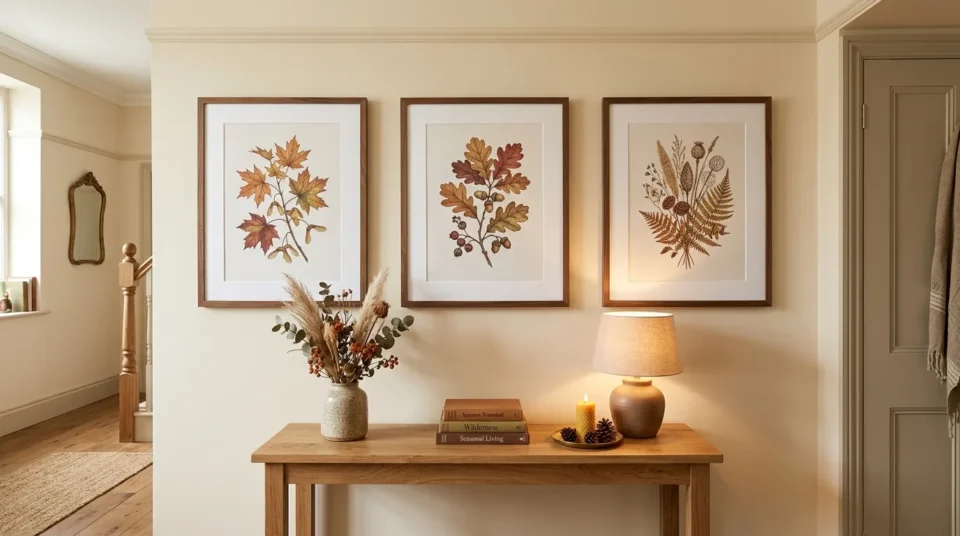

Why Is the Kitchen the Hardest Room to Decorate for Fall?
Walk into most kitchens on the first cool Saturday in October and you can watch the problem happen in real time. A small pumpkin goes on the counter. A stem arrangement goes beside the kettle. By Tuesday the pumpkin is on the windowsill, the stems are on the microwave, and both are dusted with flour. Nothing was styled badly. The kitchen just needed the counter back.
Fall kitchen decor fails on surface space, not on taste. A kitchen counter is a work surface first — it holds prep, appliances, groceries and dishes every single day, so anything decorative placed on it gets pushed aside within a week. The fix is to decorate the surfaces your kitchen never cooks on: above the cabinets, the window ledge, the cold half of the island, open shelves and cabinet fronts.
Looking for more ideas? Explore our full guide to Fall Decor by Room.
That one move changes what you buy, too. Objects above eye level need to be larger and simpler. Objects on a window ledge need to survive steam. If you are refreshing several rooms this season, our home decor inspiration covers the rest of the house. The kitchen is usually the third room worth doing, after the porch and the living room. These creative fall and autumn decor ideas set out that whole-home order.
Editorial field note: Three small autumn objects spread across a busy counter usually look messier in week two than on day one. Group the same three onto one tray, set a fourth on top of the cabinets, and the room looks settled — because the cook can still work.
A Fall Kitchen Decor Checklist Before You Unpack the Bin
- Measure the gap above your wall cabinets before buying anything for it.
- Clear the whole counter first, then add back only what earns a spot.
- Keep a 30-inch working stretch beside the range and sink permanently empty.
- Pick objects in the wood tone your cabinets or floor already use.
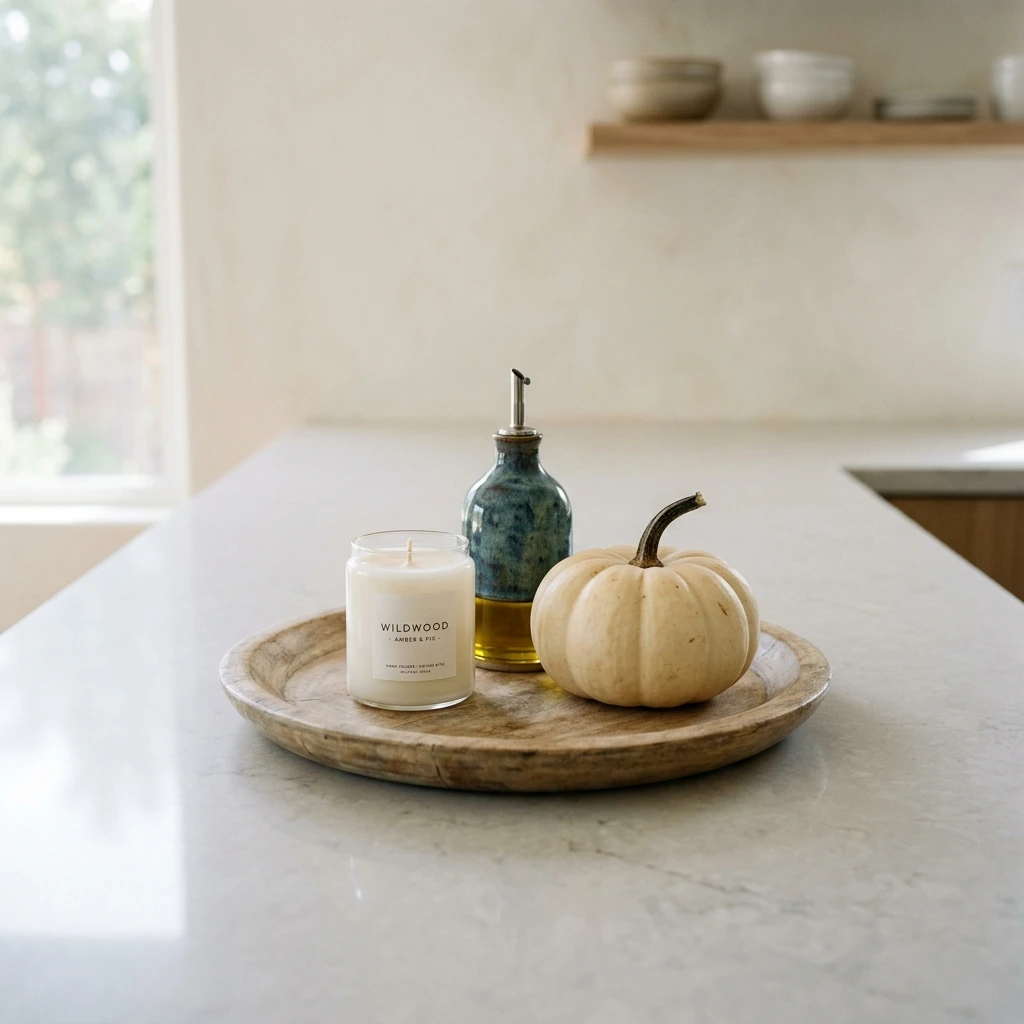
- Choose one tray, roughly 18 inches, as the only counter zone that gets decorated.
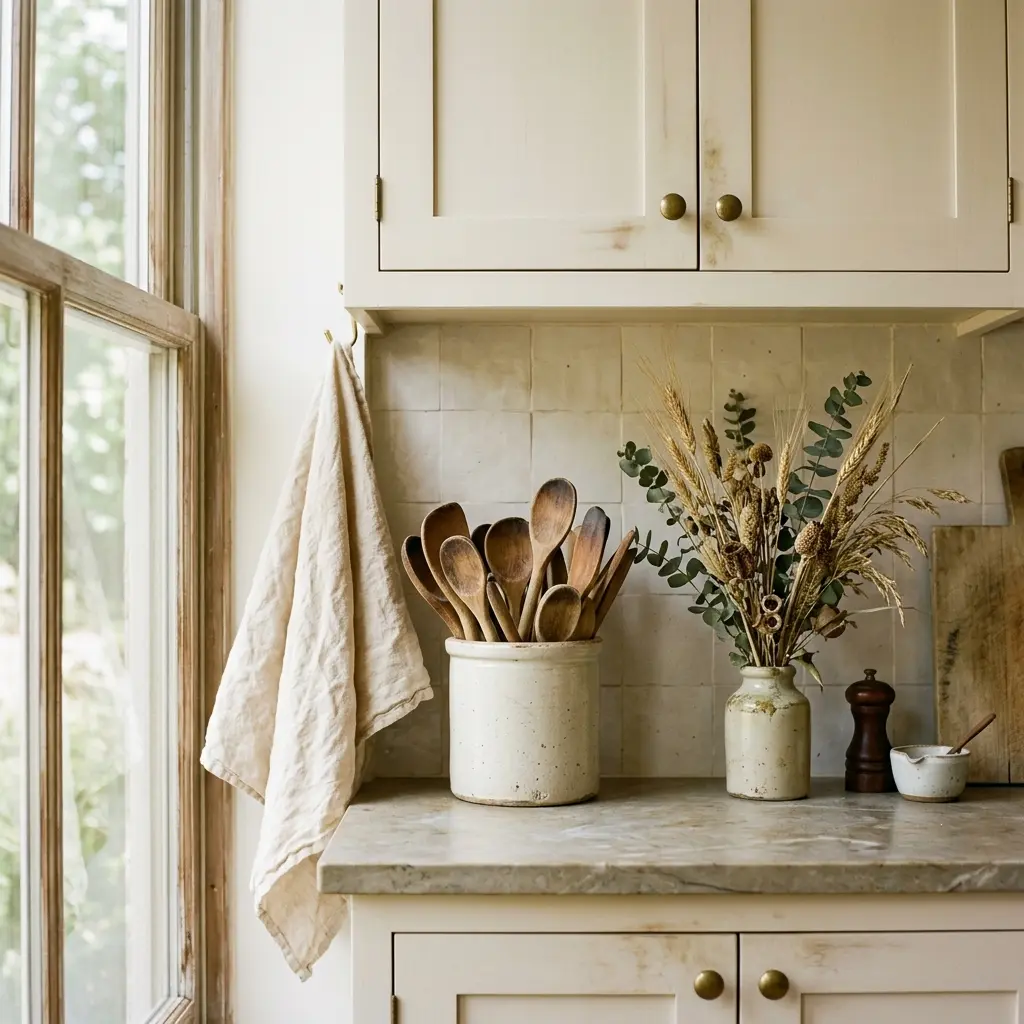
- Swap two dish towels and one crock instead of buying a themed set.
KEY TAKEAWAY: Fall kitchen decor works when you decide where it goes before you decide what it is.
Why Does Fall Decor Suddenly Match Your Kitchen?
Autumn palettes used to fight the kitchen. Cool grey cabinets and bright white quartz made burnt umber and ochre look like they had wandered in from another room. That gap has closed. Kitchens themselves moved warm, so the season’s colors now land on finishes that already agree with them.
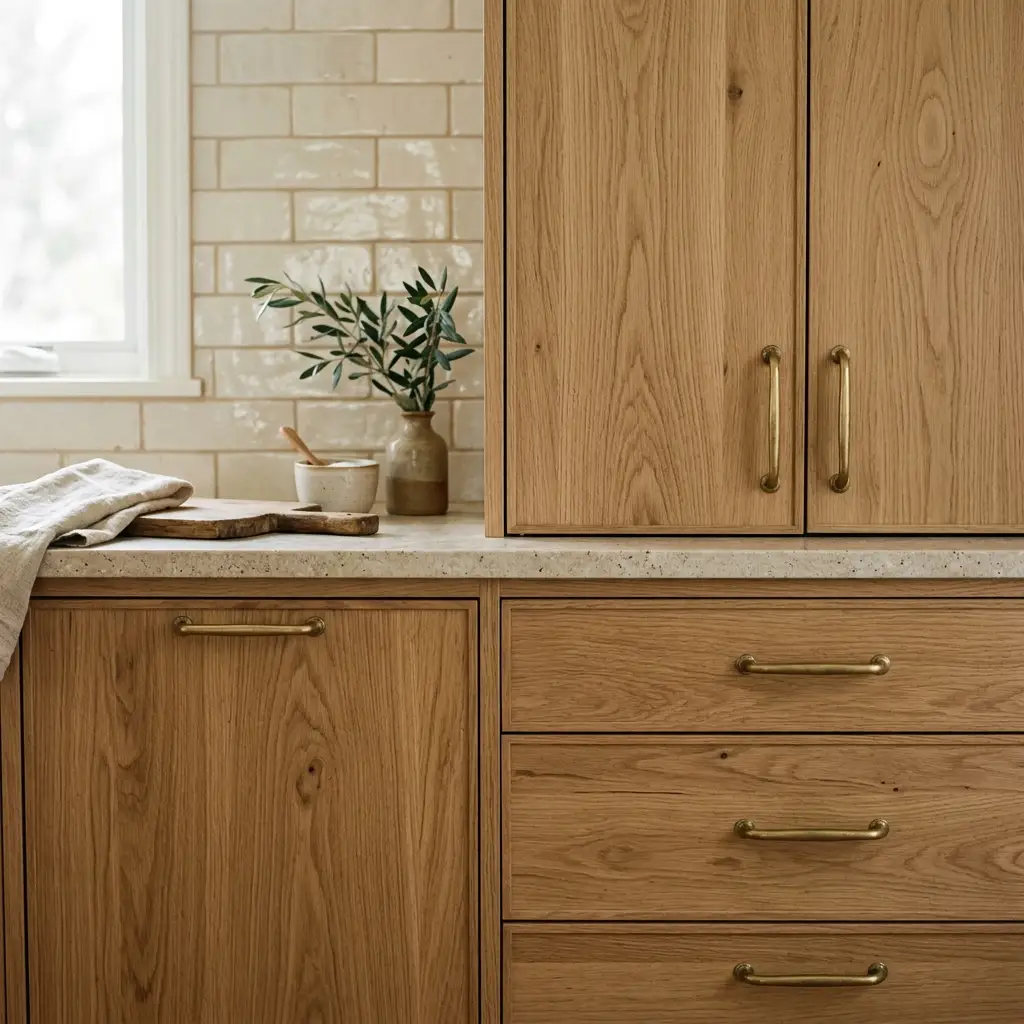
The NKBA 2026 Kitchen Trends Report puts numbers on the shift: 96% of the professionals surveyed named neutrals the most popular kitchen colors, greens followed at 86% and blues at 78%, while 59% reported wood grain growing in popularity and 51% named white oak the leading wood. Organic and natural design landed at 58%. Bright orange sat near the bottom at 7%.
Signs This Is Catching On:
- White oak and walnut cabinet fronts have replaced painted grey in most new kitchen showrooms.
- Warm cream and greige have taken over the backsplash tile that used to be cool white.
- Autumn styling has drifted away from bright orange toward cream, umber and deep olive.
That matters practically. A warm kitchen needs less seasonal decor to look like autumn, because the cabinets are already doing part of the work. Pick your accent to agree with the wood you own rather than fighting it — full interior palette planning is its own subject, worth handling once for the whole house. Our seasonal decorating archive tracks how the same rooms shift across the year.
Which Kitchen Surfaces Can Actually Hold Fall Decor?
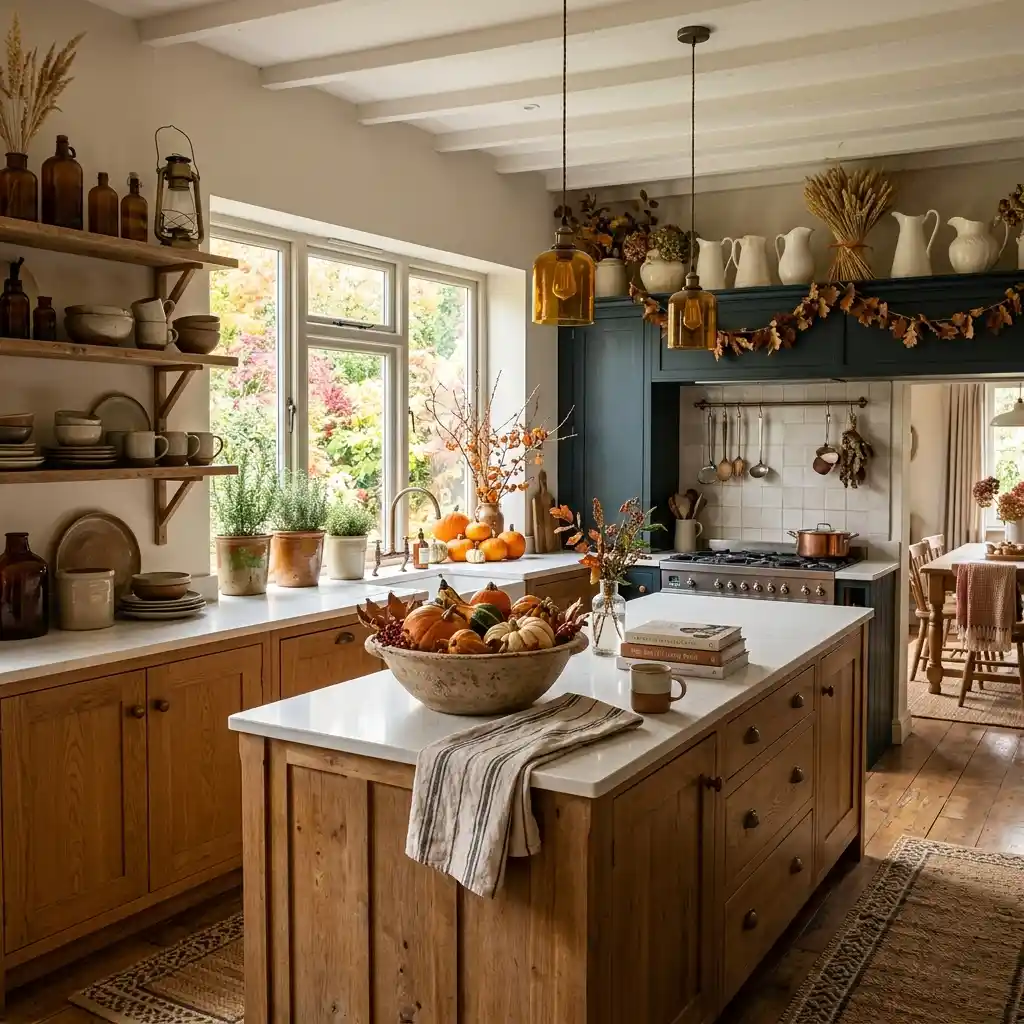
A kitchen has more horizontal surface than most rooms and less usable surface than any of them. That is what makes it different from every other space in our room-by-room decorating ideas. Sort every spot with one question: does anything land here during cooking? If yes, it is a work surface and stays clear. If no, it is yours all season. Five spots almost always come back free, and a sixth opens up once you give it a boundary.
Above the Cabinets — the One Surface Nobody Cooks On
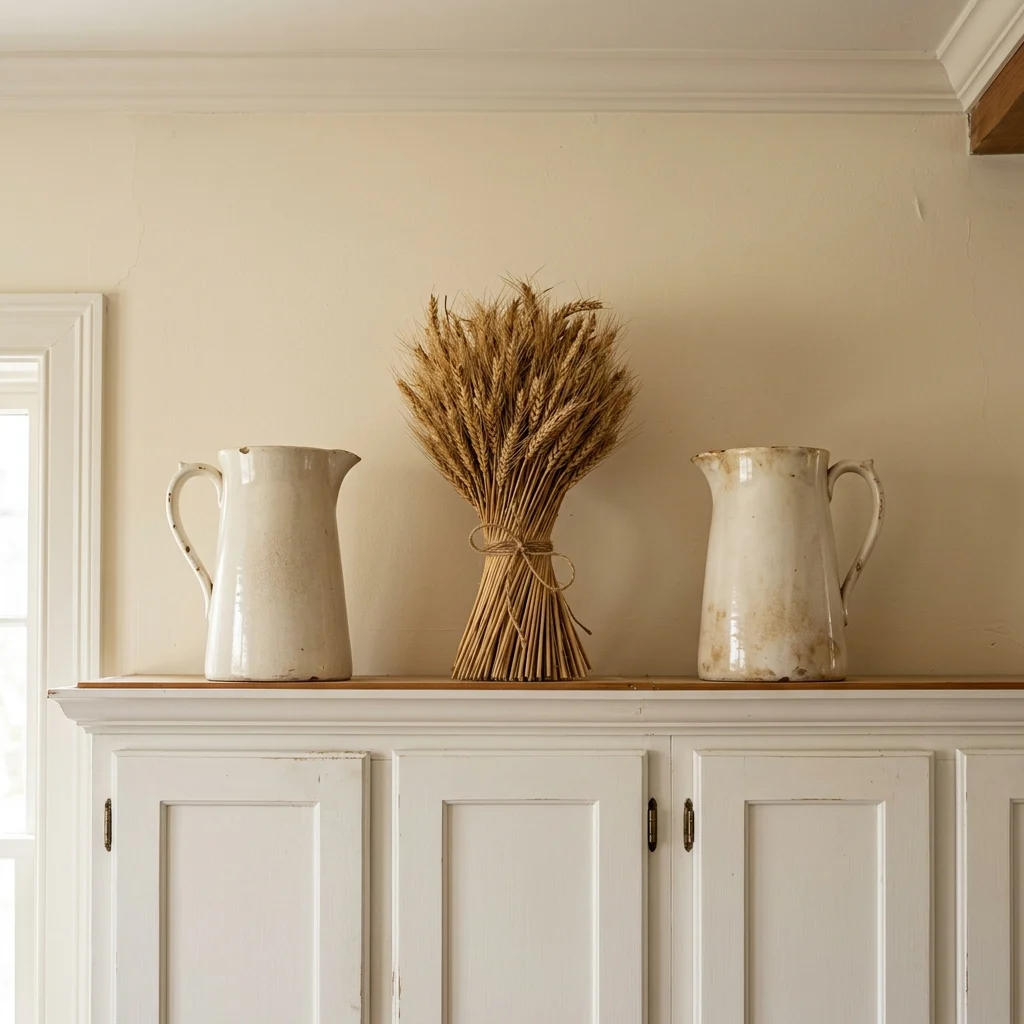
Above-cabinet space is the only horizontal surface in a kitchen that nothing else claims. Do the arithmetic before you shop. KraftMaid states that wall cabinets are typically installed 54 inches above the floor, or 18 inches above the countertop, at a standard 12-inch depth. A 30-inch cabinet hung at that height tops out around 84 inches, which leaves roughly 12 inches of clearance under a standard 8-foot ceiling.
Twelve inches is your whole object budget, so buy tall and simple: two or three vessels between 8 and 10 inches, not eight small ones. Detail disappears at that height. Silhouette does not. A pair of ironstone pitchers, one dark stoneware crock and a bundle of dried wheat will carry from the doorway when a row of tiny gourds will not.
Material Note: Cabinet tops collect a fine grease film in any kitchen that cooks. Wipe the surface before you place anything, and pick glazed ceramic or sealed wood over raw baskets, which trap it.
Our guide to what to put on top of kitchen cabinets covers the year-round arrangement; for autumn, keep the permanent pieces and swap only the filler — wheat, dried hydrangea or eucalyptus in place of whatever sits there in summer.
What Goes on the Window Ledge Over the Sink?
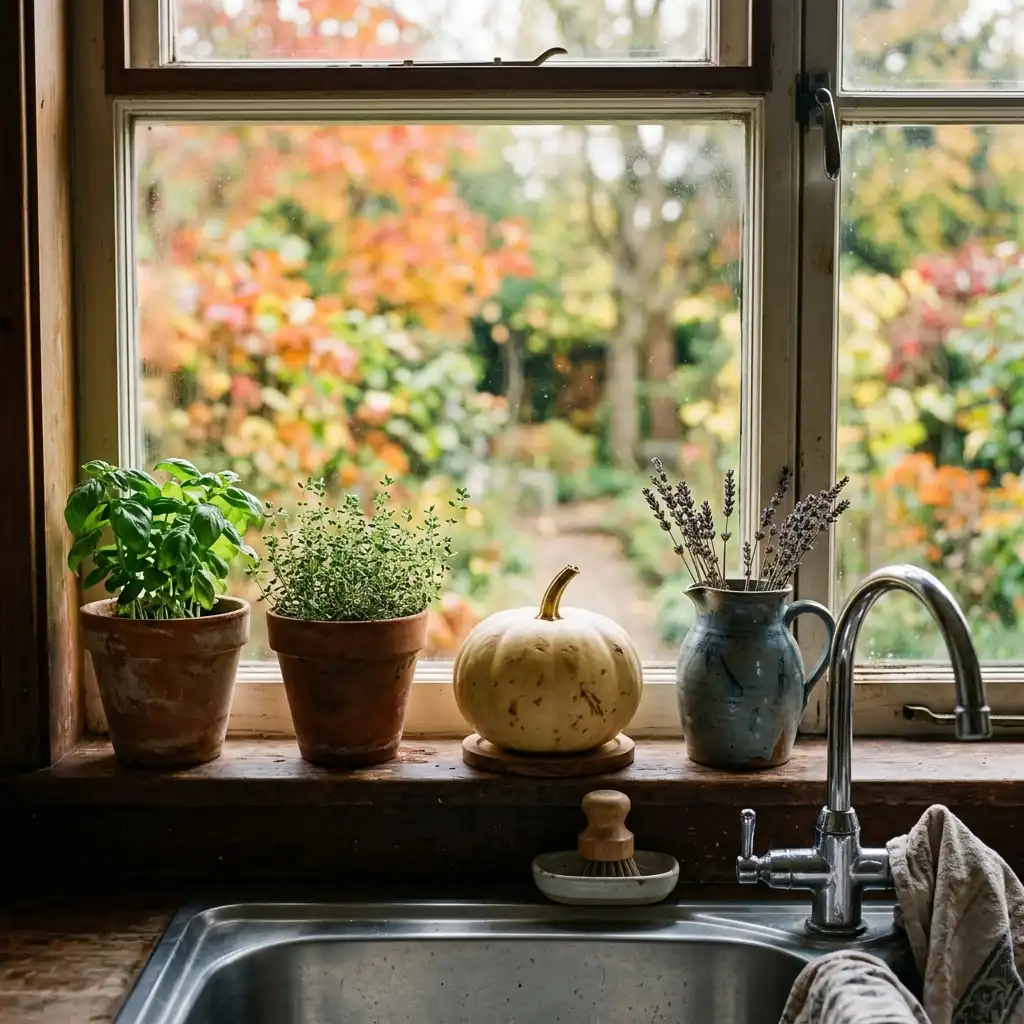
The sink window is the highest-traffic view in the kitchen and the ledge under it is almost never used for cooking. It is also the wettest, steamiest spot in the room, so the material rule tightens. Skip paper, dried citrus and untreated cardboard. Small glazed pots, a stoneware jug and one squat cream pumpkin hold up.
Keep the group short. Anything taller than about 6 inches starts blocking daylight, which is the one thing a kitchen window is for. Three objects at staggered heights beat a row of five matching ones. Our Christmas window decor ideas apply the same logic in December.
The Cold Half of the Island
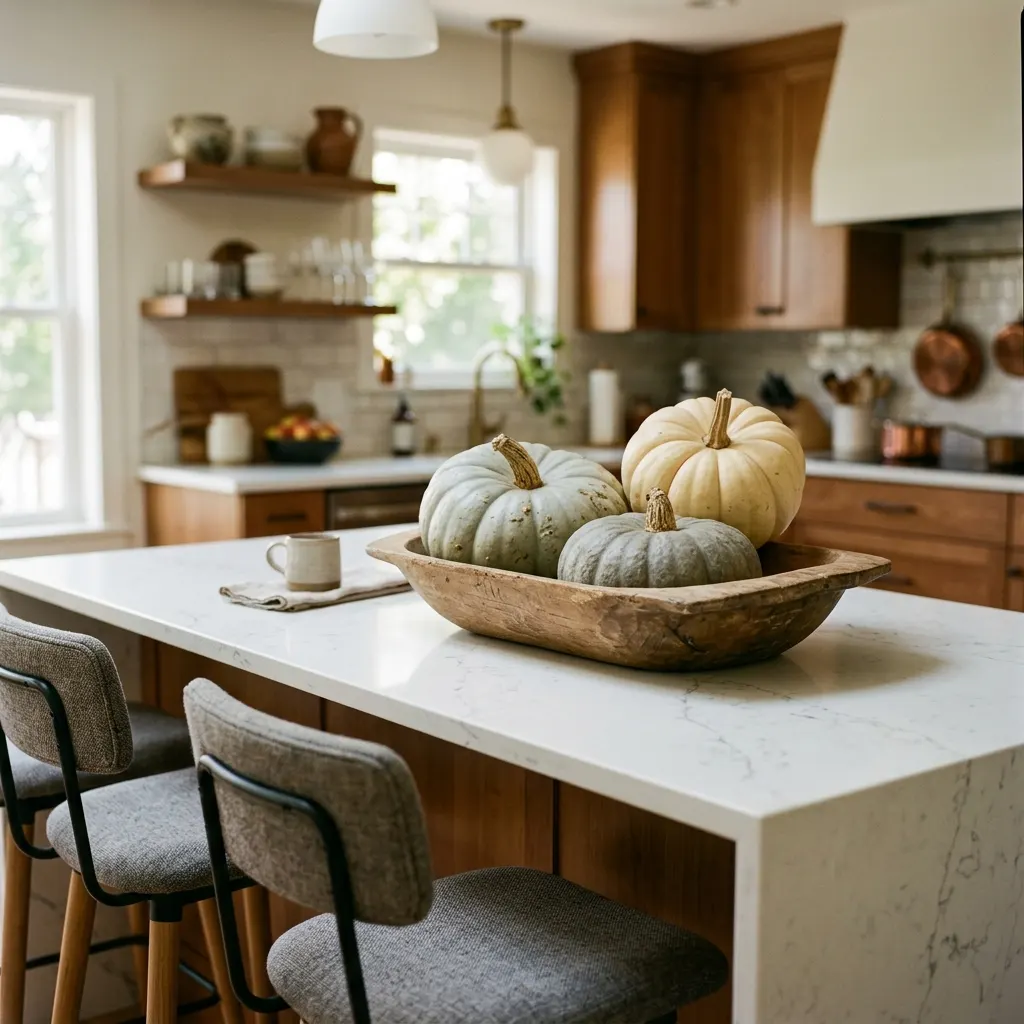
An island has a hot half and a cold half. The hot half sits nearest the range and sink, absorbs bags, chopping boards and hot pans, and cannot hold decor. The cold half — usually the seating end — goes untouched most days.
Put one grouping there and stop. A shallow wooden bowl with three uncarved heirloom pumpkins in cream and blue-grey, or a low stoneware vase of dried stems, is the whole job. Keep it under about 10 inches so people can see each other across the island. Our Christmas kitchen island decor ideas use the same surface and the same height limit in a different palette.
Designer Rule of Thumb: If you have to move it to set down a grocery bag, it is on the hot half. Slide it toward the seating end.
Open Shelves and the Plate Rail
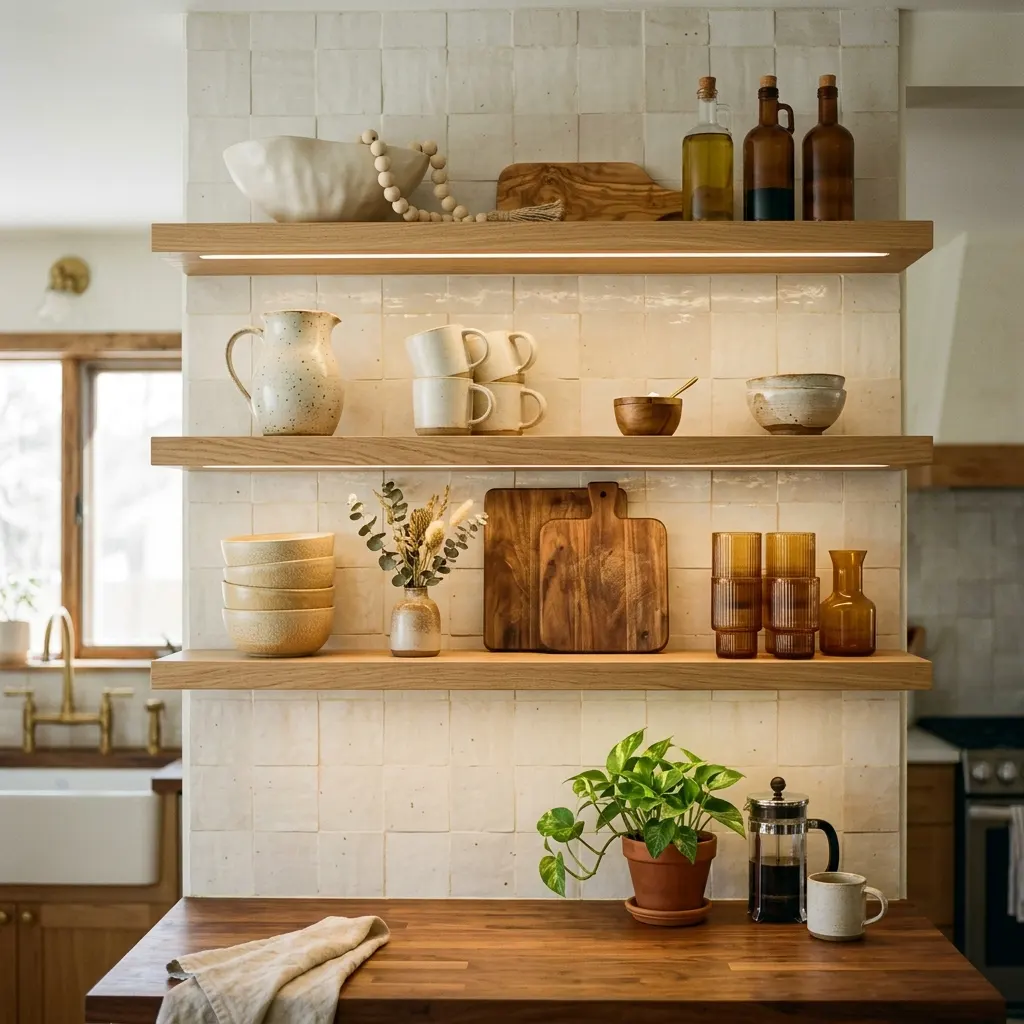
Open shelving is already decor, which makes it the cheapest fall change in the kitchen. You are not adding objects — you are re-sorting the ones you own. Move the white everyday plates back and bring forward anything in warm cream, amber glass, walnut or brown-glazed stoneware. One small dried bundle at the end of a shelf shifts the whole wall into season for nothing.
Leave real gaps. A shelf packed edge to edge looks like storage; the same shelf with a quarter of its length empty looks styled. Keep heavier pieces low and lighter ones high, which is also the safer arrangement in a room where doors slam. The rest of our kitchen decorating ideas cover the year-round version of the same wall.
Do Cabinet Fronts Count as a Surface?
They do, and almost nobody uses them. A cabinet door is vertical, so it never competes with cooking. A small wreath of dried wheat or preserved oak leaves, roughly 10 to 12 inches, hung on the end cabinet or the pantry door adds a full season of signal without taking an inch of counter.
Rental Note: Use an over-the-door hook or removable adhesive rated above the object’s weight rather than screwing into a cabinet face — cabinet fronts are the most expensive part of a kitchen to repair.
Our Christmas decor for cabinets guide is built on the same trick. One hook, three seasons.
One Tray Makes Counter Decor Legal
Counters are not off-limits. They are off-limits without a boundary. A tray of about 18 inches in wood, rattan or matte black metal turns a slice of counter into a defined zone, and a defined zone stops spreading. Put the salt cellar, the oil bottle, one candle and one small pumpkin on it. Everything else stays off.
Push it back against the backsplash rather than out toward the front edge. Base cabinets run 24 inches deep, so an 18-inch tray set at the back still leaves about 6 inches in front of it — enough to rest a bowl, not enough to chop on, which keeps the tray out of the prep path instead of in the middle of it.
The real payoff is hygiene, and this is where a kitchen differs from every other room. A counter gets sanitized, not dusted. Lift one tray, wipe the whole run, set it back down — instead of relocating six loose objects around raw food every time you cook.
What Survives Heat, Steam and a Daily Wipe?
A kitchen is harder on decor than any other room. Steam softens paper, grease settles on porous surfaces, and everything gets wiped or moved weekly.
Faux and dried stems hold color better than fresh foliage in kitchen steam and cost nothing to maintain. Glazed stoneware, ironstone and sealed wood wipe clean. Unglazed terracotta, raw jute, paper garlands and untreated baskets absorb grease and look grey by November. Real pumpkins do well on a cold windowsill and poorly beside a warm range. The durable half of this list carries straight into our cozy winter decor ideas, which is why it is worth buying well once.
Safety Note: The U.S. Fire Administration is direct about this — “Keep anything that can catch fire — paper towels, oven mitts, wooden utensils, food packaging, towels and curtains — away from your stove top.” Dried wheat, paper leaves and cotton garlands belong to that list. Nothing seasonal goes above or beside the cooktop.
How to Put a Fall Kitchen Together in One Evening
- Clear every counter completely, including what lives there year-round. You cannot judge the room until you see it empty.
- Place the tray first, then decide what earns a spot on it. Everything else goes into a drawer.
- Style above the cabinets next, using two or three tall pieces and one dried bundle. This is the change people notice from the doorway.
- Re-sort the open shelves and the window ledge using objects you already own, in warm cream, amber and brown-glazed tones.
- Swap two dish towels and the utensil crock last. Four minutes, and it ties the metal and wood tones together.
Do the eat-in table separately. A dining or breakfast table is a hosting surface with its own rules on runners, centerpiece height and place settings, so it deserves its own plan. The bedroom is the other interior room where a small autumn change pays back quickly, and our fall bedroom refresh ideas cover that layer.
What Pushes Fall Decor Off the Counter
Instead of spreading small objects across three counters, Try grouping them on one tray and putting a single large piece above the cabinets — small things scattered across a work surface turn into clutter within a week.
Instead of buying a matching themed set of canisters, towels and signs, Try swapping only the soft items and adding one real material — the matched set dates faster and costs four times as much.
Instead of filling the above-cabinet gap edge to edge, Try three tall pieces with clear space between them, since a packed gap makes an 8-foot ceiling feel lower than it is.
Instead of putting fresh gourds or dried stems near the range because the light is good there, Try the window ledge or the island’s cold half — heat is the one thing that decides this, not looks.
What You’ll Spend
Fall kitchen styling is one of the cheapest seasonal changes in the house, because most of the work is re-sorting rather than buying. Under $40 gets you the budget version — two warm dish towels, a stoneware crock and three small pumpkins. The mid-range move, at roughly $30 to $75, is the tray. Premium here tops out near $140 for a pair of large above-cabinet vessels that stay up all year.
| Project | Estimated Cost | Impact Level |
|---|---|---|
| Two dish towels and a stoneware utensil crock | $18-$35 | Medium |
| An 18-inch wood or rattan counter tray | $30-$75 | Very High |
| Three uncarved heirloom pumpkins, cream and blue-grey | $15-$40 | High |
| Three faux or dried stem bunches for ledge and island | $24-$50 | High |
| Two large above-cabinet vessels in ironstone or stoneware | $60-$140 | Medium |
Best First Upgrade: The tray, at roughly $30-$75 — it is the only purchase that also fixes the counter problem permanently, in every season.
Skip for Now: A full themed canister set or a new backsplash. Neither changes how the room feels in autumn, and both cost more than everything above combined.
Small Kitchens and Rentals: What Changes?
In a galley or apartment kitchen the surface math gets stricter, not different. With no island and no above-cabinet gap, you are left with the window ledge, the cabinet fronts and one small tray. Choose two and skip the third — a tiny kitchen with one styled ledge looks better than the same kitchen with something on every surface. Our guide to tiny kitchen ideas for small apartments covers the layout side of that constraint.
Renters have an easier season than they expect. Every spot in this post is a set-down or a hook — nothing needs a drill, a nail or a paint sample, and it all comes down in ten minutes. Browse our fall decorating ideas for the no-install versions in other rooms.
The Bottom Line
The Pick: If you only do two things, style above the cabinets and add one tray. One is seen from the doorway, the other protects the counter that made autumn styling fail in the first place. Fall decor holds up in a kitchen when it stays off the surfaces that work for a living.
Frequently Asked Questions
Conclusion
The one move worth making first is the tray, because it is the only change that fixes the reason fall kitchen decor keeps migrating in the first place — the counter needs a boundary, not fewer objects. Do that, style the space above the cabinets, and the rest is optional. If the kitchen is the first room you have refreshed this season, our home decorating ideas will help you carry the same warm tones into the rooms beside it.