TL;DR
A porch usually looks cluttered because it holds three different looks at once, not because it holds too many objects. Pick one — warm neutral, farmhouse harvest, dried and foraged, dark and moody, or modern minimal — then keep the palette to three tones, let one material lead, and put every fixture on the same bulb.
Looking for more ideas? Explore our full guide to Fall Porch Decor.
A Fall Porch Fails on Agreement, Not Amount
Here is something the decorating world, this site included, has been quiet about for years: almost every autumn porch guide hands you a pile of separate good ideas and never mentions that they have to agree with each other. A buffalo-check doormat, a bleached pampas bundle, a galvanized bucket, and a matte black modern planter are each defensible. Together they are four different houses.
Most fall porch decor ideas fail on agreement rather than amount. A porch reading as one clear look needs a single palette of about three tones, one material family doing the heavy lifting, and one bulb temperature across every fixture. Add or subtract objects after that, not before. The count was rarely the problem. Once the look agrees, our cozy fall porch guide covers making it usable after dark.
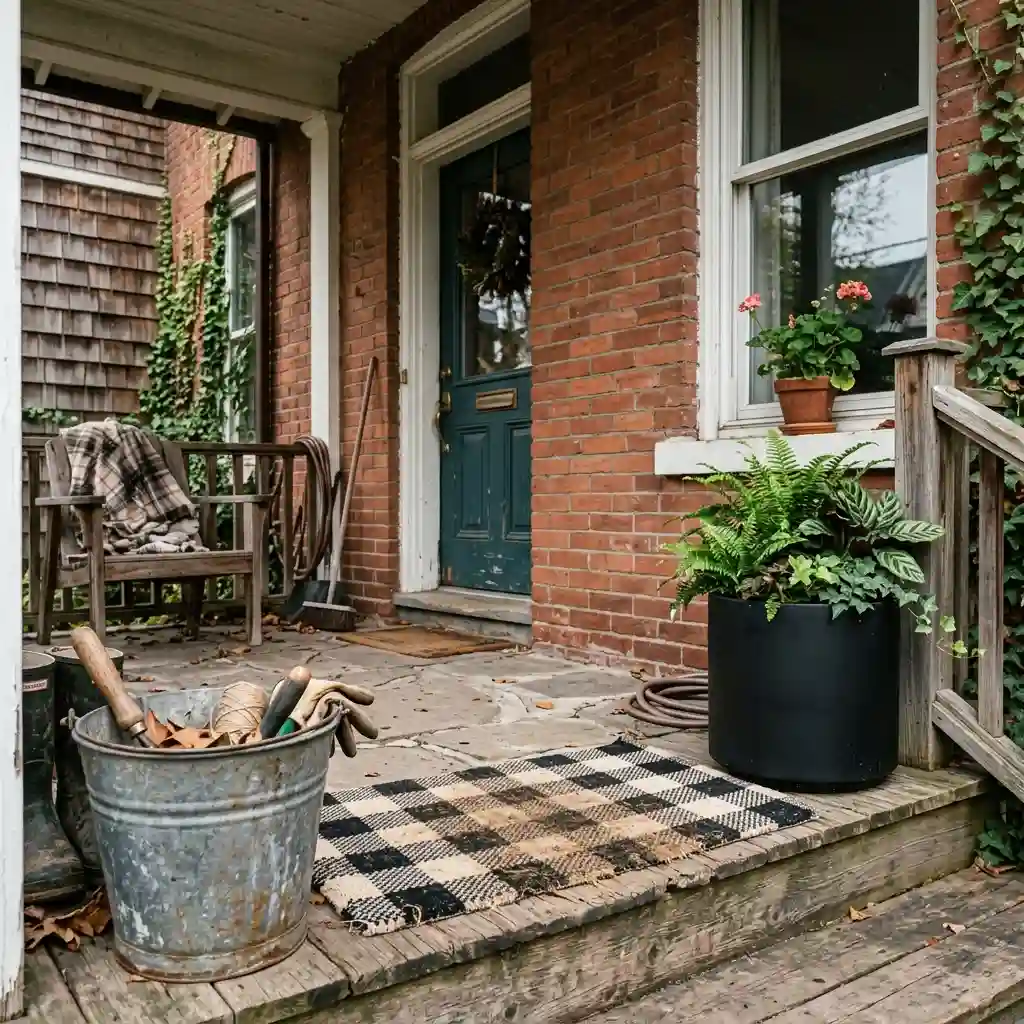
That is also why the “add one more thing” instinct backfires. Every new piece from a different look pulls the whole entry a little further apart, so the porch gets busier and less finished at the same time.
Editorial field note: a porch holding nine items in one palette looks calm and settled from the walk. The same porch with six items in three palettes looks unfinished, and the owner usually responds by buying a seventh.
If the permanent shell needs attention first — paint, railings, lighting — the year-round front porch decor ideas collection covers that groundwork.
What follows is the season sorted into five finished looks, plus the four rules that hold any of them together. There is plenty more autumn styling in our home decor inspiration library once the entry is settled.
Why Are Porches Committing to a Single Style This Year?
Autumn entries have narrowed. Where a porch once carried a bit of everything the season offered, the ones that look current now pick a lane and stay in it — all dried material, or all glazed ceramic, or all painted wood. The mixed harvest pile has quietly gone out of favor.
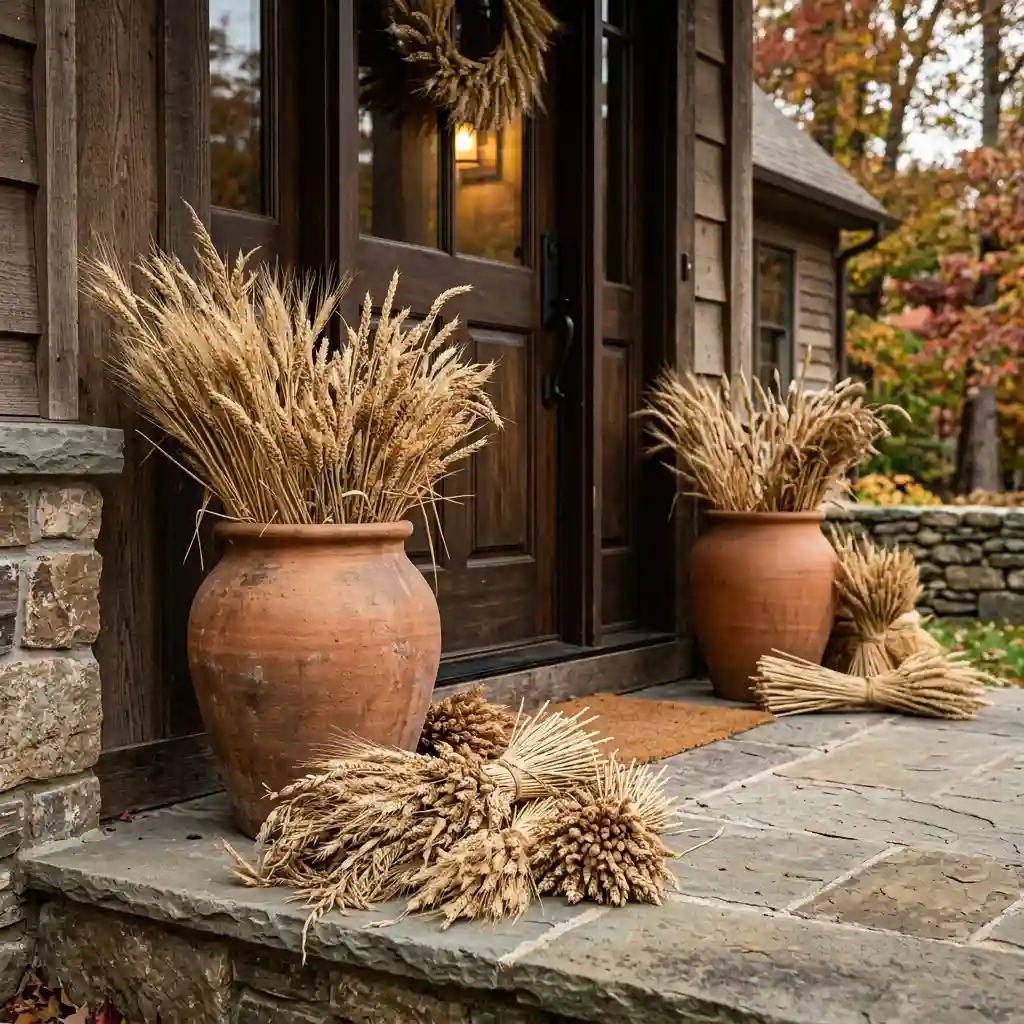
Some of that is the exterior itself. A porch sits against fixed inputs you cannot restyle: brick or siding color, door color, roof tone, railing material. A single committed look works with those inputs. A mixed one fights them — which is why we start from the facade itself when picking a palette.
Signs This Is Catching On:
- Retail autumn ranges are now merchandised as complete looks — one neutral story, one farmhouse story, one dark story — rather than as a single mixed harvest aisle.
- Paint brands have moved their autumn-adjacent neutrals to warm earth tones, which pushes accessories toward one coherent family instead of a bright orange default.
- Preserved and dried material has replaced plastic maple as the standard filler, and dried goods pair badly with glossy props, which forces a choice.
The Halloween split helps here too. Fall owns harvest styling and warm palettes; anything spooky, carved, or costumed sits with the Halloween decorating ideas and gets its own few weeks rather than being mixed into the autumn look.
What Makes a Porch Look Like One Idea Instead of Six?
Four rules do almost all of the work, and they hold no matter which look you pick.
Palette first. Cap the porch at three tones and use each one at least twice — a cream that shows up in the pumpkins and the doormat border, an olive in the grasses and a pillow, a warm brown in the planters and a basket. A color used once looks like a leftover.
Let one material lead. Choose the family that carries the look — woven fiber, dried plant material, painted wood, glazed ceramic, or metal — and give it roughly two-thirds of the surface area. A second family supports it. A third almost always breaks the look.
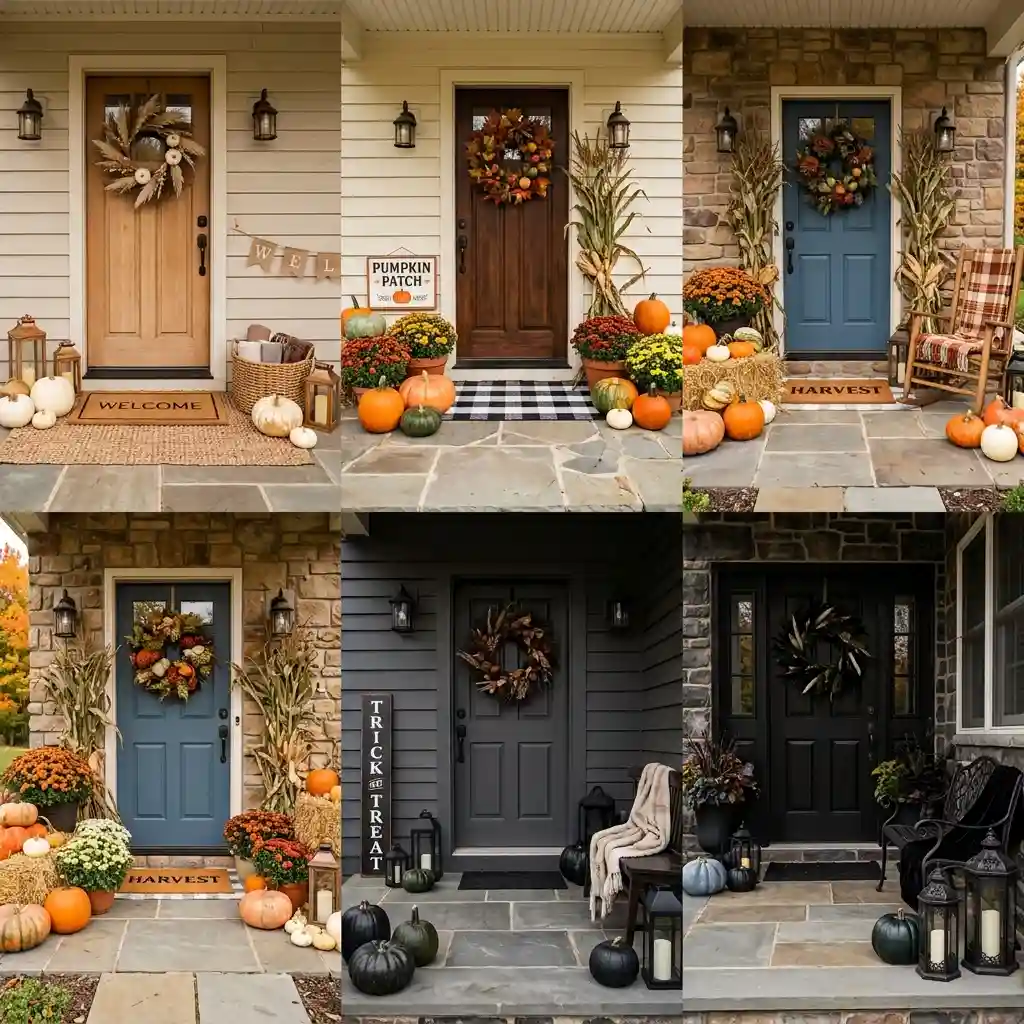
Pick one metal and stay there. Matte black or aged brass, on the lantern, the house numbers, the planter bands, and the hardware. Two competing finishes is the single most common reason a porch full of nice things still looks assembled by accident.
Then unify the light. Safety Note: match the fixture to its exposure before anything else — lighting maker Schoolhouse explains that damp-rated fixtures suit covered porches while wet-rated fixtures are the ones built for direct rain and snow. Once the fixture is right, put every bulb on the porch at the same warmth so the entry glows one color after dark instead of two.
Designer Rule of Thumb: stand at the door and name the look out loud in three words. If you cannot, the porch does not have one yet.
Five Fall Porch Decor Ideas Built as Complete Looks
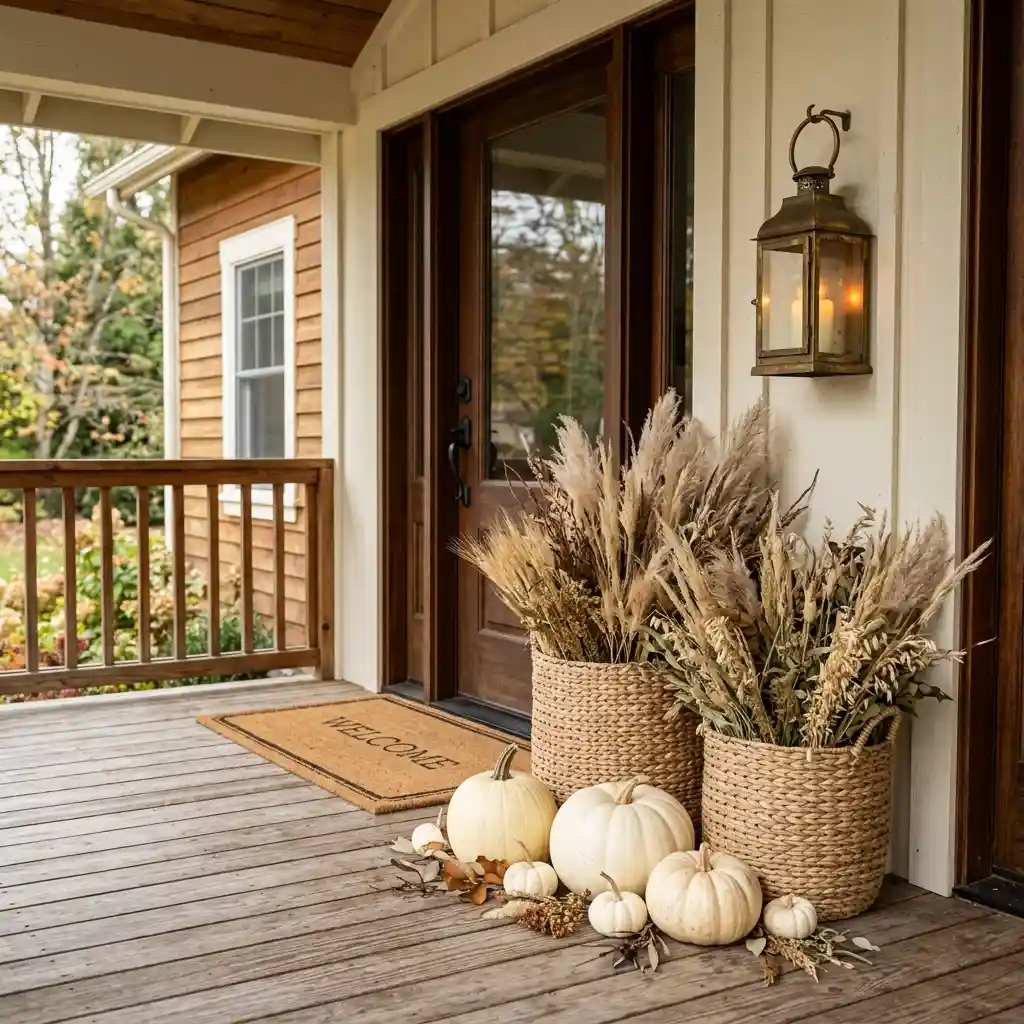
Each of these is a finished composition rather than a single object — palette, lead material, anchor pieces, and a lighting cue. Pick the one your house already leans toward.
The Warm Neutral Porch
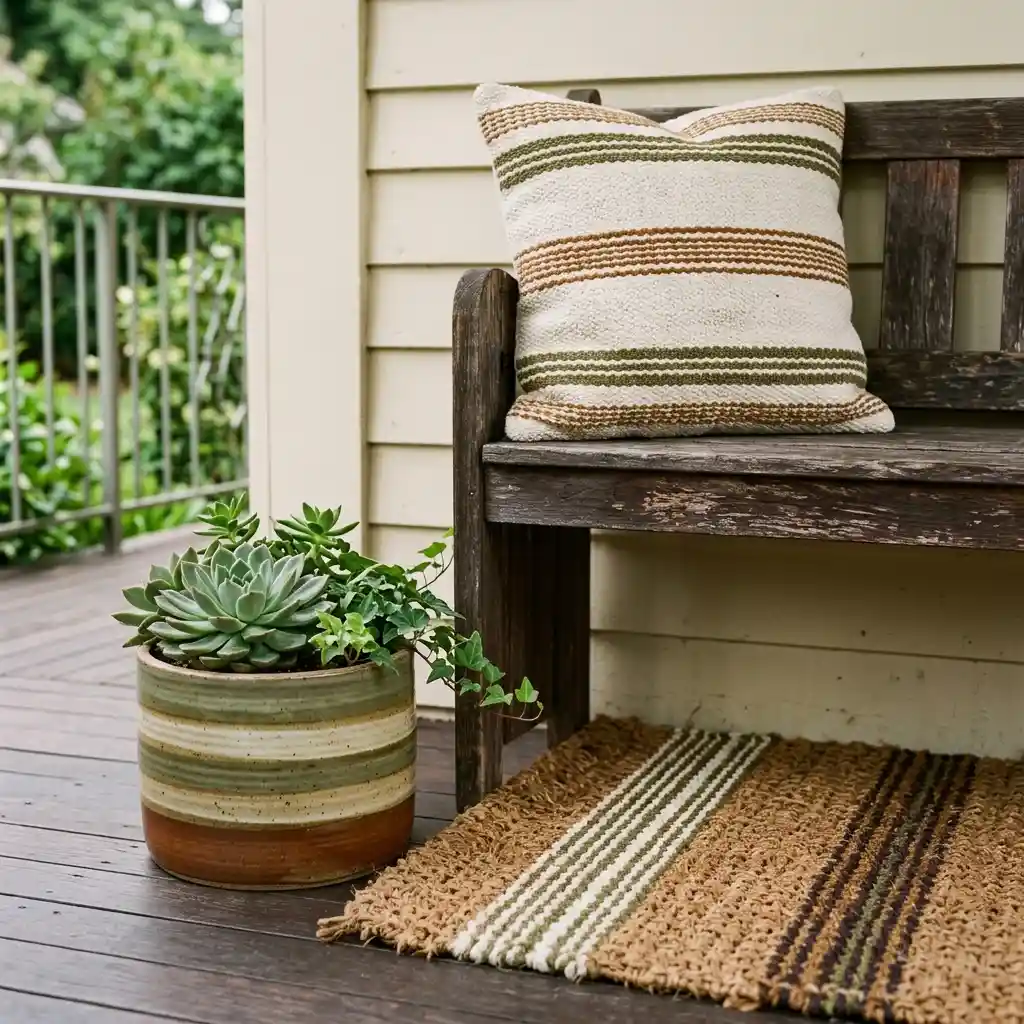
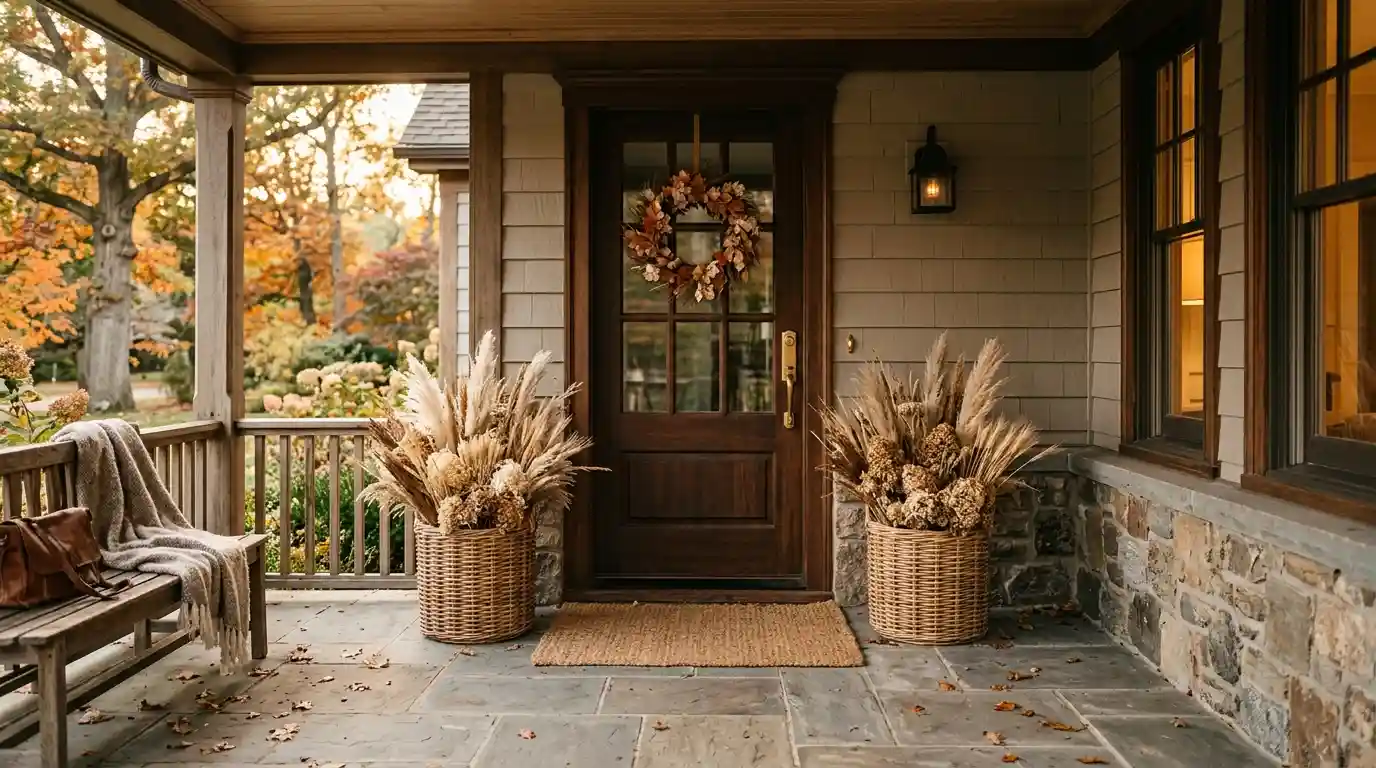
Palette: warm cream, khaki, and burnt umber. Lead material: woven fiber. Anchor pieces are two large seagrass or rattan-look planters filled with dried grasses, a flat-weave doormat with a plain border, and cream and pale grey pumpkins kept low near the planter bases. Lighting: aged brass lantern with a warm bulb. This look suits cream, grey, or beige siding and almost any door color, and it stays right from late August through Thanksgiving because nothing in it is loud enough to date. It is also the structure a cozy winter front porch reuses in December with evergreen swapped in for the grasses.
The Farmhouse Harvest Porch
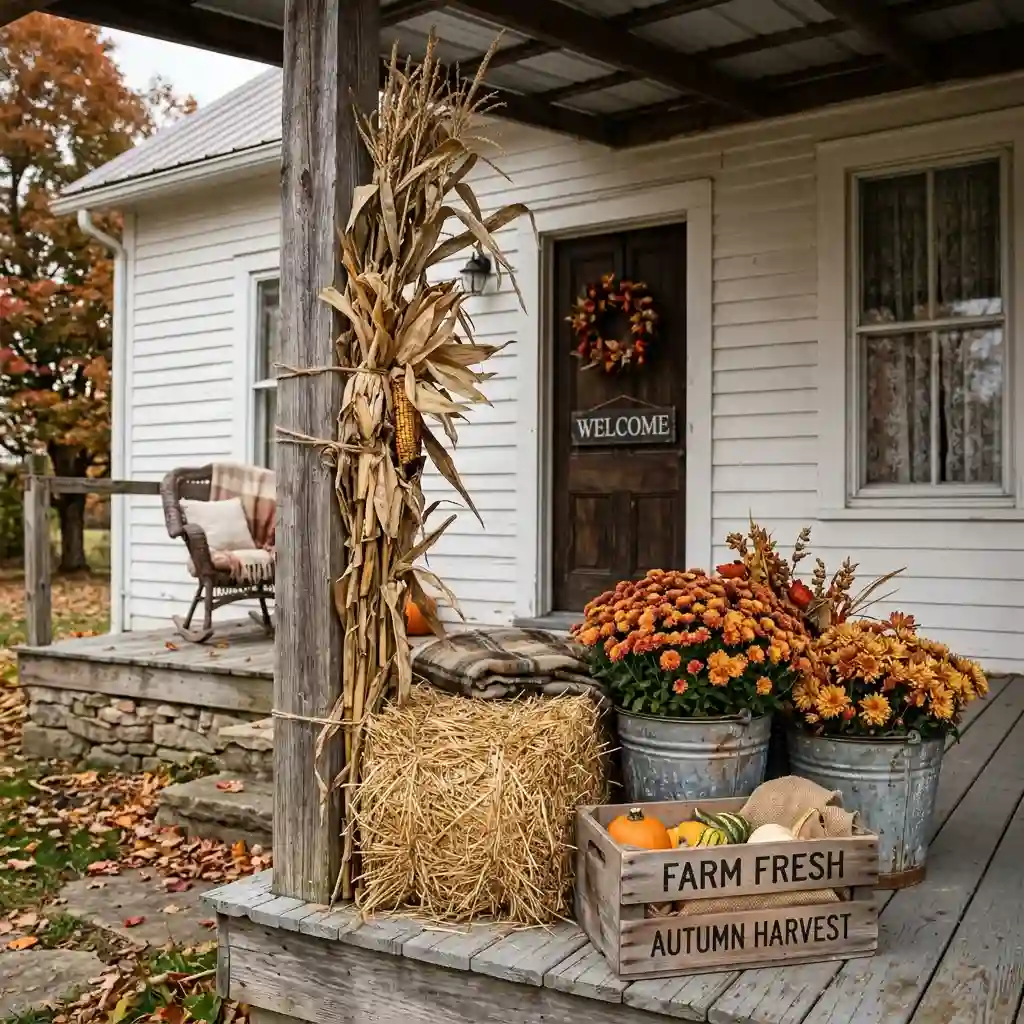
Palette: warm white, deep orange, and galvanized grey. Lead material: painted and weathered wood. Anchor pieces are a wooden crate or riser, a hay bale or two, corn stalks tied to the posts, and galvanized buckets holding mums. Lighting: black metal lantern with a battery candle. This is the one look where classic orange belongs, because the palette is built to carry it. It reads best on white clapboard or a red brick front with a black or barn-red door.
The Dried and Foraged Porch
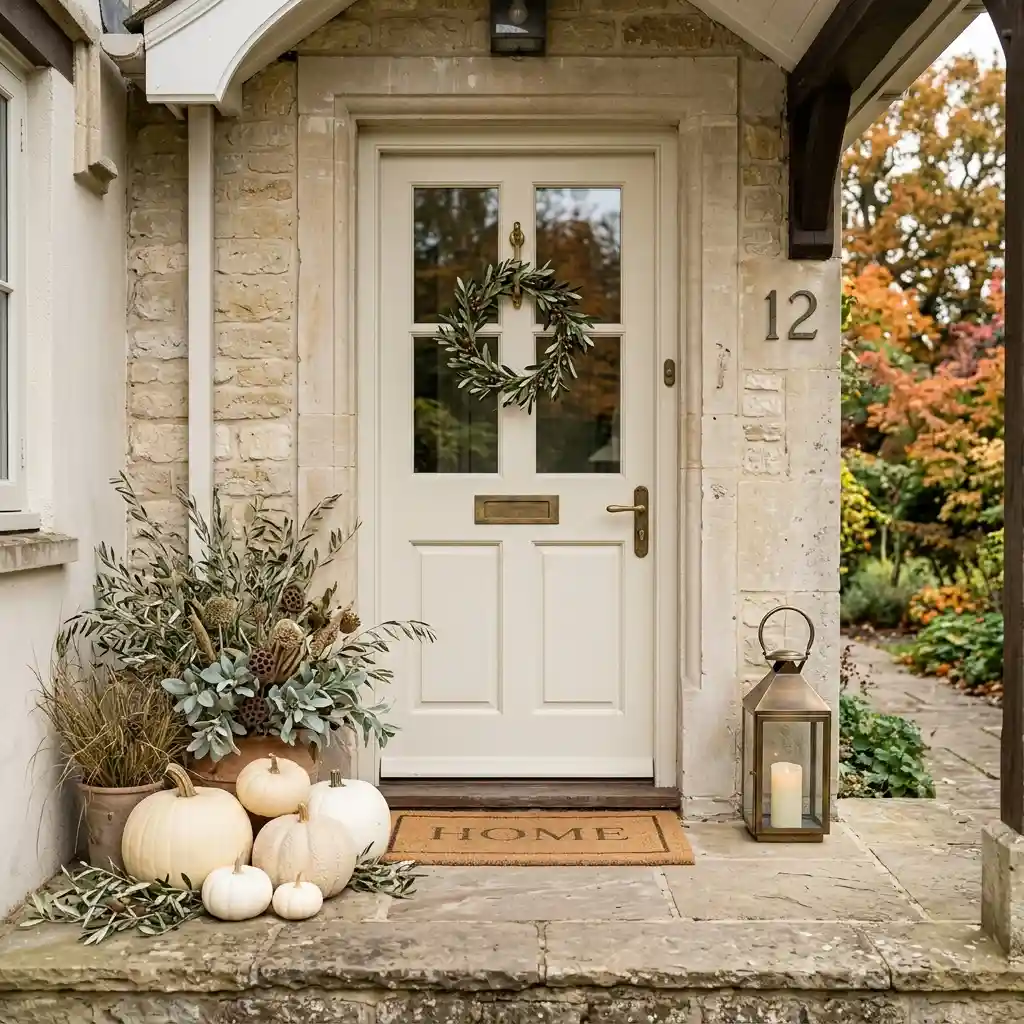
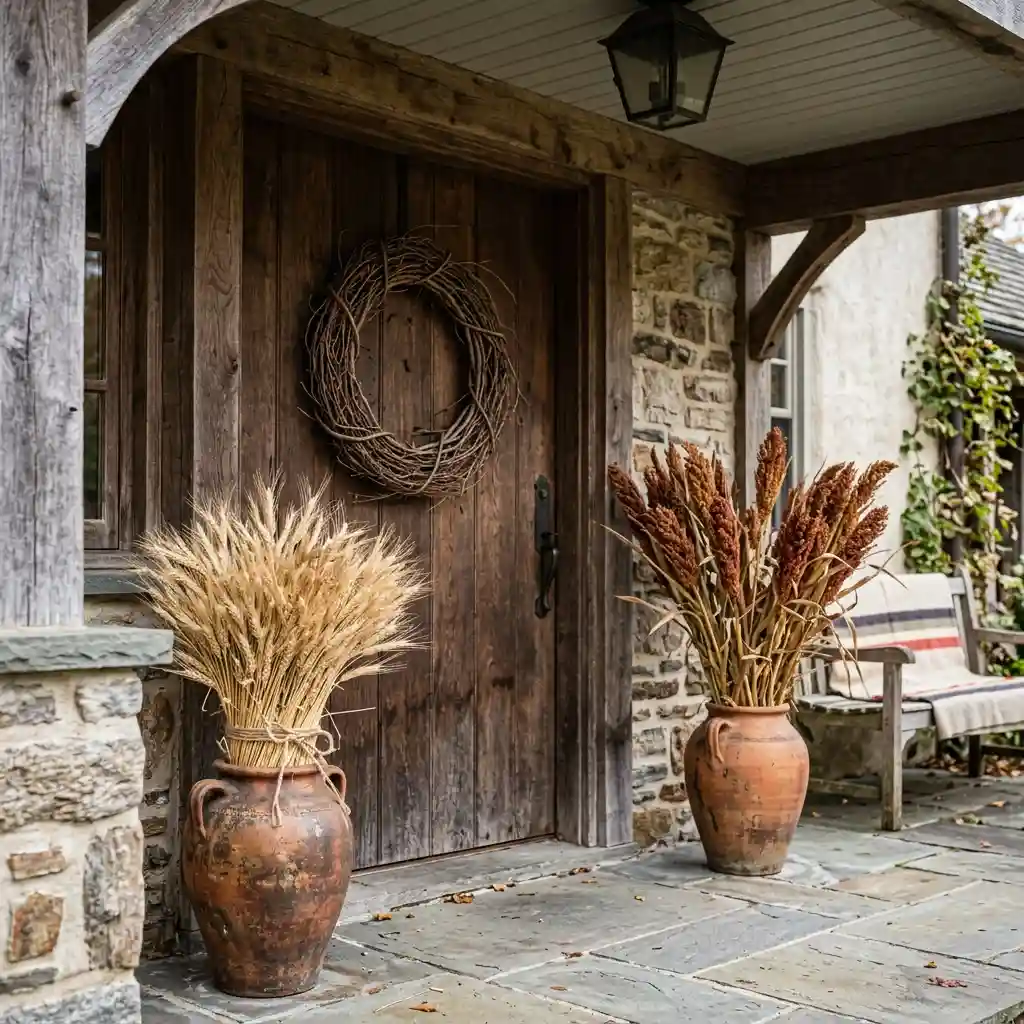
Palette: wheat, bleached bone, and soft olive. Lead material: dried plant matter and nothing else. Anchor pieces are bundled wheat and broom corn in heavy terracotta urns, a bare grapevine wreath left mostly open, and eucalyptus or bay tucked at the door. No faux anything — the look depends on real texture, and the open-base modern wreath styling approach carries straight over with only the palette changed. Material Note: dried wheat and pampas shed badly in wind and driving rain, so this look needs a roof over it or a sheltered recess.
The Dark and Moody Porch
Palette: charcoal, oxblood, and deep olive. Lead material: matte-finish metal and glazed ceramic. Anchor pieces are near-black planters, deep plum or rust mums, a dark dried wreath, and a charcoal outdoor rug. Lighting: aged brass with a low warm bulb, which keeps the depth from tipping into gloom. This look suits a dark or near-black front door and pairs well with grey stone or dark siding. It is autumn-moody, not Halloween — no black cats, no cobwebs.
The Modern Minimal Porch
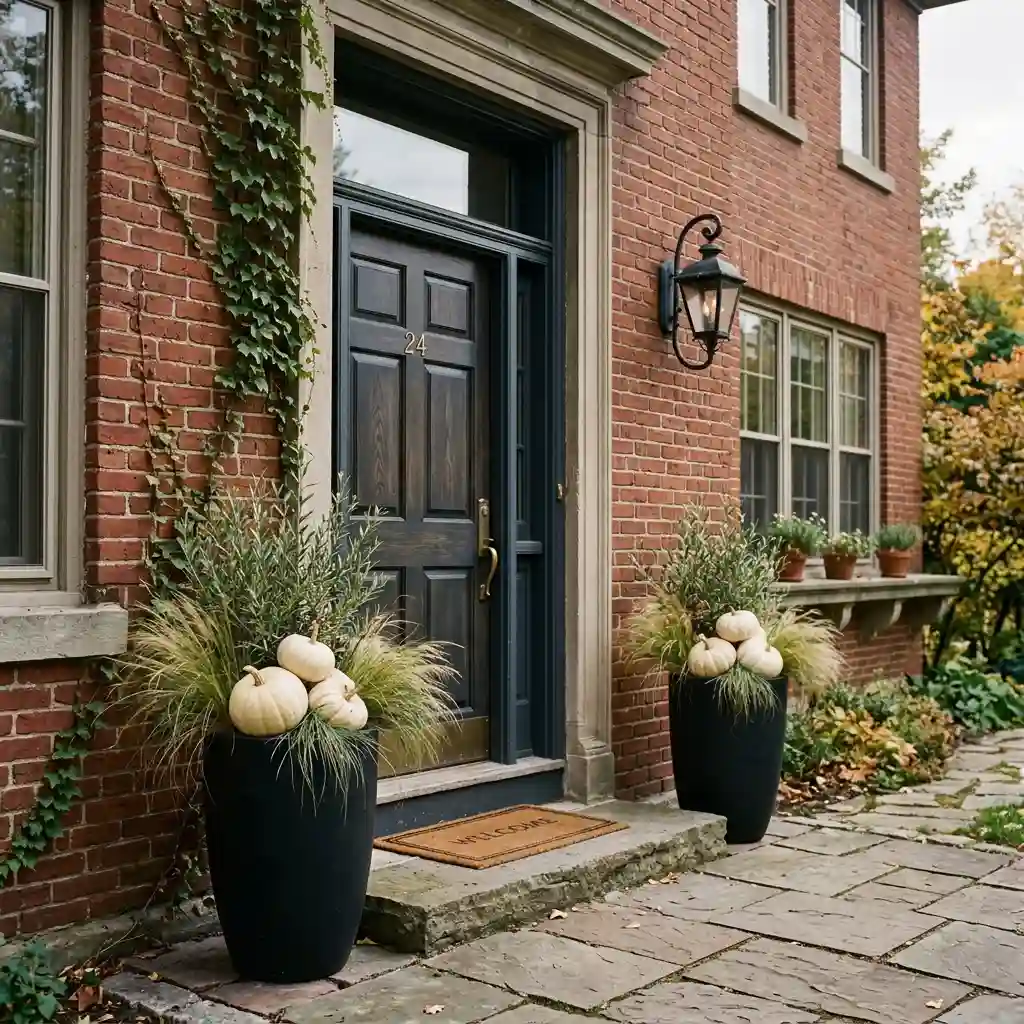
Palette: warm white, concrete grey, and one green. Lead material: smooth matte surfaces. Anchor pieces are a single oversized concrete or fiberstone planter with one grass species in it, a plain charcoal mat cut square to the door, and either one large pumpkin or none at all. Lighting: matte black wall fixture, no lanterns on the floor. This is the strongest choice for a flat-fronted modern house, and it is also the cheapest to maintain because there is so little of it. It pairs naturally with the clean lines in these modern front porch ideas.
How Do You Get to One Look From What You Already Own?
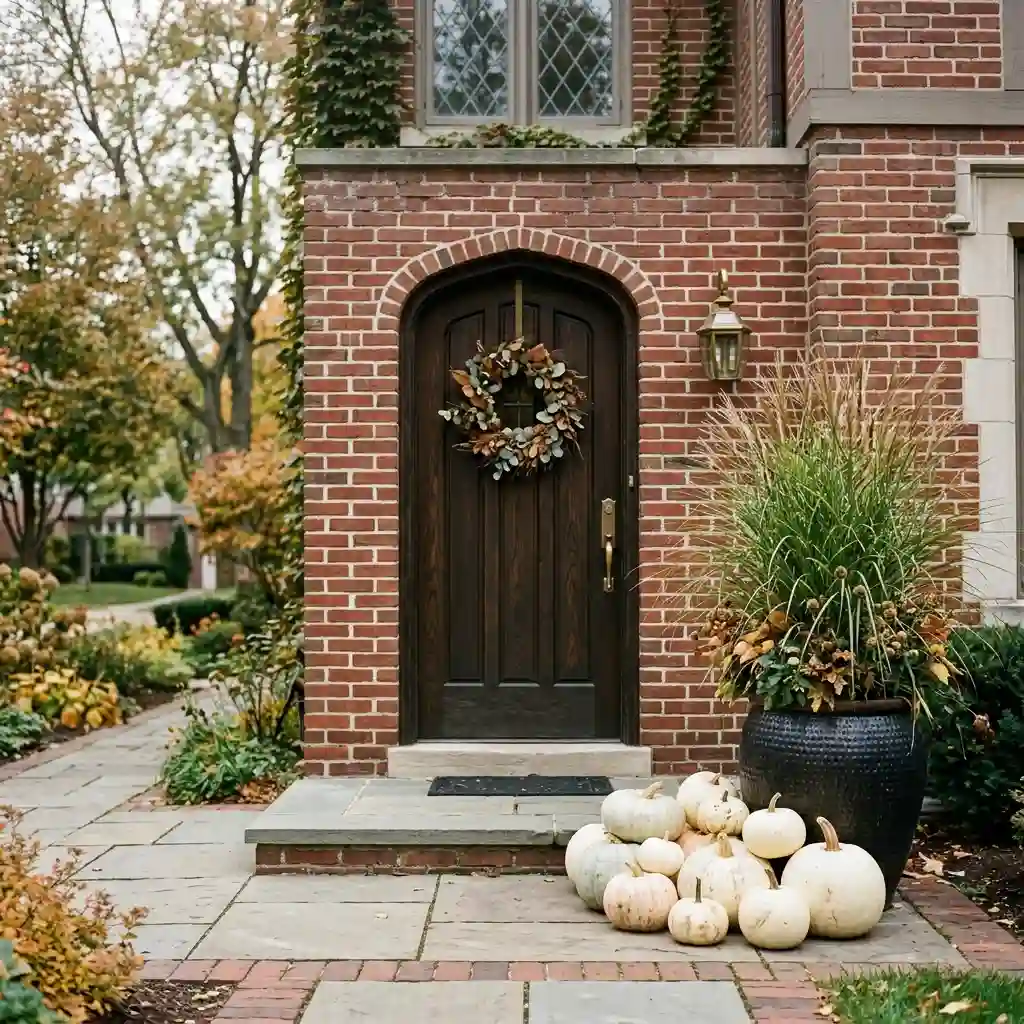
Start by taking everything off the porch and putting it on the lawn. Working from an empty porch is the only reliable way to see what you have, and it costs nothing.
Sort what you own into the five looks above. Most people find one pile is clearly biggest — that is usually the look to commit to, because you already own most of it and your house probably nudged you there. Our fall decorating ideas archive is a useful place to check which pile you are actually drawn to.
Put back only the largest pile, then check the three-tone rule and the one-metal rule against what is standing there. Anything failing both goes to storage rather than the bin, since it may suit next year’s look or another season.
Buy the single missing piece last. Nine times out of ten it is the item that repeats a color a second time — a pillow, a second planter, a doormat with the right border — not a new statement object.
DESIGNER TIP: shop your own back garden and side beds before a store. Cut hydrangea heads, seed pods, and branches dry well and cost nothing, and foraged material matches itself automatically.
What Works on a Small Porch or Apartment Landing?
Small entries make the coherence rules easier, not harder. With room for only three or four pieces, one look is almost forced on you — the failure mode on a tiny stoop is trying to fit a bit of every look into a four-foot square.
Use one planter rather than a matched pair, keep the palette to two tones instead of three, and hang the wreath so the floor stays clear. The modern minimal and dried foraged looks both scale down well because neither needs volume to work.
Rental Note: over-the-door wreath hooks and freestanding weighted planters cover a shared landing without a single screw into siding or a fire door. The same constraint thinking runs through these balcony ideas for apartment spaces if your outdoor space is a ledge.
Fall Porch Look Checklist
- Name your look in three words before buying anything else this season.
- Count your tones — if there are more than three on the porch, remove the least-repeated one.
- Check that every color appears at least twice across separate objects.
- Confirm one material family covers roughly two-thirds of what is out there.
- Match every metal finish on the porch, including house numbers and hardware.
- Put all porch bulbs at the same warmth and check the fixture rating matches your exposure.
- Store the pieces that do not fit rather than discarding them.
KEY TAKEAWAY: A porch looks styled when every piece belongs to the same look, and no amount of extra decorating fixes a porch that holds three looks at once.
Where a Fall Porch Loses the Plot
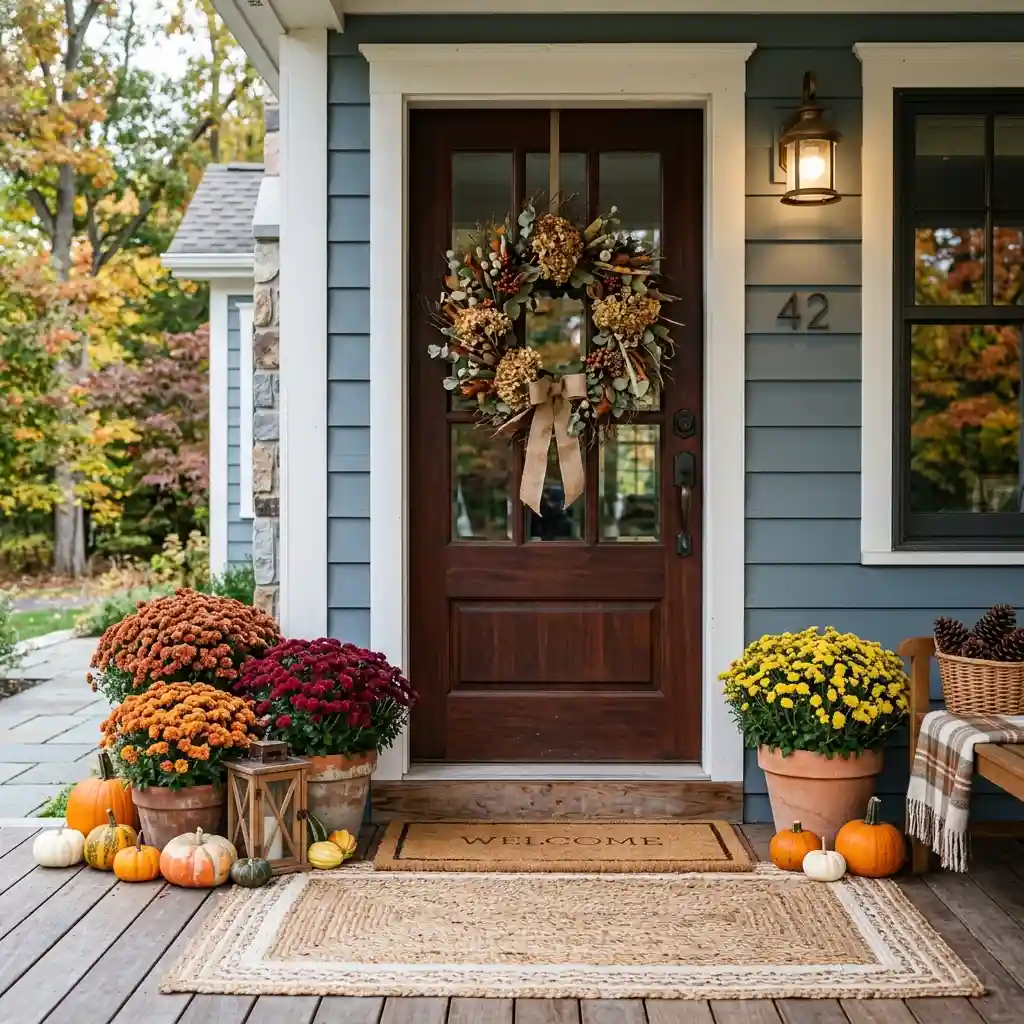
Instead of adding one more piece to a porch that feels unfinished, Try the lawn test — a porch that has quietly collected three looks over four seasons gets worse with every addition, not better.
Instead of buying the seasonal piece you fell for and finding a home for it, Try choosing the look first and shopping to it. A bleached pampas bundle is lovely and belongs to exactly one of the five looks; on a farmhouse-harvest porch it sits there looking slightly wrong all autumn.
Instead of letting the finishes land where they land, Try matching outward from the door hardware you already have. A black lantern, a brass knocker, and galvanized buckets is three competing metals on a surface smaller than most bathrooms.
Instead of matching the porch to your living room, Try matching it to the exterior it touches. Interior palettes are chosen under warm lamplight against painted walls, and the same tones go flat outside against brick, siding, and grey autumn daylight.
What Does One Coherent Look Cost?
Committing to a single look is usually cheaper than the mixed alternative, because the money goes into fewer, larger pieces and the fillers get reused. A budget version at roughly $100 covers one large planter, dried filler, and a doormat in the right palette. A mid-range porch near $250 adds the matched second planter and an outdoor rug. A premium version above $500 brings in glazed ceramic planters and a fixed light in the chosen metal, both of which outlast the season by years.
| Project | Estimated Cost | Impact Level |
|---|---|---|
| One large planter plus dried filler in your palette | $45-$110 | High |
| Second matching planter and an outdoor rug | $95-$240 | High |
| Glazed planters plus a fixed light in one metal | $220-$550 | Very High |
Best First Upgrade: The piece that repeats your second color — usually a doormat or a pillow. It costs the least and does the most to make the porch look planned.
Skip for Now: Any statement object bought before the look is chosen. It is the single most common item that ends up in the garage by November.
Planters, rugs, and fixtures all carry into spring, which is why they belong with other outdoor and exterior decor spending rather than in the seasonal column.
The Look I’d Pick for Most Houses
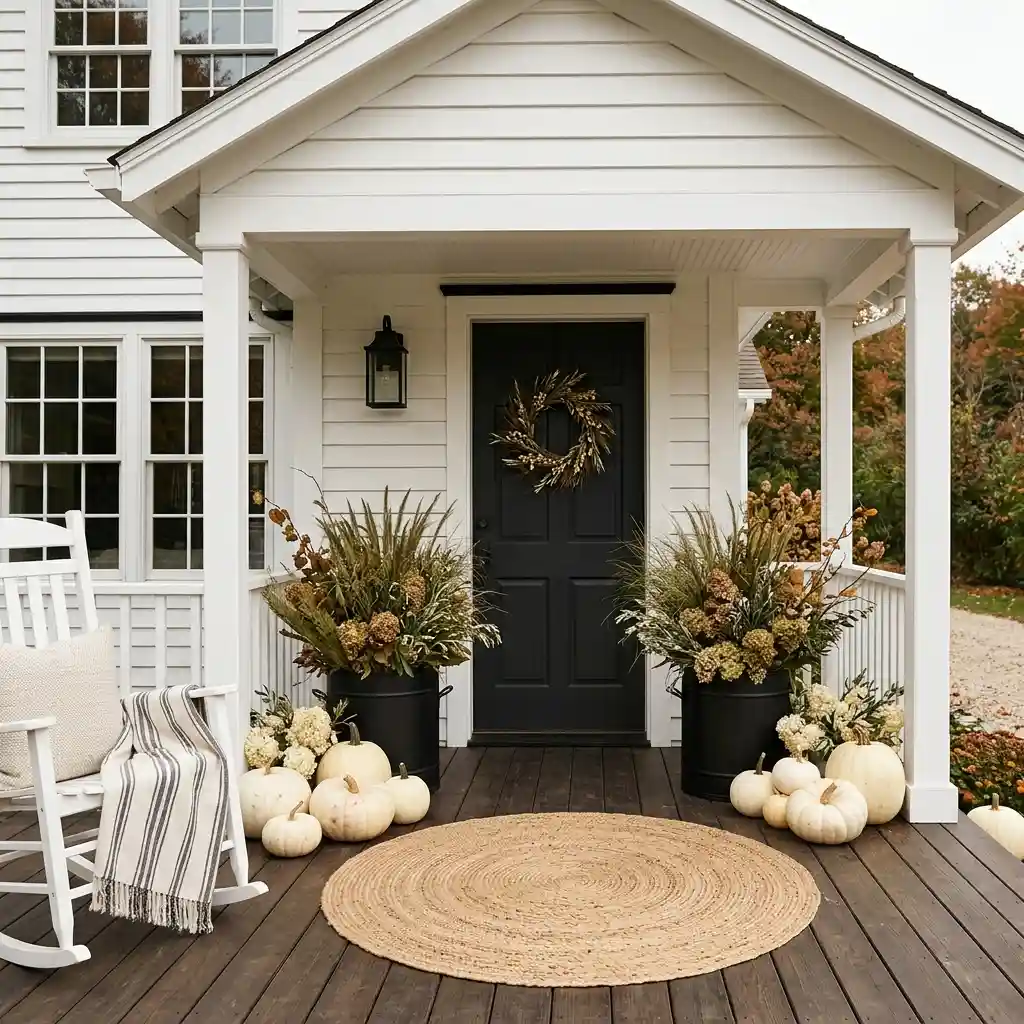
Warm neutral, for three reasons. It sits well against the widest range of siding and brick, it holds from late August to Thanksgiving without looking early or late, and almost every piece in it works again in spring with the filler swapped. Farmhouse harvest is the more fun look, but it dates faster and fights any house that is not white clapboard or red brick.
The same logic carries across the calendar. The palette lifts across these spring front porch decor ideas, while the one-look habit that makes an autumn entry work stays exactly as it is.
Wreath choice deserves its own thinking, since it is the piece everyone meets at eye level. These spring wreath ideas for the front door cover material and proportion in a way that transfers to any season.
Beyond the door, this creative fall and autumn decor guide picks up the rooms behind it, so the entry does not end up as the only styled surface in the house.
Warm neutral in particular travels indoors well. Carrying one shared tone through the door is what links the two, and these fall bedroom refresh ideas use the same cream and olive base.
The rest of the year lives in our seasonal decor collection, where the winter and spring versions of these same five looks already exist.
Frequently Asked Questions
Conclusion
A year from now you will have forgotten which objects were on the porch, but you will remember whether the entry looked settled or scattered — and that comes down to agreement, not spending. Fall porch decor ideas pay off when every piece belongs to one look, which is also why the planters and rugs bought this way keep working through winter and spring. There is more seasonal styling in our home decor inspiration library once the entry is done.
Next Steps
- Clear the porch completely and sort everything you own into the five looks.
- Name the look your house already leans toward in three words.
- Count your tones and remove the color that appears only once.
- Match every metal finish on the porch, including the house numbers.
- Buy one piece last — the one that repeats your second color.