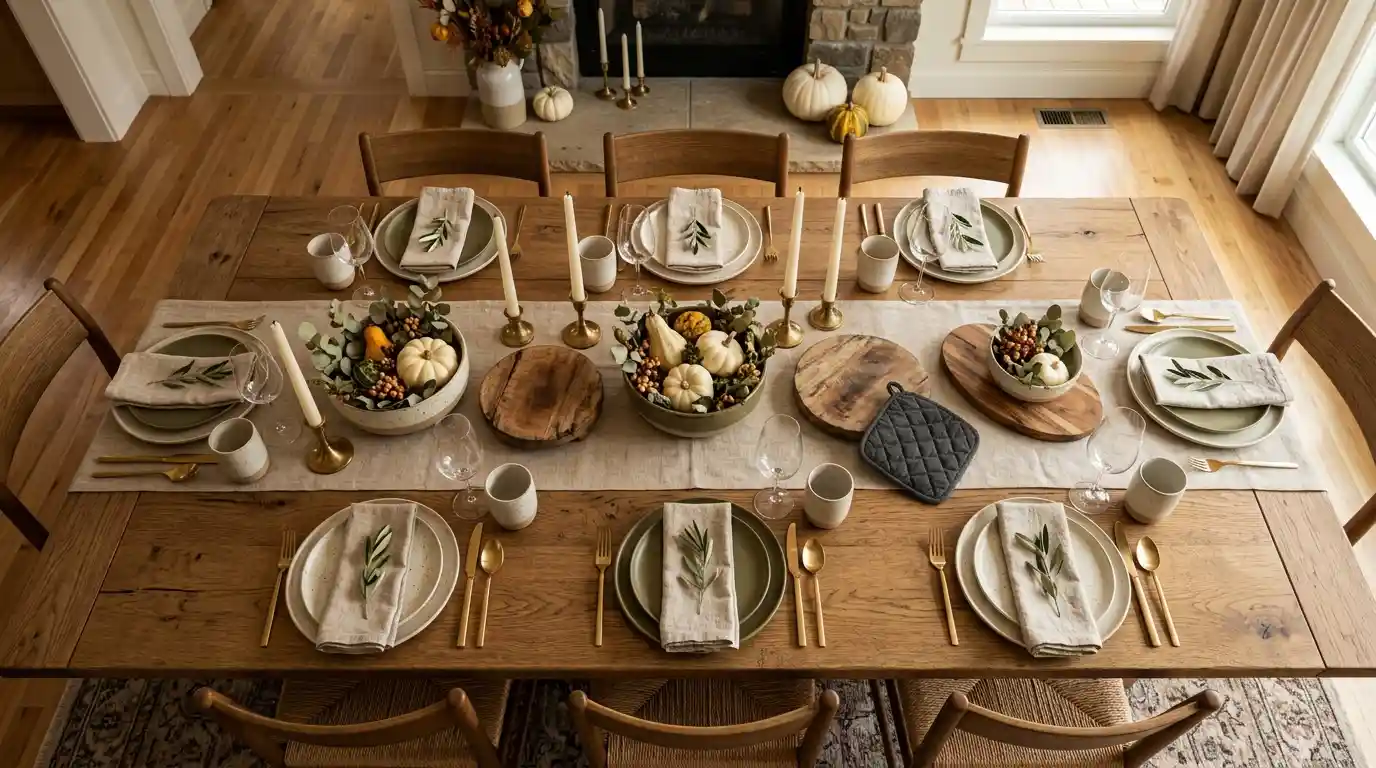
Thanksgiving Is the One Meal Where the Food Comes to the Table
Why does a beautifully decorated Thanksgiving table end up half-dismantled by the time anyone eats?
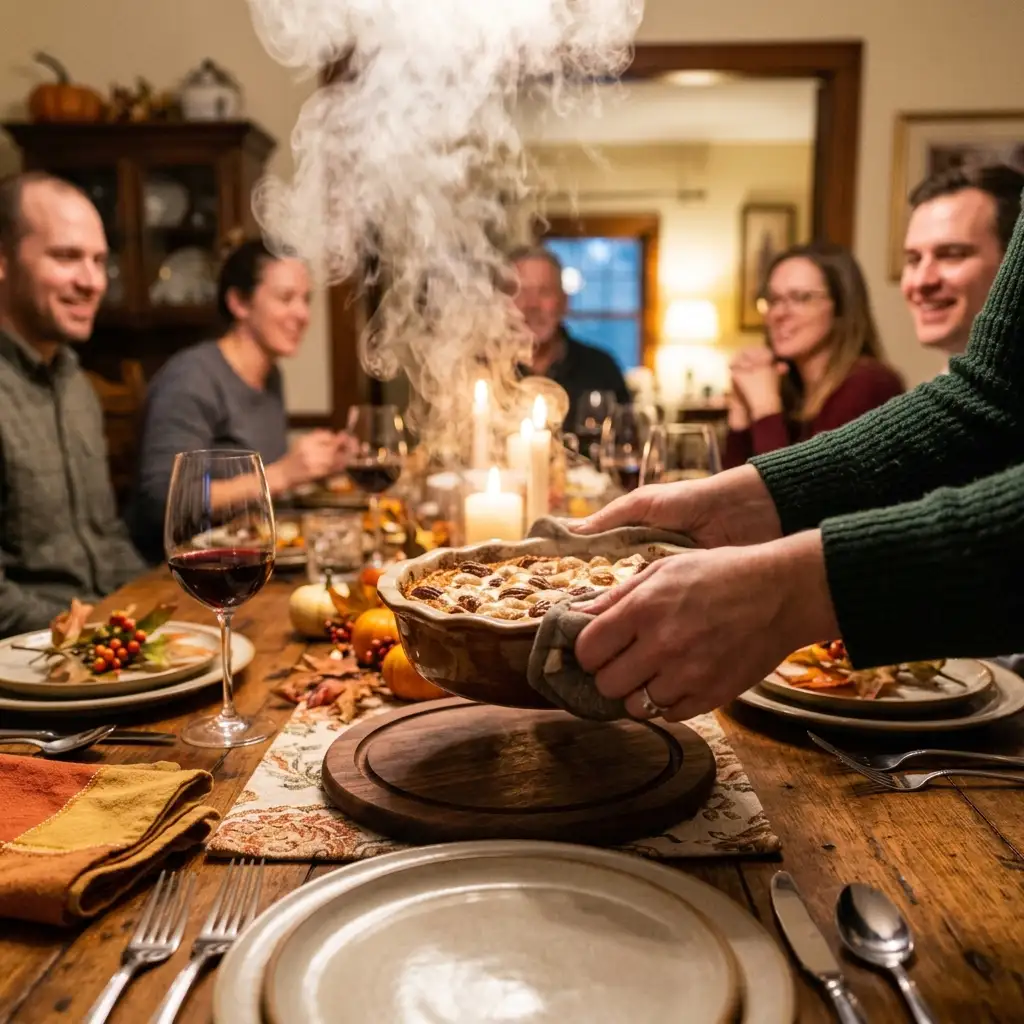
Because on almost every other day of the year, the food arrives on a plate. On Thanksgiving it arrives in dishes — a turkey platter, two or three casseroles, a bowl of green beans, a gravy boat, a basket of rolls. All of that has to land somewhere, and the only somewhere is the middle of the table, which is exactly where the styling went. It is the one hosting problem our home decor inspiration cannot solve with a prettier object.
Looking for more ideas? Explore our full guide to Fall Tablescape Ideas.
Thanksgiving table decor works when it is planned around the serving dishes rather than against them. Place settings claim 16 to 18 inches of depth from each long side of a standard 36-to-40-inch table. That leaves a shared middle strip of about 5 to 9 inches, and the food has first claim on it. Everything you set there should lift with one hand.
Editorial field note: A table styled end to end with dried stems and scattered gourds photographs well at noon. Once the roasting pan comes out, someone sweeps the stems into a pile at one end and the gourds move to a chair. The same table set with two small bowls, a pair of trivets and folded napkins still looks put together when the plates are cleared.
That is a different job from making a table look expensive, and it is worth separating the two. For the wider season, start with these creative fall and autumn decor ideas for a seasonal refresh. Then come back here, because the hosting table has its own rules.
✦ Free for readers
500+ Original Home Decor Images, Yours to Keep.
Curated room by room, high‑resolution and royalty‑free — created in‑house by 101HomeDecor, not stock. No attribution needed.
Free forever · about one email a month
Count the Dishes Before You Count the Decor
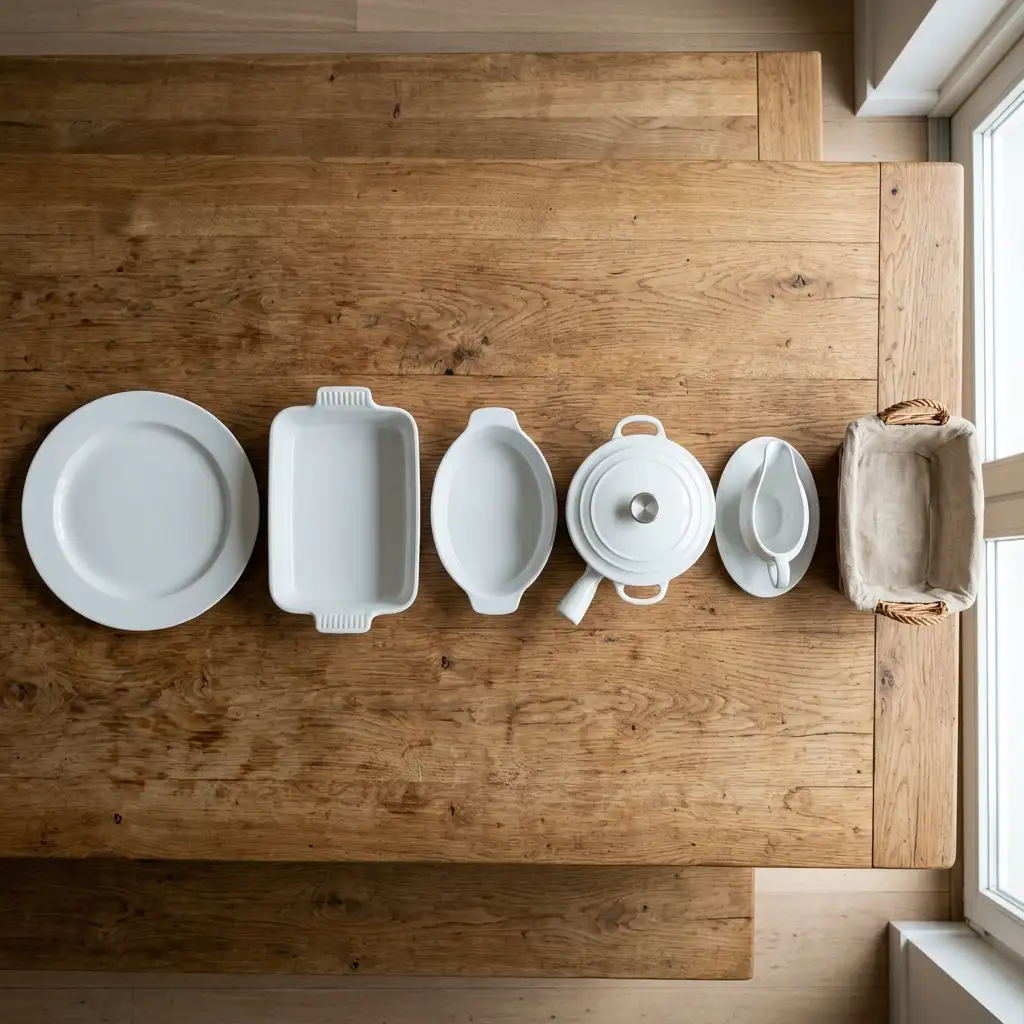
Ten minutes with a tape measure and your actual serving dishes saves the whole afternoon. Do it a week out, while there is still time to change the plan.
- Pull out every dish you plan to serve from and line them up on the table.
- Set one full place setting so you can see how much middle is genuinely free.
- Decide now whether the turkey is carved in the kitchen or at the table.
- Put two trivets in position and leave them there — they are part of the layout.
- Choose decor pieces you can lift with one hand, and count them.
- Keep dried stems and paper napkins a clear hand’s width from any flame.
- Name the one surface where overflow dishes will go when a guest brings something.
KEY TAKEAWAY: If a piece cannot be moved with one hand while your other hand holds a hot casserole, it does not belong in the middle of a Thanksgiving table.
How Much Table Do the Serving Dishes Actually Need?
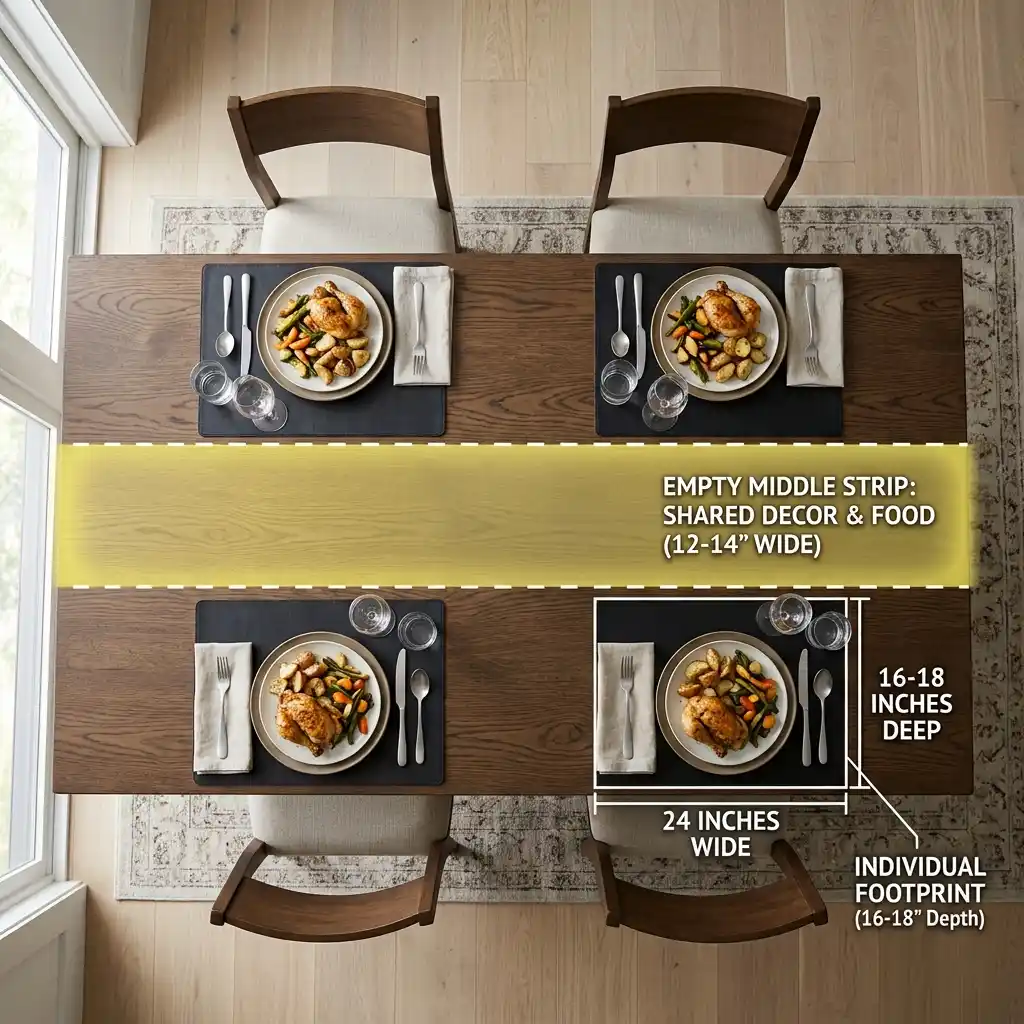
Run the numbers once and the shopping gets much easier. A standard rectangular dining table measures 36 to 40 inches wide. A place setting takes roughly 16 to 18 inches of depth, and two rows of them facing each other eat 32 to 36 inches of that width.
Source Note: Published table setting sizes and dimensions put a minimum setting at 16 inches deep with a 5-inch shared zone, and an optimum setting at 18 inches deep with a 9-inch shared zone.
Now add the food. A turkey platter typically runs about 18 by 13 inches. A standard nine-by-thirteen casserole dish takes roughly 15 by 10 inches once you count the handles. Two of those plus a gravy boat and a bread basket will use most of a six-foot table’s middle on their own.
So the honest answer is that a Thanksgiving table has almost no free styling surface. What it has is the space between dishes. Narrow, low, repeating objects fit there. One large centerpiece does not, and a full-length garland laid down the middle definitely does not. If you are still choosing furniture for a room you host in often, leg placement matters more than finish — these mid century modern dining tables show how the base decides who actually fits.
Family Style, Buffet or Plated Decides Everything
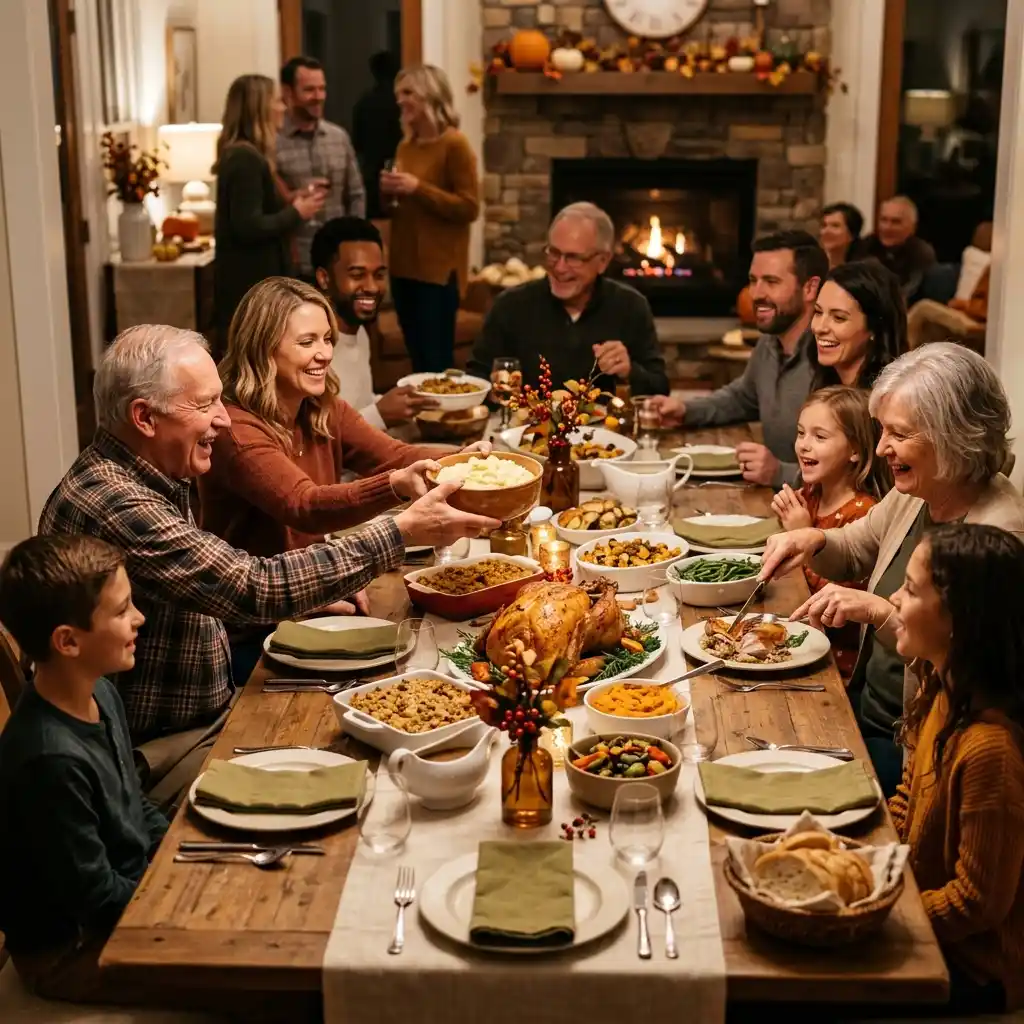
This is the fork in the road, and most table guides skip it entirely. How you serve changes how much you can decorate by a factor of three.
Family style puts every dish on the table and passes them. It is the traditional version and the most demanding one. Assume four to six dishes live on the table for the whole meal, leave two clear landing zones, and keep decor to two or three small pieces plus the napkins.
Buffet style plates everyone at a sideboard, a kitchen island or a separate table. The dining table then holds only plates, glasses and napkins — which frees the entire middle. This is the version where a proper run of bowls, candles and small pumpkins actually survives the meal. If you have a hallway console or a kitchen island, use it.
Plated service sits between the two. Food comes out already on the plate, but seconds still need somewhere to land, so keep one clear zone at the end of the table.
Decide this before you shop. A host planning family style who buys buffet-style decor spends the afternoon moving it.
Decor That Has an Exit
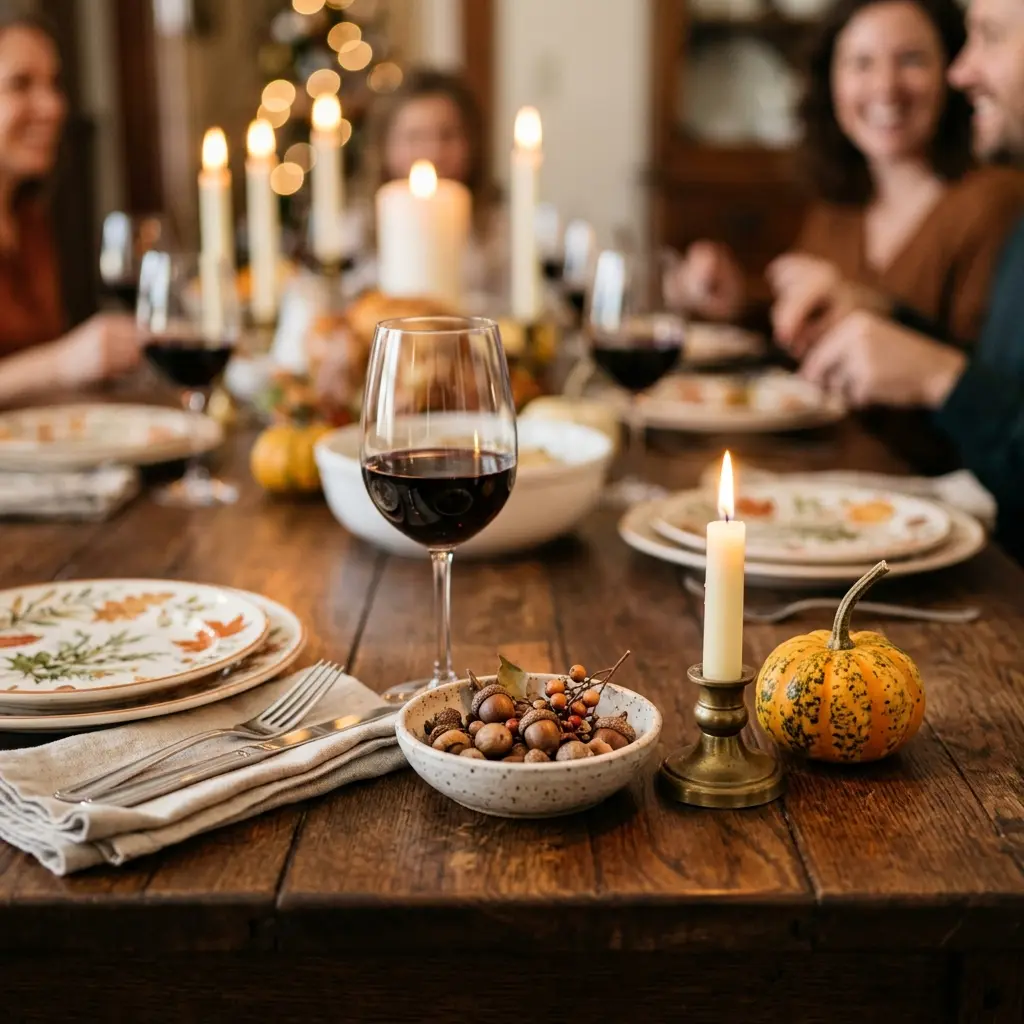
Here is the idea that makes the whole thing work: on Thanksgiving, some of your styling is meant to come off the table partway through the meal. Design for that from the start and nothing feels disrupted when it happens.
Four things earn a place in the middle under that rule. Each one either moves easily, does a job during the meal, or is deliberately not there at all.
Separate Pieces, Not One Long Arrangement
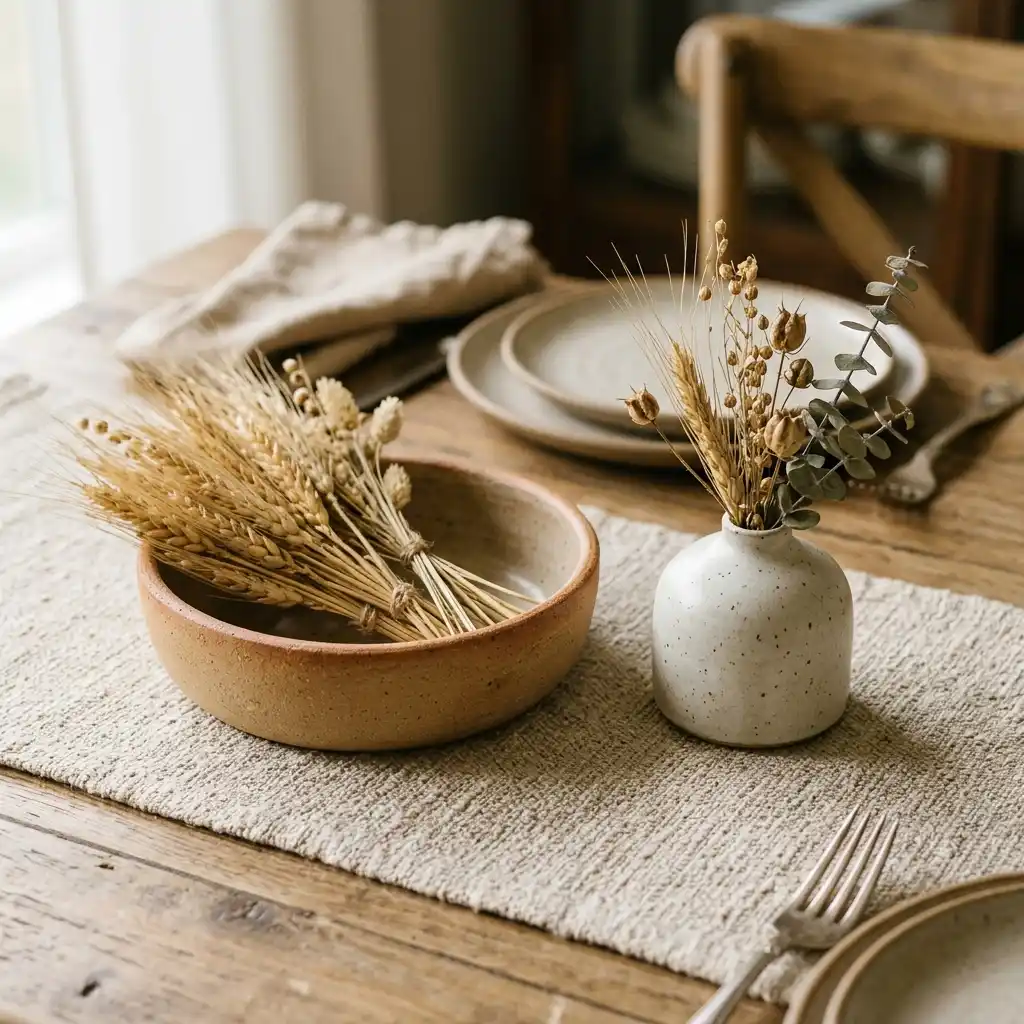
On an ordinary autumn table, grouping everything onto one runner or long tray works well — it gives the whole display a handle and stops it drifting. On Thanksgiving that same tray occupies the exact strip the turkey platter needs, and it can only go one place: off the table entirely.
Break it into separate pieces instead. A shallow stoneware bowl about 6 inches across, a small footed compote, a squat vase — each under 6 inches tall and 8 inches wide, spaced well apart down the table. When the food arrives you relocate one bowl, not the whole display, and the rest of the setting stays where it is.
Material Note: A vessel filled with water and stems can weigh several pounds and needs two hands and a spare surface. Dry fills — wheat, small pears, figs, a few nuts — keep every piece light enough to shift with your free hand.
Trivets That Count as Decor
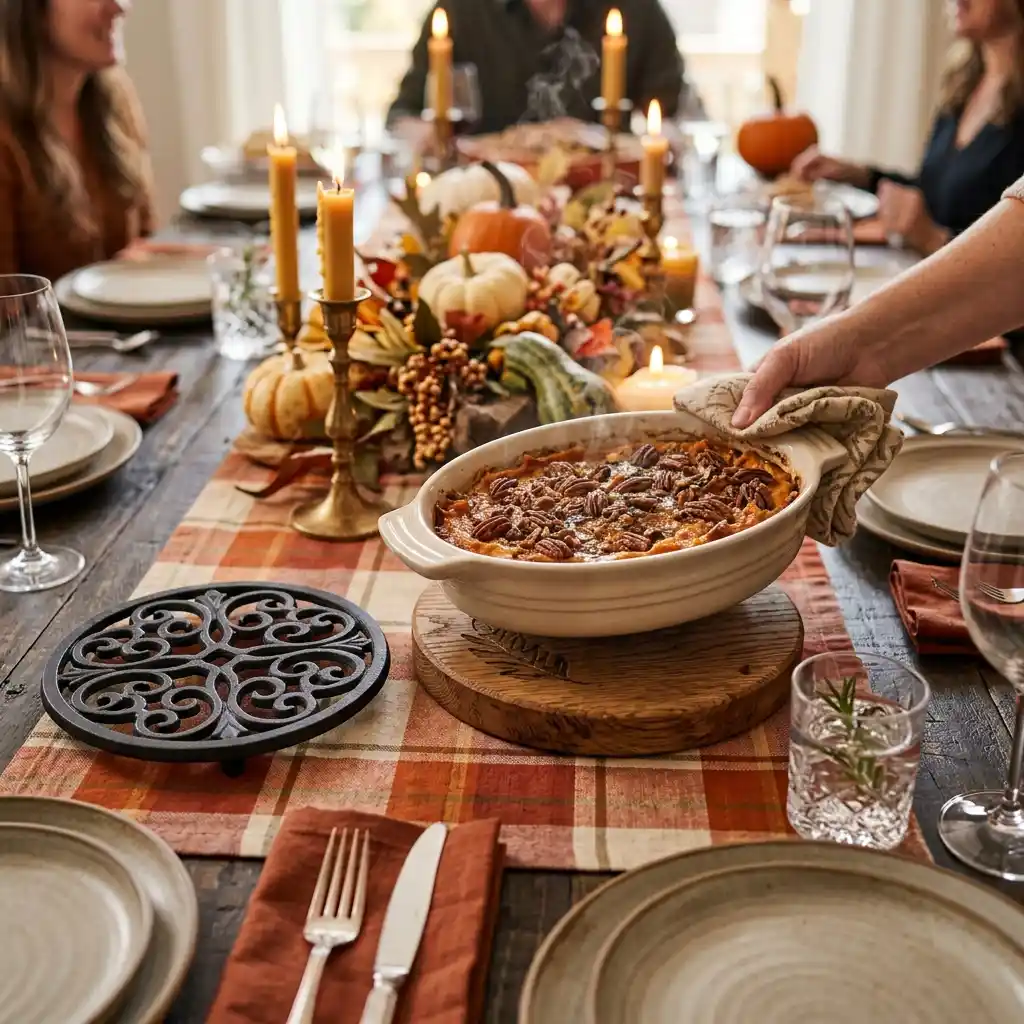
Nobody plans trivets, and every host needs them. A casserole out of a 350-degree oven will mark a bare wood table and scorch a thin runner. Most people discover this at the moment the dish is already in their hands.
Buy trivets you would happily leave on the table all afternoon. Thick oak or walnut rounds, cast iron in matte black, unglazed stoneware or a coiled jute mat all read as part of the setting rather than as kitchen equipment. Two large ones and two small ones covers a typical spread.
Set them before the guests arrive, in the positions the dishes will actually land. A trivet already in place tells everyone where the food is going, which stops the shuffle of moving decor mid-meal. It is the single most useful thing on this list and the cheapest.
Candles That Last the Whole Sit
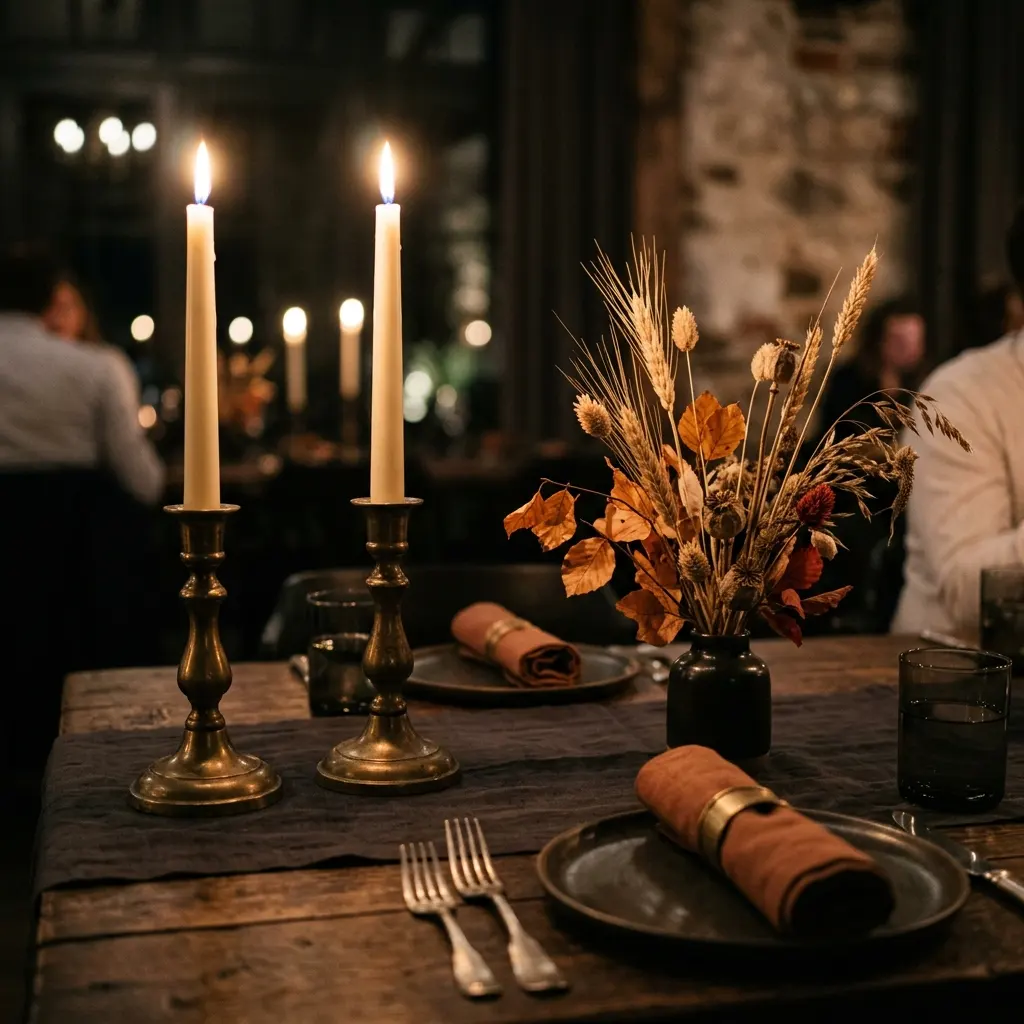
Weight matters more than height here. A Thanksgiving table gets reached across constantly — for the gravy, for the rolls, for the salt — and a light candlestick tips the first time a sleeve catches it. Choose weighted brass, cast iron or thick ceramic holders that stay put when knocked.
Then plan the swap. Dinner often runs three hours or more, and a short taper will not make it to dessert. Keep a spare pair in the sideboard drawer and change them while the plates are being cleared, rather than eating the second half of the meal under a dying flame.
Safety Note: The U.S. Fire Administration’s candle fire safety guidance is to keep a burning candle at least 12 inches from anything that can catch, and most home candle fires start when something flammable was left too close. Dried wheat, rolls in a napkin-lined basket and loose paper all count. Never leave the table lit and unattended, and put them out before the room empties.
A Landing Zone You Keep Clear for the Food
The most useful part of a Thanksgiving table is the part with nothing on it. Pick two spots — usually near the middle of each long half — and keep them clear from the moment you start setting.
An empty zone looks unfinished while you are styling and looks planned the moment the first dish arrives. It also stops the pile-up at one end that happens when guests have nowhere obvious to set down what they are carrying.
If the emptiness bothers you, mark each zone with a trivet rather than leaving it blank. That looks chosen instead of forgotten, and it still does its job.
Push the Styling Out to the Seats and the Chairs
Everything the middle cannot hold moves outward. This is where a hosting table starts to look considered without ever getting in the way of a serving spoon.
Cloth napkins do the most work for the least money. A folded linen napkin in warm cream, rust or olive at every place spreads color across the whole table for less than one large arrangement costs. Add an aged brass ring, or tie jute twine with a single bay leaf tucked under it.
Place cards are worth ten minutes even for family. They end the doorway shuffle, they seat the people who talk away from the people who argue, and they give each setting a small piece of styling. Kraft card or a thin slice of dried orange both work.
Chair backs are the last unused surface in the room. A short length of dried wheat or a eucalyptus sprig tied to the two end chairs frames the table and touches nothing anyone eats from. The same warm-neutral palette runs through the rest of our fall decorating ideas, so the dining room does not sit apart from the house.
When the Leaf Goes In and the Guest Count Climbs
An extension leaf adds 12 to 18 inches of length and no width at all. That is the detail people miss. The table now seats two more, carries two more dishes, and the middle strip is exactly as narrow as it was before.
Re-space the decor when the leaf goes in rather than leaving the original arrangement clustered at the old centre. Two bowls that looked right on a 60-inch table read as a lonely knot on a 78-inch one. Add a third piece, or spread the two further apart and let the gap between them become a landing zone.
A second table beats an overcrowded first one. Style it as a matched pair — same napkins, one low bowl, one candle. Mismatched chairs are fine and always have been; mismatched napkins are what makes a second table look like an afterthought.
For a small apartment table, run the whole meal buffet-style and let the seats carry the styling. The approach is closer to a brunch table than a banquet, which is the same logic behind these spring tablescape ideas for a seasonal brunch.
The Reset Between Dinner and Pie
The meal has two halves and most hosts only plan the first one. Around four o’clock the serving dishes leave and the table goes back to being mostly empty.
That is when your decor earns its keep. Slide the two bowls back toward the middle, swap or relight the tapers, clear the trivets, and the table looks set again in under a minute — because every piece moves in one hand.
Six Ways a Thanksgiving Table Falls Apart
These are logistics failures, not taste failures. Every one of them shows up between two and four in the afternoon.
- The turkey platter has no home. It is the largest object of the day at roughly 18 by 13 inches, and it arrives hot in someone’s hands. Decide its exact spot while you are still styling, and put a trivet there.
- Hot dishes land on a bare wood table. A casserole straight from the oven leaves a pale heat ring in a finish, and a thin cotton runner scorches. Set real trivets before guests arrive rather than hunting for a folded tea towel mid-meal.
- Decor takes two hands to move. A water-filled vase, a heavy urn, a loose scatter of leaves — each needs a free hand and a spare surface at the moment neither exists.
- The leaf goes in and nothing gets re-spaced. Two bowls sized for a 60-inch table look stranded on a 78-inch one, and the new length gets used for nothing. Spread the pieces out or add a third when the table grows.
- The candles get lit too early. Guests arrive at one, the tapers go on straight away, and by the time anyone sits down at three the best of them is gone. Light them as people take their seats, not as they take their coats off.
- The second table is treated as leftovers. Different napkins, no candle, no bowl — and everyone seated there knows it. Matching the napkins alone fixes most of it for the price of one extra set.
The Table Budget, Borrowed to Bought
Table styling is the cheapest seasonal decorating there is, because most of it is textiles and hardware that reappears every year.
| Project | Estimated Cost | Impact Level |
|---|---|---|
| Cotton or linen napkins, set of eight | $20-$45 | High |
| Four trivets in oak, cast iron or unglazed stoneware | $30-$75 | Very High |
| Two small stoneware bowls plus dried wheat | $40-$95 | Medium |
| Tall tapers and two weighted brass holders | $50-$130 | High |
At the budget end, cloth napkins plus two wooden trivets under $60 change the table more than anything else at that price. Mid-range, add two stoneware bowls and dried stems for around $80. At the premium end, weighted brass candlesticks and long tapers run past $120 and last a decade of hosting.
Best First Upgrade: Trivets you would leave on the table. They protect the surface, mark the landing zones, and cost less than a single floral arrangement.
Skip for Now: The tall centerpiece. It is the most expensive thing on most Thanksgiving tables and the first thing to get carried to the sideboard. Our wider seasonal decorating ideas have better places to put that money.
After the Plates Land, What Actually Held Up
Designer’s Verdict: Trivets, cloth napkins and two small bowls win, because that combination is the only one that still looks set after the serving dishes have been on the table for two hours.
The big centerpiece is not wrong. It is just built for a surface with no other job. Put it on a sideboard, a console or a hall table where nothing has to share the space, and the same arrangement earns its money for three weeks instead of one afternoon.
Related Table and Seasonal Ideas:
- 15 winter tablescape ideas that make your home feel extra cozy
- 11 winter centerpieces for table arrangements that last all season
- 15 stunning Christmas table settings for the next holiday you host
- 12 romantic natural Valentine’s Day table settings for a cozy dinner
- 12 fall bedroom refresh ideas for a cozy, layered seasonal look
- 15 cozy winter decor ideas to keep your home warm and stylish
- more table and furniture styling ideas
Frequently Asked Questions
Conclusion
The centerpiece was never really the problem — the meal was. Good Thanksgiving table decor is planned around the dishes that will arrive on it, which means low pieces that move in one hand, trivets set early, and the real decorating pushed out to the napkins and chair backs. Set it that way once and you will set it faster every November, using more of what you already own and less of what our home decorating ideas tempt you to buy.