Every Fall Table Guide Is About the Dining Table
Almost every autumn table guide is really a dining table guide — centerpiece height, runner length, where the serving dishes land. All of it useful, and none of it written for the low table sitting in front of your sofa. That table is in your eyeline every evening from September to December, and it gets styled with leftovers.
Fall table decor splits into two jobs, not one. A dining table is looked across at seated eye level and cleared for dinner most nights, so height and liftability decide everything. A coffee table sits roughly a foot lower, gets looked down on from the sofa, and never gets cleared at all — so the top face of every object and the empty space around it do the work instead.
Looking for more ideas? Explore our full guide to Fall Tablescape Ideas.
Editorial field note: a low table styled by someone standing over it almost always disappoints from the sofa. Objects that looked balanced from above flatten into one line at seated height, and a single flat stem laid on the wood vanishes into the grain completely.
If you are still working out which surfaces earn the effort, this seasonal guide to fall and autumn decorating takes the wider view. The coffee table usually earns it easily. It is the surface you spend the most hours looking at, and it costs less to dress than any other one in the house. Our home decor and styling ideas cover the year-round arrangement underneath the seasonal layer.
✦ Free for readers
500+ Original Home Decor Images, Yours to Keep.
Curated room by room, high‑resolution and royalty‑free — created in‑house by 101HomeDecor, not stock. No attribution needed.
Free forever · about one email a month
Run This Before You Style the Low Table
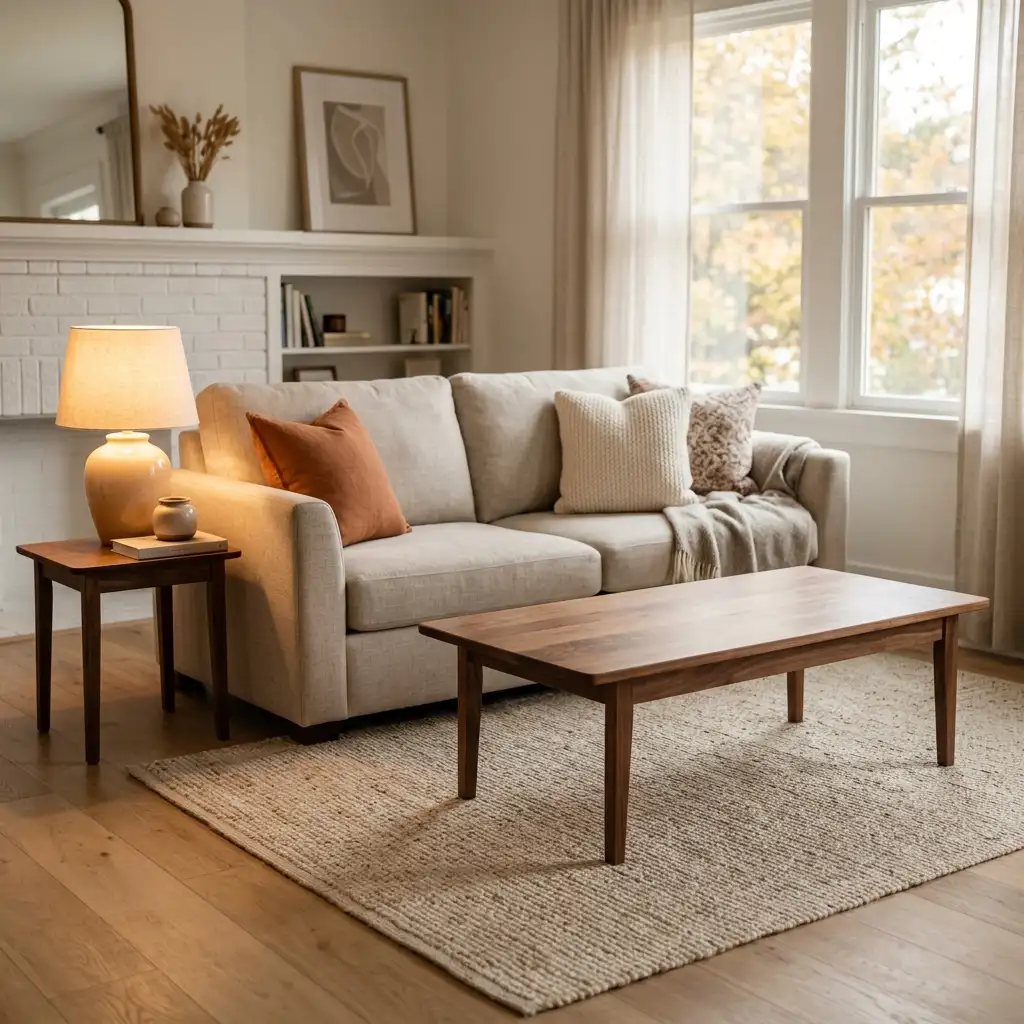
Eight checks, all of them from the sofa rather than standing over the table. None needs a shop.
- Clear the coffee table to bare wood and leave it empty for a day before deciding anything.
- Sit in your usual seat and note which edge of the table your hand reaches without leaning.
- Keep that edge bare permanently — it is the landing zone for a mug, a book and a remote.
- Group everything seasonal on the far side or the opposite corner, not down the middle.
- Lift one object on two hardcover books and check whether it separates from the tabletop.
- Swap anything that sheds seeds, husks or dried petals for something that stays intact.
- Replace open flame with a battery pillar if the table is used every evening.
- Look at the group from the doorway as well as the sofa — a low table is seen from both.
KEY TAKEAWAY: A dining table is a working surface that clears every night, and a coffee table is a permanent one that never does — which is why the same autumn pieces succeed on one and quietly fail on the other.
The Coffee Table Is the Autumn Surface Nobody Styles
Autumn styling has spread out of the dining room over the last few seasons. Hosting happens a handful of times each fall; the sofa happens every night. The low table in front of it has quietly become the surface people photograph most and plan for least.
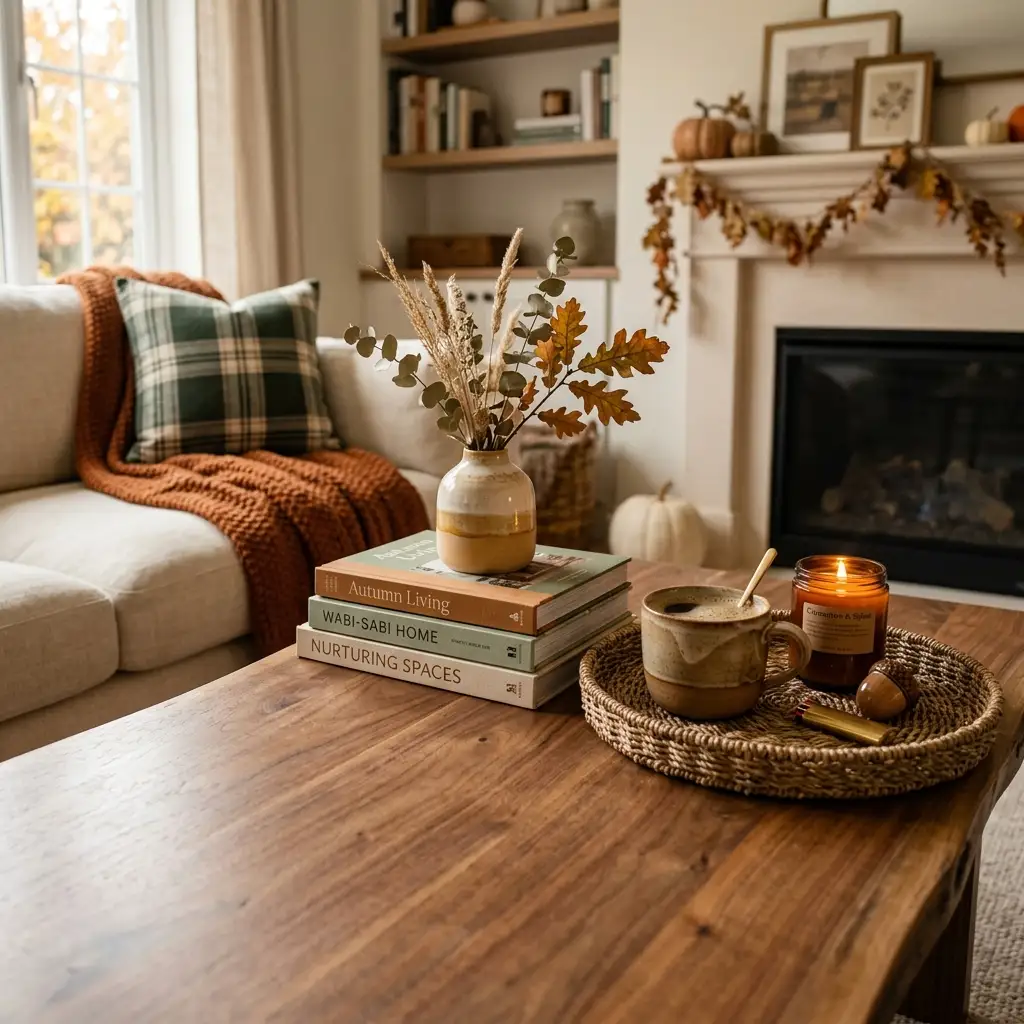
Signs This Is Catching On:
Autumn ranges now carry low trays, footed bowls and stacking boards sized for a coffee table rather than only long runners built for a dining table.
Catalog styling has shifted toward objects photographed from directly above, which only makes sense for a surface people look down on.
Reusable bases — a wooden tray, a stoneware bowl, a pile of hardcover books — have replaced seasonal filler as the part worth spending on.
None of that is dramatic, which is why it holds. The same quiet shift runs through our fall decorating ideas: the pieces that survive the season are the ones you never had to work around.
What Makes Two Tables in One House Play by Opposite Rules?
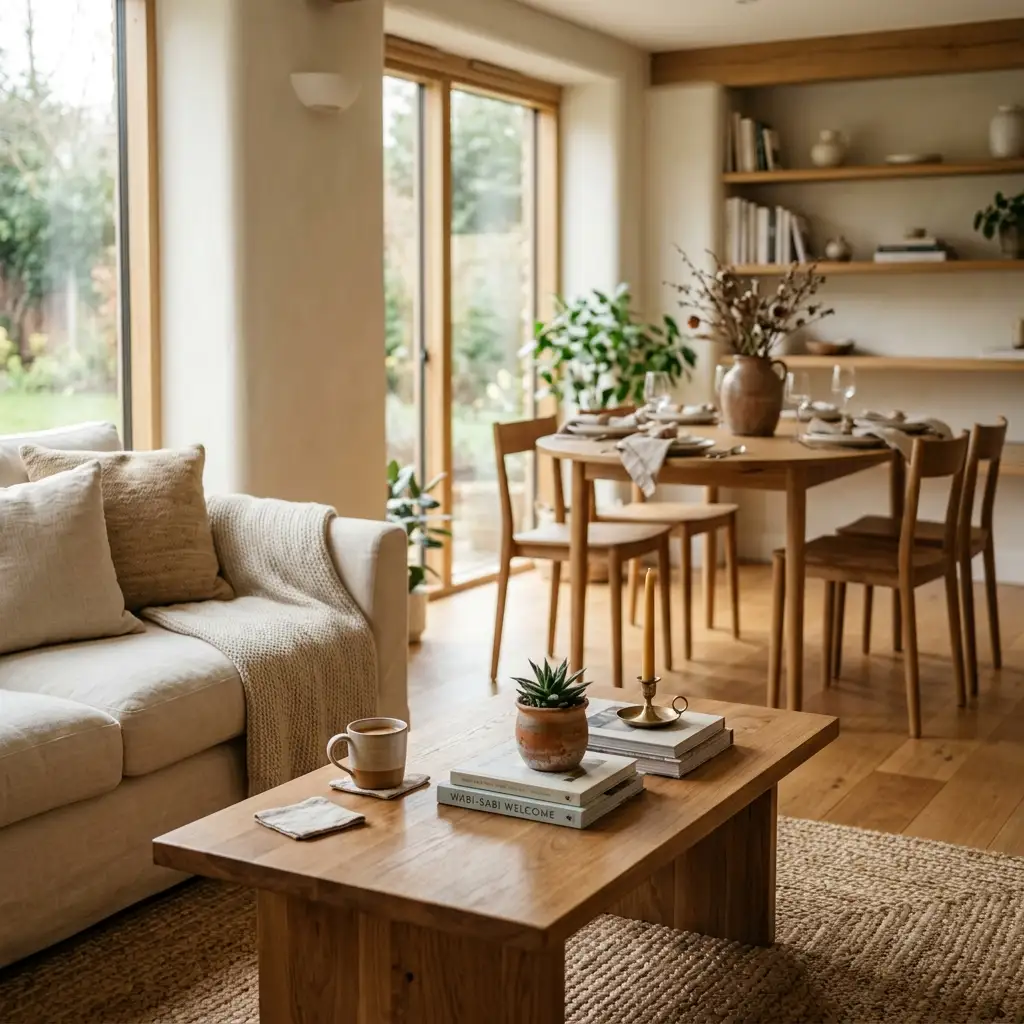
Two things separate them, and both are physical rather than a matter of taste. One table clears and the other does not. One is met across the surface and the other from above. Every practical difference in what you put on them follows from those two facts, which is why advice written for one so rarely transfers to the other. The same logic decides which surfaces carry the season in these fall bedroom refresh ideas, where the bed does most of the work and the shelves do almost none.
One Clears Every Night, the Other Never Does

A dining table empties for dinner, so fragile things survive on it — they leave before the plates arrive. A coffee table has no such moment. Whatever you set down stays there while mugs, remotes, laptops and feet arrive around it for the next eight weeks, and nobody sweeps underneath it either.
That single difference decides most of the buying. A loose dried arrangement is fine on a dining table because it goes back to the sideboard nightly; on a low table it drops seed heads onto the rug until December. Permanence, not season, is the filter here.
DESIGNER TIP: Buy the low table’s autumn pieces as if you were choosing something to live there year-round, then change only the filler. A glazed bowl works in October and in March. A printed pumpkin plate works for six weeks.
You Look Across a Dining Table and Down at a Coffee Table
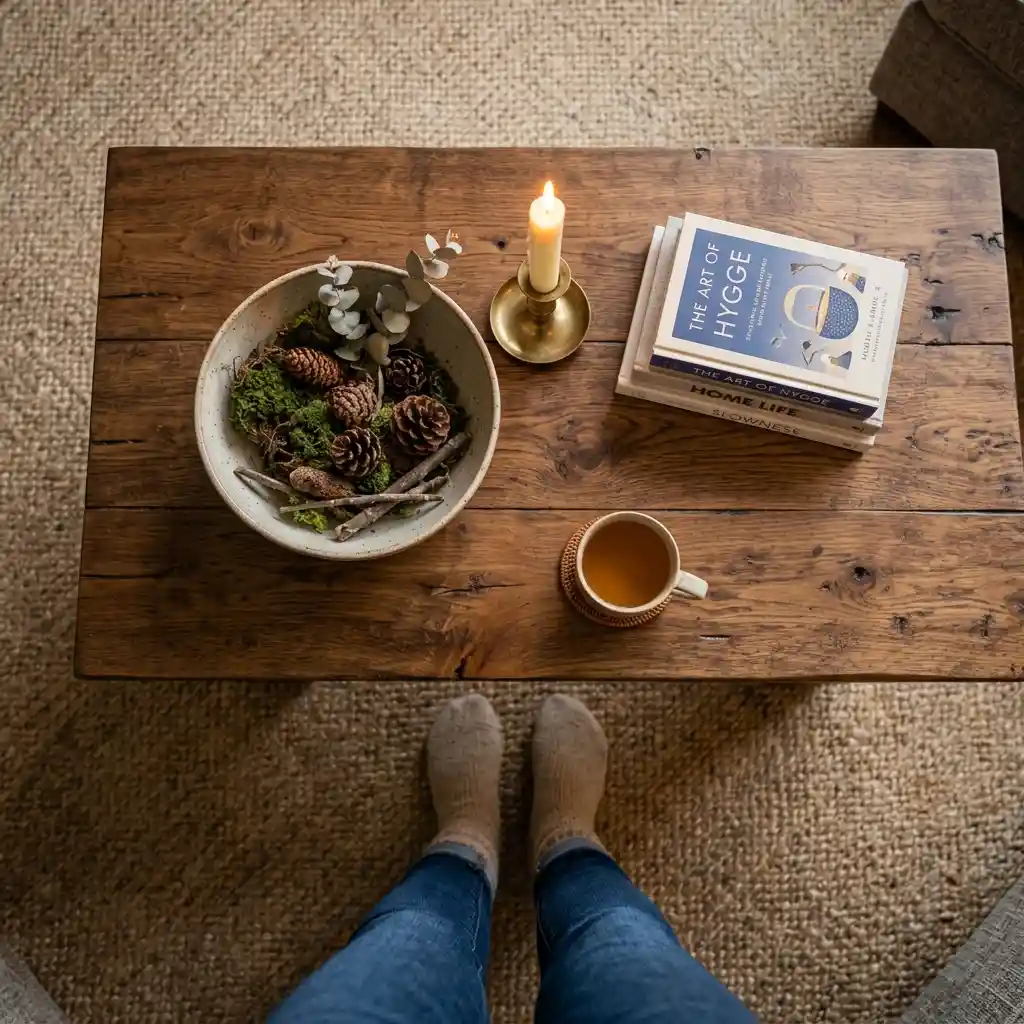
The height gap between the two tables is bigger than it looks. Furniture maker Castlery notes that the standard height for most dining tables falls within 28 to 30 inches, while a coffee table sits between 16 and 18 inches from the floor, roughly 1 to 2 inches below your sofa seat cushions. Sit down at each and you meet them from completely different angles.
At a dining table your eye sits well above the surface and level with the person opposite, so anything tall blocks a face. The Emily Post Institute’s Thanksgiving table setting guidance puts it plainly: whatever centerpiece you choose, “be sure that guests can see each other,” because blocking the view “limits conversation and can create a more divided feel at the table.”
At a coffee table there is no face to block. Your eye sits roughly two feet above the top and you look down at a shallow angle, so height stops being the constraint and the top surface of every object becomes it. That is the whole reason centerpiece rules do not transfer — sizing a dining arrangement is its own job, with its own numbers.
What Actually Works on a Low Table in Autumn?
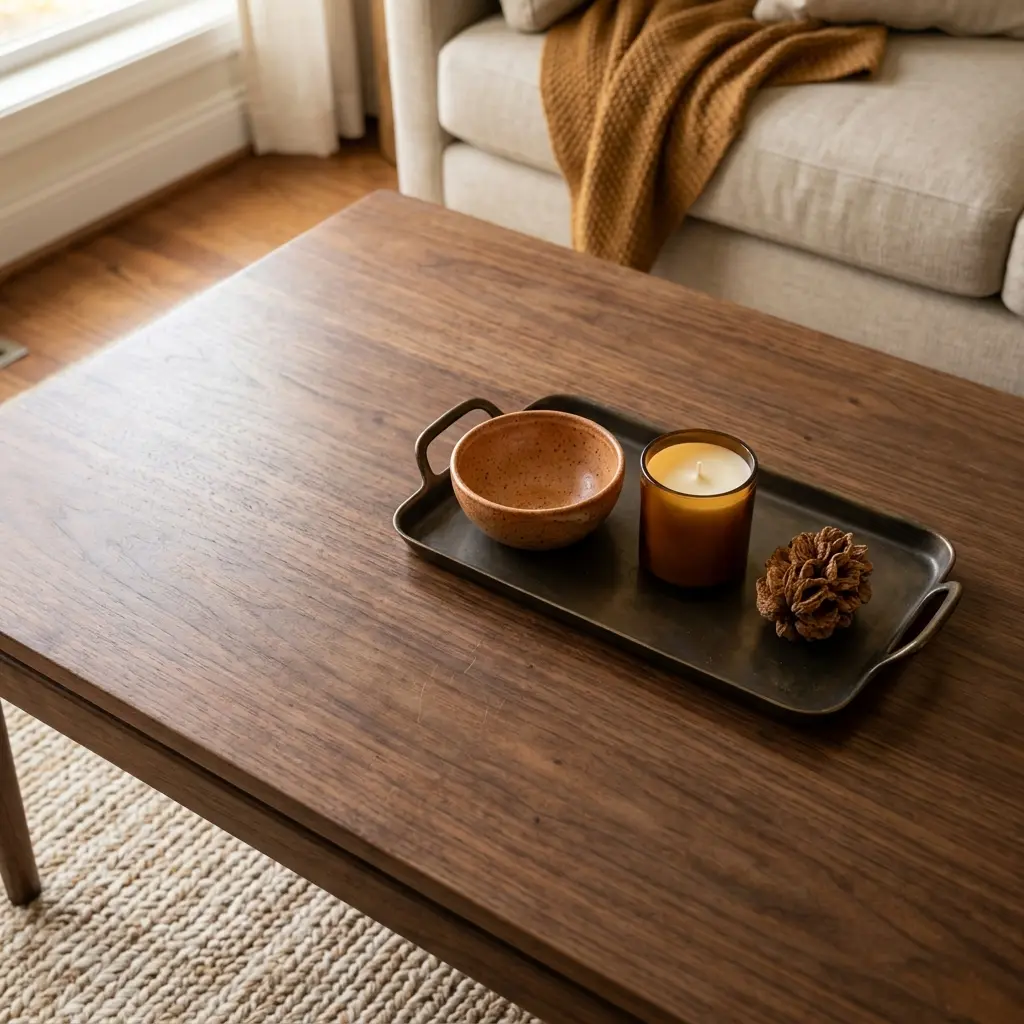
Three pieces on a tray, one of them lifted, with the near edge left bare. That is the short version, and it holds on almost any coffee table between 40 and 54 inches long. The detail worth getting right is which three pieces, how the lift works, and where the empty space goes.
Should You Buy Something Tall or Lift Something Small?
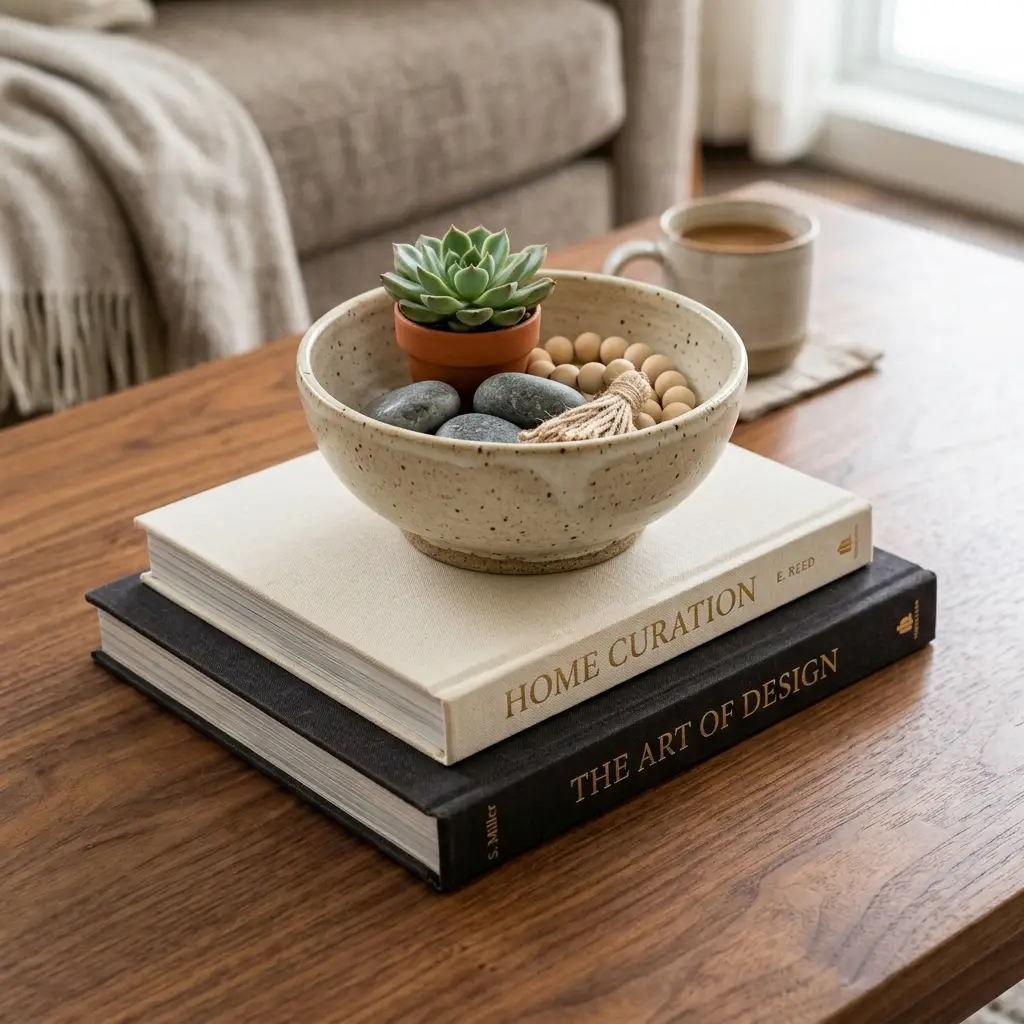
Flat objects disappear on a low table. A single dried stem laid on the wood reads as a shadow from the sofa, and a low ceramic dish sitting directly on the surface merges into it. The fix is not a taller object — it is lifting a small one.
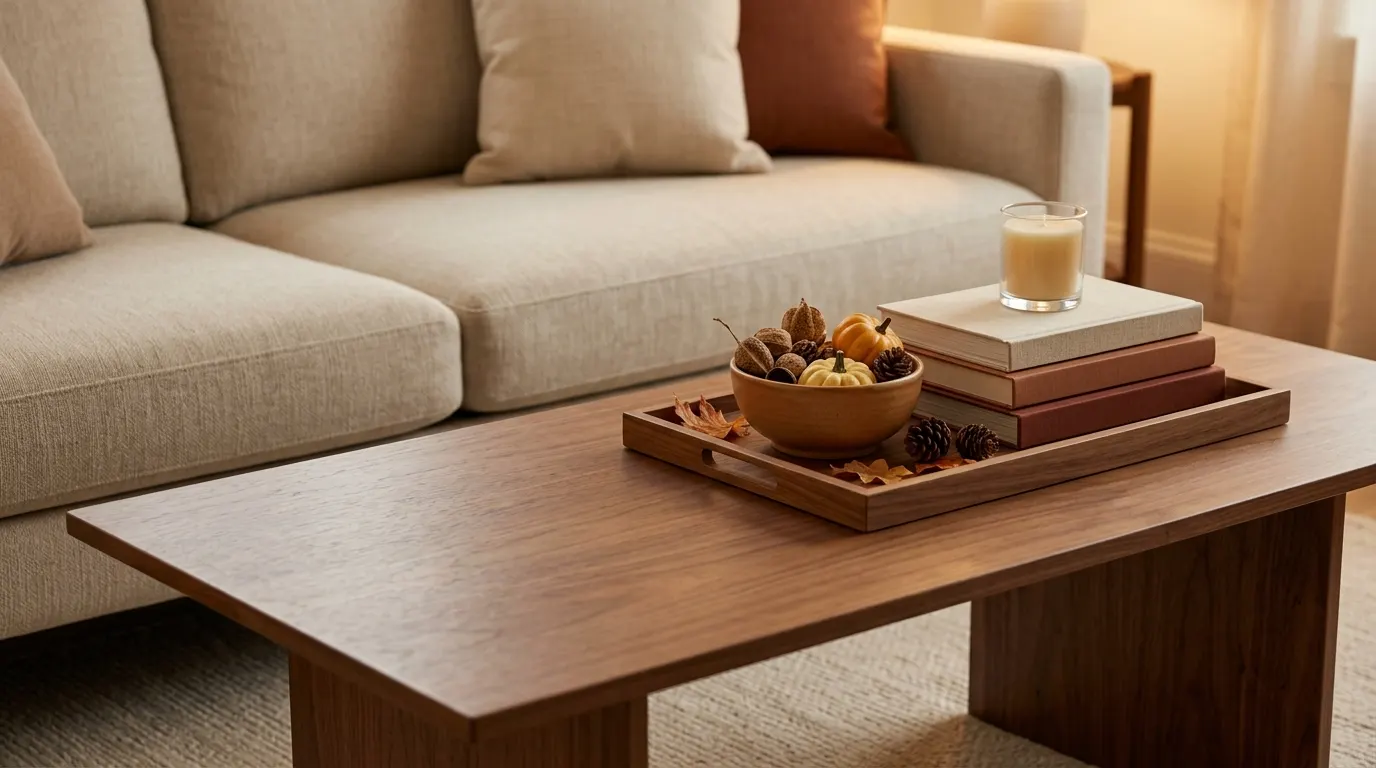
Two hardcover books raise a piece 3 to 4 inches, which is enough to separate it from the tabletop at a seated angle without pushing it into the sightline across the room. A stack of three under a small stoneware bowl of chestnuts does more than a 12-inch vase in the same spot, because the vase reads as a narrow circle from above and gives you almost nothing for the space it takes. Our living room decor ideas cover the year-round pieces those seasonal layers sit on.
Designer Rule of Thumb: one lifted piece per low table, never two. A second riser turns a group into a staircase, and from the sofa the two heights cancel each other out.
Which Shapes and Textures Read From Above?
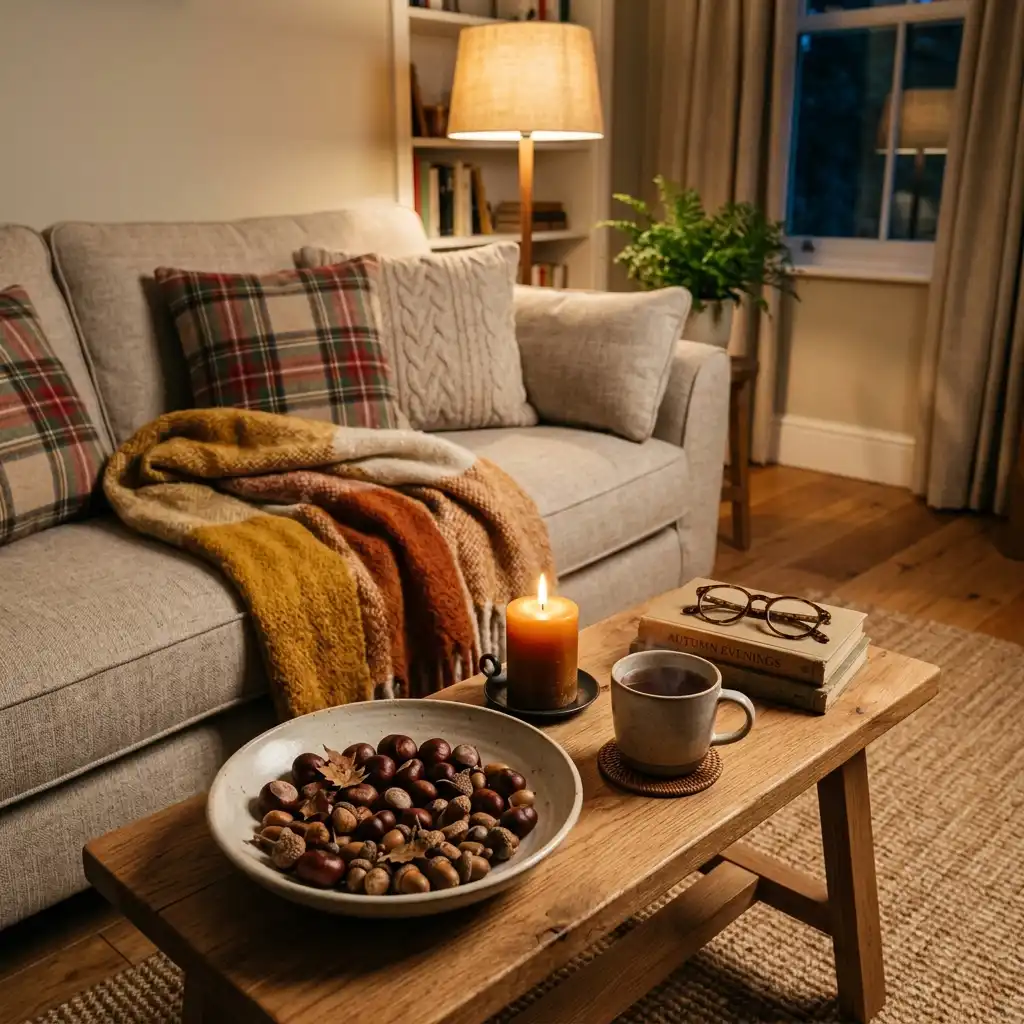
Shape matters more than color at this angle. A shallow bowl of acorns, an open-weave basket and a tray of pillar candles all show their contents from above, so they carry the season immediately. A closed jar, a narrow bud vase and a tall lidded canister show you a lid and a rim, which is why they feel flat on a coffee table and fine on a shelf.
Texture is the other thing you see from directly overhead. A woven jute runner, the glaze pooling on a stoneware rim, the top of a boucle-covered box and the grain of an oiled walnut board all register clearly from a seated position. A printed pattern does not, because you are reading it at a shallow angle. These shelf styling ideas work on the opposite principle, since a shelf is met straight on at eye level.
Warm colors still help, but they are doing less work than most autumn guides suggest. Cream, warm khaki and burnt umber in a matte finish read from above; the same tones in gloss bounce the ceiling light back and go pale.
Where Should the Bare Wood Be Left?
The edge nearest the seat you actually use stays empty, permanently. Put the autumn group on the far side or the diagonally opposite corner, and you keep a landing zone for a mug, a book and a remote without anyone shuffling a pumpkin sideways every evening. On a standard 48 by 24-inch coffee table that leaves about a forearm’s width of open surface exactly where your hand goes.
Two facing sofas change the answer. There the bare zone is whichever side people walk past, because a shin meets a low table long before an eye does. In a room with one sofa and a chair, the group sits nearest the chair and the sofa side stays clear. Browse all our living room ideas for the layouts these low tables sit inside.
What Survives a Table That Never Gets Cleared?
Glazed, sealed and washable survive. Dried, raw and paper do not. A glazed stoneware bowl wipes clean where an unglazed terracotta one absorbs a ring, and an oiled walnut board recovers from a wet glass where a raw pine riser stains permanently.
Material Note: Condensation is the specific problem on a coffee table, because cold drinks sit on it for hours and nobody uses a coaster every time. Moisture trapped in a wood finish shows as a pale cloudy ring, so put the seasonal group on a tray or a board rather than straight on the tabletop and the finish underneath stays protected.
Safety Note: Skip open flame on a low table you use nightly. Anything you have to move before you put your feet up gets moved carelessly, and dried stems sitting inches from a wick are the pairing to avoid entirely — a battery pillar or a lidded vessel gives you the same glow with none of it.
The same durability sort runs through these spring coffee table decor ideas in a lighter palette, and the tray and bowl carry straight across both seasons.
One Table Doing Both Jobs: Studios, Rentals and Small Rooms
A studio or a one-bedroom often has a single table eating, working and holding drinks. There the dining rules win, because the table has to clear for meals whether or not it is also the coffee table. Keep the group small, keep it on a tray, and accept that the season lives on about 14 inches of surface rather than the whole top.
A lift-top coffee table is the other common case, and the rule there is simply that nothing seasonal sits on the hinge side. Anything over the lifting section has to be relocated every time the table is used, which means within a fortnight it will not be there at all. Renters get the easiest version of this whole post: nothing here needs a wall, a drill or a deposit conversation, which is more than most small living room ideas can promise.
Four Moves for the Low Table
Work in this order and each move makes the next one simpler.
- Strip the table completely, then put back only what you would buy again today.
- Choose the base — a wooden or stoneware tray, or a stack of hardcover books.
- Add three pieces at most, and lift exactly one of them 3 to 4 inches.
- Sit on the sofa and check the group from there before you call it finished.
The Low-Table Traps Worth Knowing
Styling the low table while standing over it is the most common one. From above, a spread-out group looks balanced and generous. From the sofa, the same group flattens into a single line and the gaps you left disappear, which is why so many coffee tables look busy in person and fine in photographs.
Treating the low table as overflow storage for the dining table’s decor is the second. The pieces bought for a dining arrangement are usually taller and more fragile than a coffee table can carry, and moving them across when hosting ends is how a good arrangement turns into a leftover one within a week. Buy for one surface at a time — our furniture styling ideas go further on how scale changes between them.
Filling the whole surface is the third and the most expensive to undo. A coffee table with no bare wood left forces every mug onto the arm of the sofa, and within days the seasonal group gets pushed to one end to make room. The empty part is doing a job, not waiting to be filled.
What the Low Table Costs to Do Properly
The base is the part worth paying for, and the seasonal filler is the part that gets replaced each year.
| Project | Estimated Cost | Impact Level |
|---|---|---|
| Restyling with books, bowls and boards you already own | $0 | Very High |
| Wooden or stoneware tray, 18 to 24 inches | $35-$90 | Very High |
| Footed bowl plus a set of faux or dried-look stems | $45-$110 | Medium |
| Oiled walnut board with a pair of brass candle holders | $120-$260 | Medium |
Best First Upgrade: Buy the tray before anything else. It decides where every other piece goes, it protects the finish underneath, and it comes back out for winter tablescapes in December without a single change.
Skip for Now: Skip the matched autumn set of coasters, place mats and small printed signs. Across a year of seasonal decorating ideas those small buys quietly outspend the tray and the bowl combined, and none of them read from above.
If You Only Style One Table
Designer’s Verdict: Style the coffee table. It is seen every evening from the seat you spend the most time in, it never comes down for a meal, and three pieces on a tray finish it for under $100. A dining table gives you a bigger moment, but only on the nights you are looking at it.
The staying power is real too, because none of this is seasonal in structure. The tray, the bowl and the books stay put and only the filler inside them changes, which is the same approach behind our cozy decorating ideas. Nothing has to be rebuilt when the weather turns. A low table dressed this way hands straight over to cozy winter decor ideas in December with one swap of contents.
Frequently Asked Questions
Conclusion
The table that gets written about every autumn is the one most people set a handful of times a year, and the one they actually look at every evening gets whatever is left over. Real fall table decor on a low table comes down to three pieces, one lift and a bare edge you never fill — and our home decor and styling ideas cover the year-round arrangement it sits on.