The Skeleton Moved Indoors and Nobody Resized It
Why does a shelf of Halloween decorations look cluttered when the same shelf at Christmas looks full? The answer is not quantity, and it is not taste. Halloween is the only season whose objects have faces, and a face asks for attention in a way a bauble never does.
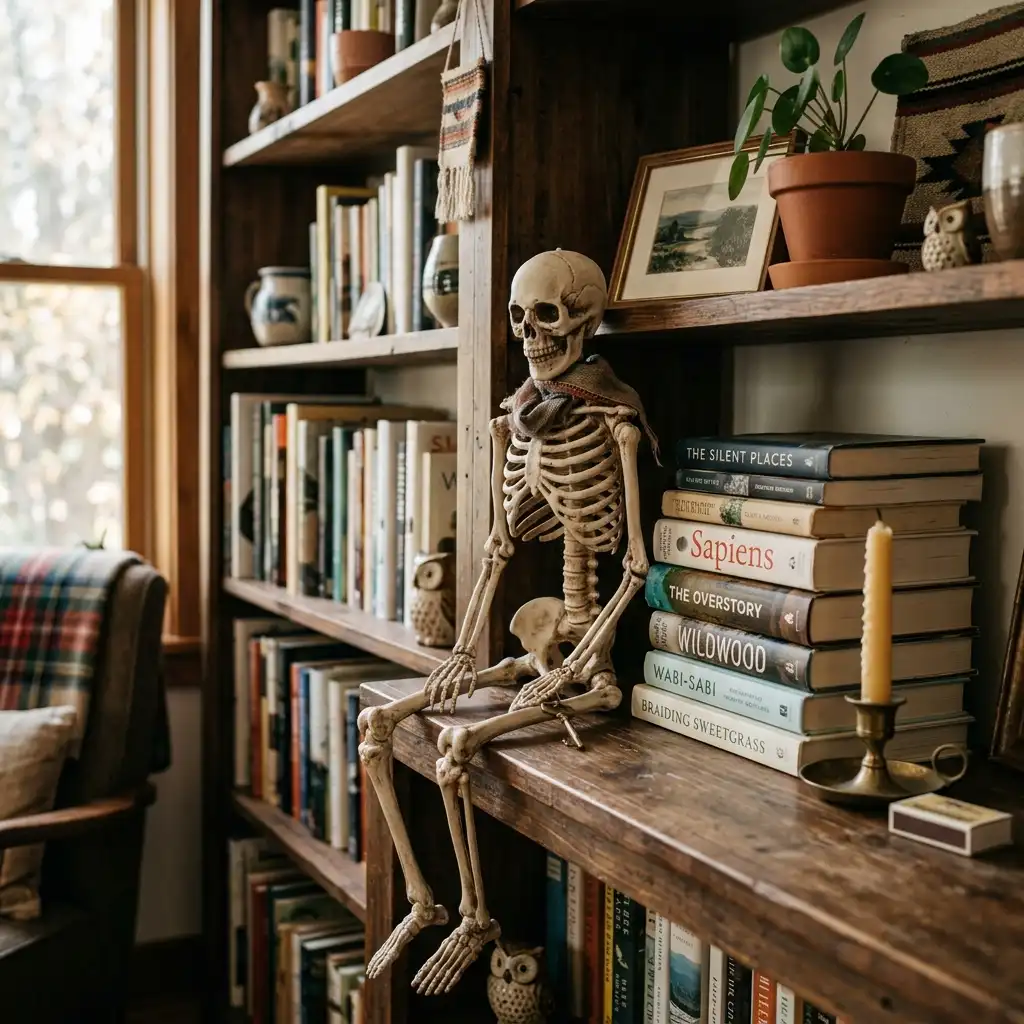
Halloween props work inside the house when you limit how many of them have a face. A skeleton, a witch figure, a grinning jack-o’-lantern and an animated prop all look back at you, and one room sightline can carry one of those before the space starts to look like a shop window. Everything faceless — tapers, cloches, bare branches, bats, webbing — can repeat as often as you like.
Looking for more ideas? Explore our full guide to Halloween Ideas.
Editorial field note: A living room holding a 3-foot skeleton, two ceramic ghosts and a carved pumpkin on the coffee table feels chaotic even though only four objects were added. Take away the ghosts and the pumpkin, leave the skeleton, and fill the same surfaces with black tapers and a glass cloche. Nothing was spent, nothing was gained in object count, and the room finally looks styled instead of stocked. That kind of editing runs through all our home decor inspiration.
This is the pillar page for element-level Halloween decor: skeletons, candles, ghosts, cats, spiders, bats, indoor pumpkin displays and the black Halloween tree. It covers how many to buy, what size to buy, and where each one earns its surface. Everything here also lives in our Halloween decorating archive as the rest of the cluster fills out.
✦ Free for readers
500+ Original Home Decor Images, Yours to Keep.
Curated room by room, high‑resolution and royalty‑free — created in‑house by 101HomeDecor, not stock. No attribution needed.
Free forever · about one email a month
How Many Halloween Props Can One Room Hold?
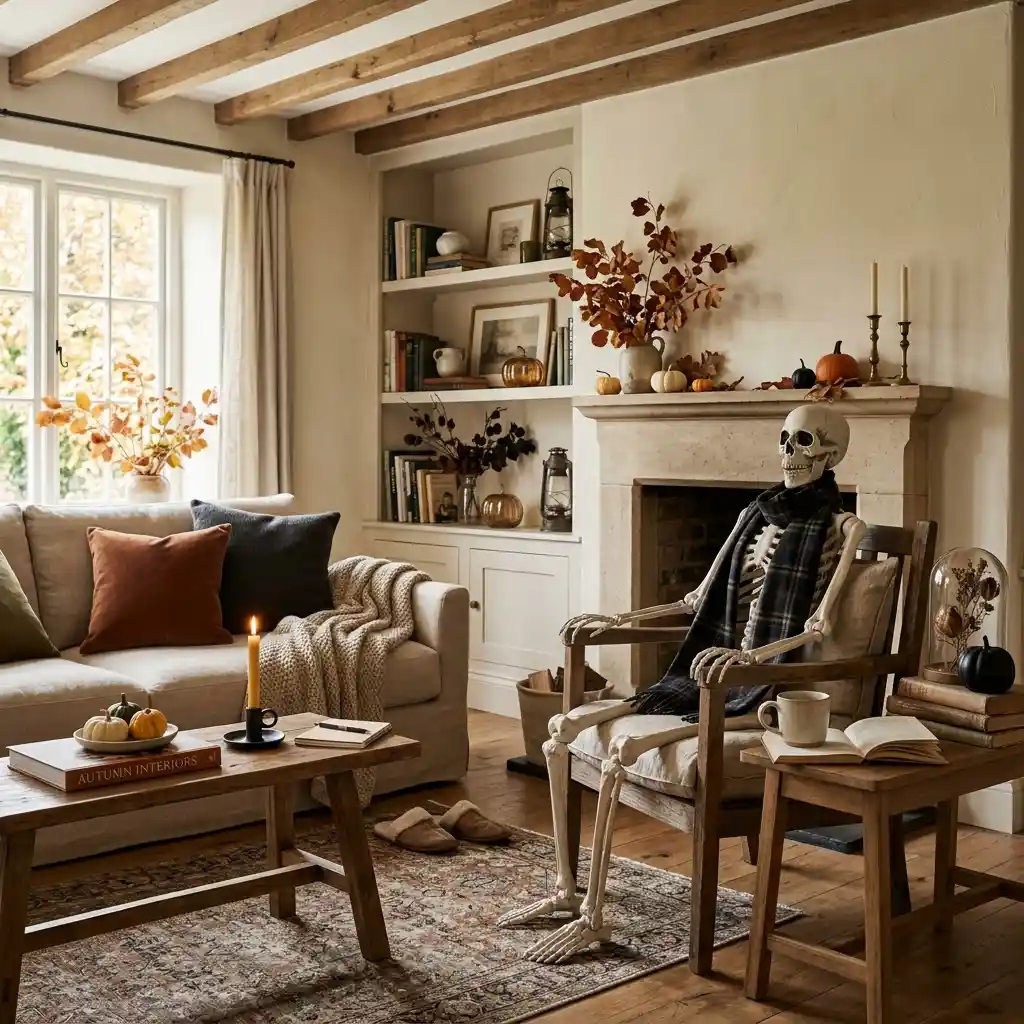
The honest limit is lower than most people expect, and it has nothing to do with square footage. A room’s capacity is set by how many objects are asking for attention at the same moment, and only one kind of object asks.
Which Objects Have a Face, and Which Are Just Texture?
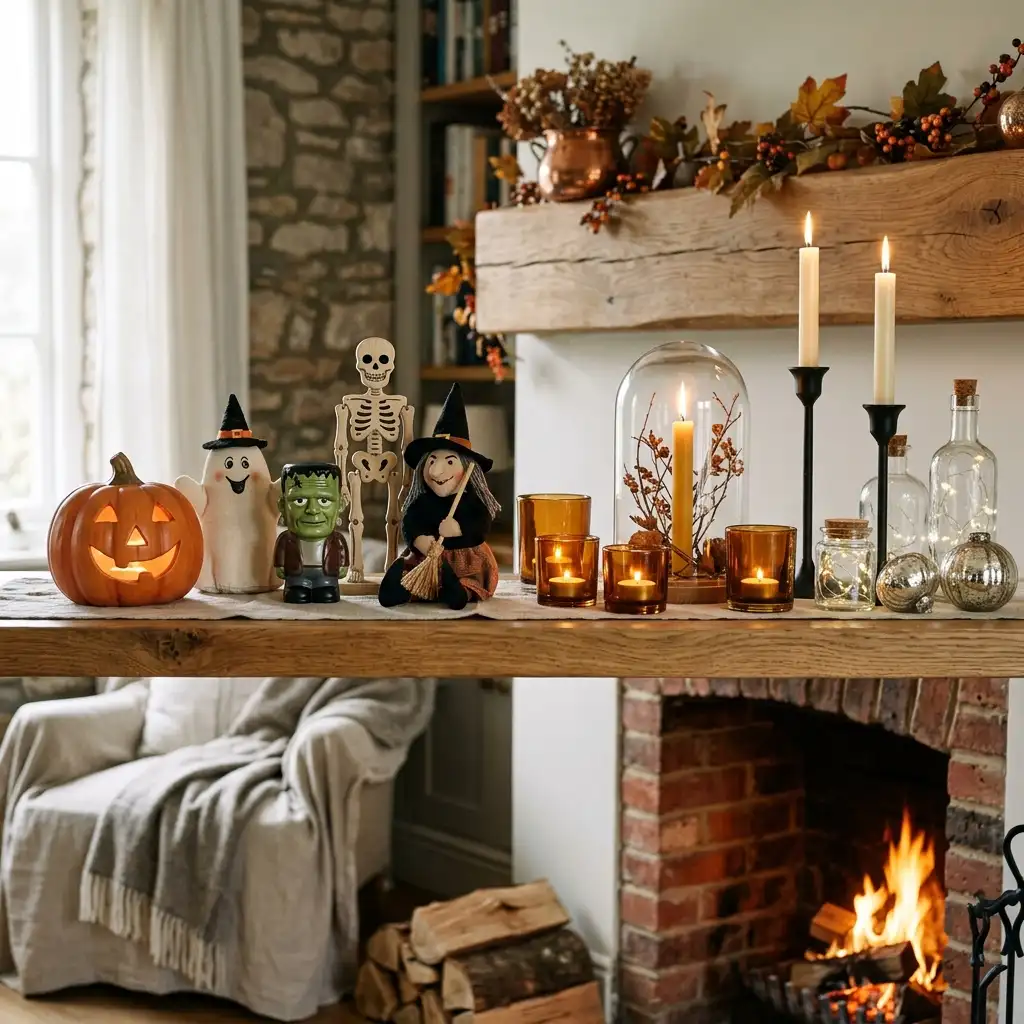
Sort every Halloween object you own into two groups before you buy anything else. Face objects include skeletons, ghosts with drawn or hollow features, witch and creature figures, dolls, masks, animated props, portrait art with visible eyes, and any carved pumpkin. Faceless accents include taper and pillar candles, candelabra, apothecary glass, cloches, bare branches, dried florals, black ribbon, stretch webbing, spiders, and bats seen as silhouettes.
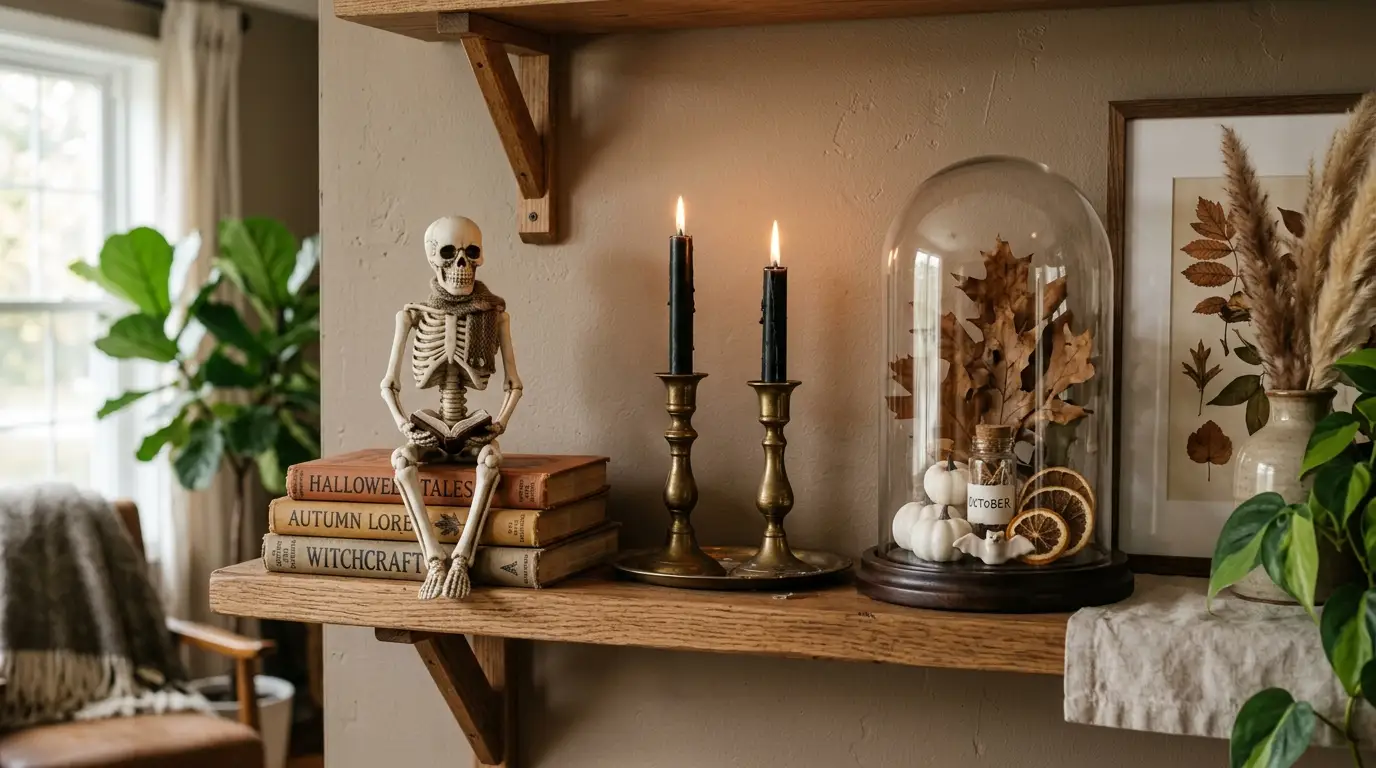
Size settles the borderline cases. Designer Rule of Thumb: an object counts as a face when it is over about 8 inches tall and its eyes are readable from across the room. A 4-inch resin skull on a stack of books is a shape, not a face, so it groups and repeats like any other accent. The same skull at 14 inches becomes a character and starts competing for the room.
What Is a Sightline, and Why Does One Face Fill It?
A sightline is everything you can see from one seat or one doorway without turning your head. Most homes have three to five of them on the main floor: the view from the front door, the view from the sofa, the view down the dining table, the view across the kitchen island, and the view from the stair landing.

Two face objects inside one sightline cancel each other. The eye moves between them and settles on neither, which is why a mantel with a skeleton at one end and a ghost at the other looks busy rather than styled. Give each sightline a single character and let the faceless accents do the rest of the work. A three-bedroom house that supports four sightlines supports four face objects for the whole season, not four per room.
| Quick Takeaways | |
|---|---|
| The split | Face objects make eye contact; faceless accents only add texture. |
| The face test | Over 8 inches tall with readable eyes counts as a face. |
| The limit | One face object per sightline, so three to five per home. |
| Scale | Indoor surfaces want the 18 to 36-inch band, not 6 inches. |
| Candles | A taper burns about an inch an hour, so long displays need flameless. |
Those five lines cover most of the shopping. The one that costs people the most money is the scale line, and the reason for that sits in what stores actually stock.
Why Did Halloween Props Move Off the Lawn?
Halloween used to be an outdoor purchase with a few paper cutouts taped inside. Buying has shifted toward the interior, and the pieces arriving there are being sold as home decor rather than as scares. That changes the standard they get judged by, because a shelf object sits eighteen inches from your face for six weeks.

What Tells You This Is Real:
Halloween ranges grew an interior section they did not have five years ago. Resin figures, LED lanterns, glass cloches, candle holders and small ceramic pieces now sit beside the yard props instead of in a single novelty bin.
Lifestyle retailers run Halloween capsules styled like their everyday home ranges rather than as a separate seasonal aisle. Anthropologie gave several of its own long-running collections a spooky version for 2026, which only works if the pieces look at home beside ordinary decor.
Flameless and battery tapers became the default way Halloween candlelight is sold. That switch only makes sense for a display meant to stay lit across weeks rather than one evening.
Poseable, jointed figures replaced fixed one-position props at hand scale, so the object gets restaged through the season instead of set once and forgotten.
The awkward part is that the objects moved indoors and their sizing did not. Store shelves still cluster around two extremes, and the useful middle is thin.
What the New Halloween Prop Shelf Looks Like
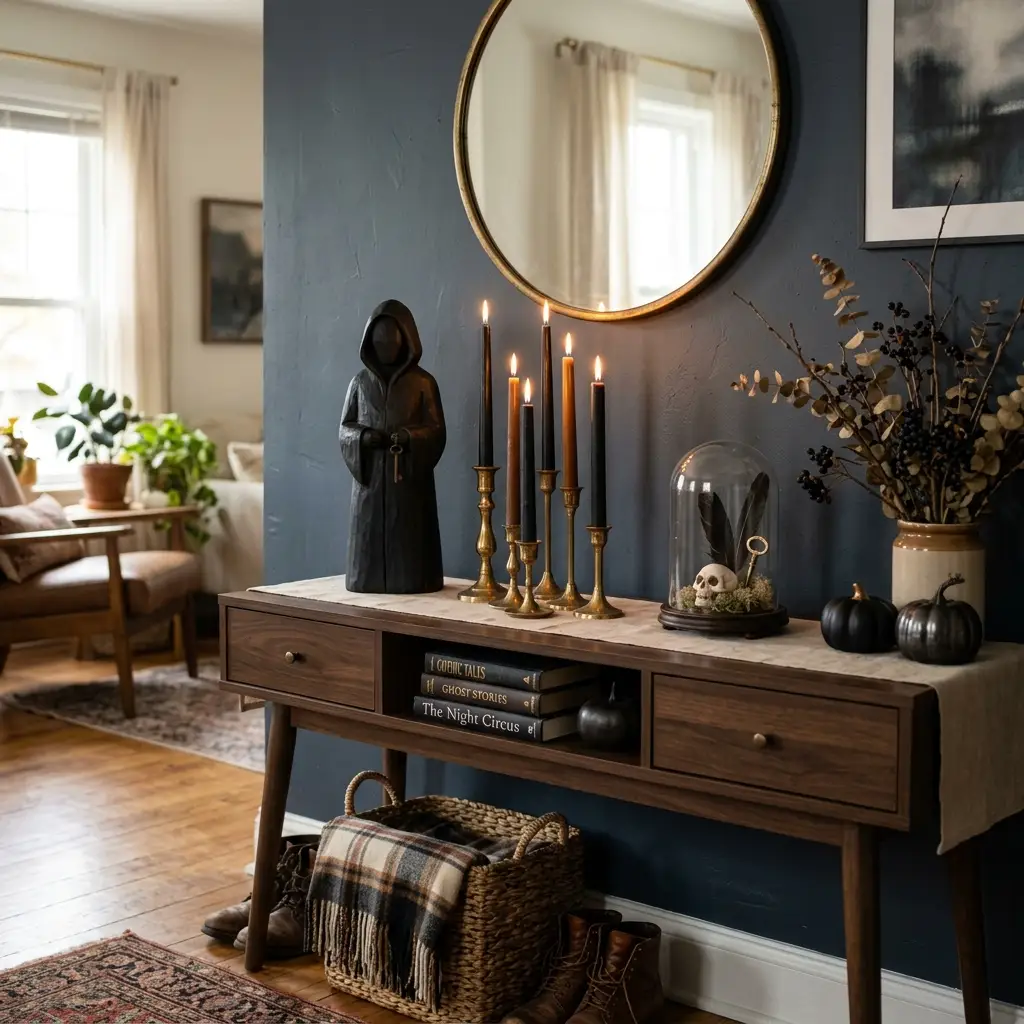
Five families cover nearly everything sold as an indoor Halloween accent. Each one behaves differently on a surface, and each has its own sizing rule.
Indoor Skeletons: Scale Is the Whole Problem
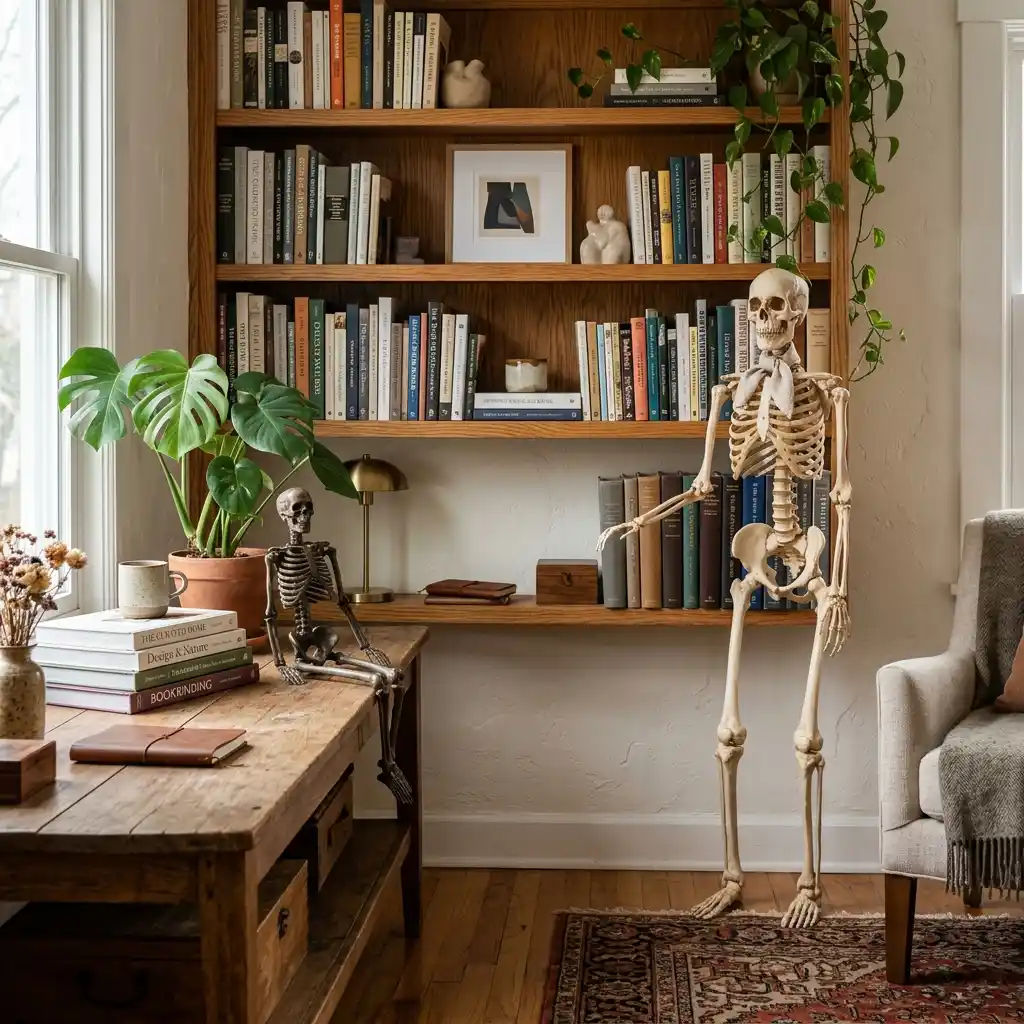
Halloween props sell at two sizes and almost nothing between: tabletop pieces of 4 to 8 inches, and yard figures of 5 to 12 feet. Interior surfaces need the band nobody stocks well, roughly 18 to 36 inches. That retail gap, not your budget, is why indoor displays so often look bought rather than chosen. Our indoor Halloween decor guide covers which rooms are worth filling at all.
The fix is proportion to the opening, measured before you shop. A standard bookshelf opening runs 11 to 13 inches tall, so a 6-inch skeleton leaves half the space empty above it and the shelf still looks bare. A console table sits 30 to 32 inches high with art starting near 58 inches, which leaves about 26 inches of open wall — and a piece filling half to two-thirds of that gap, so 13 to 18 inches, sits correctly in it. The same proportion sum governs styling shelves in any season, which is why these spring shelf styling ideas translate straight across once you swap the objects.
Are Halloween Candles Worth Real Flame?
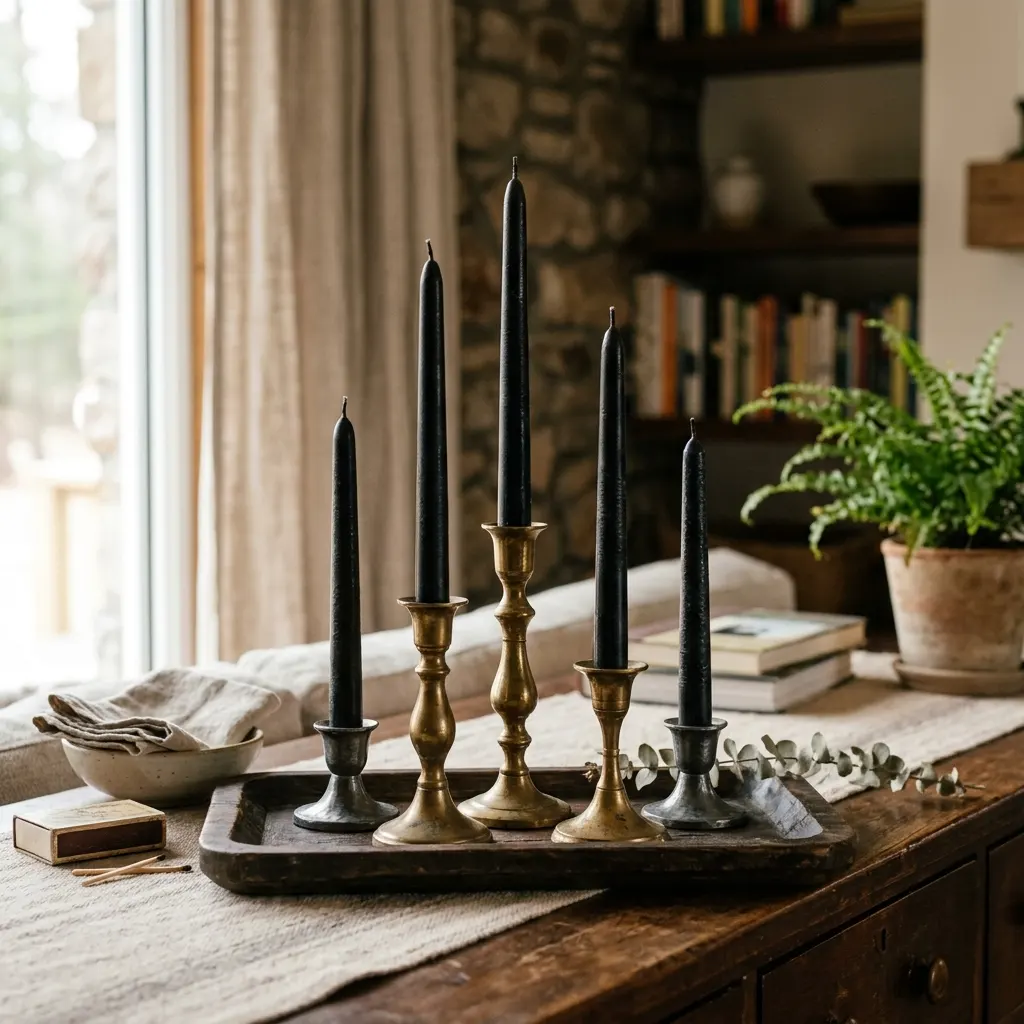
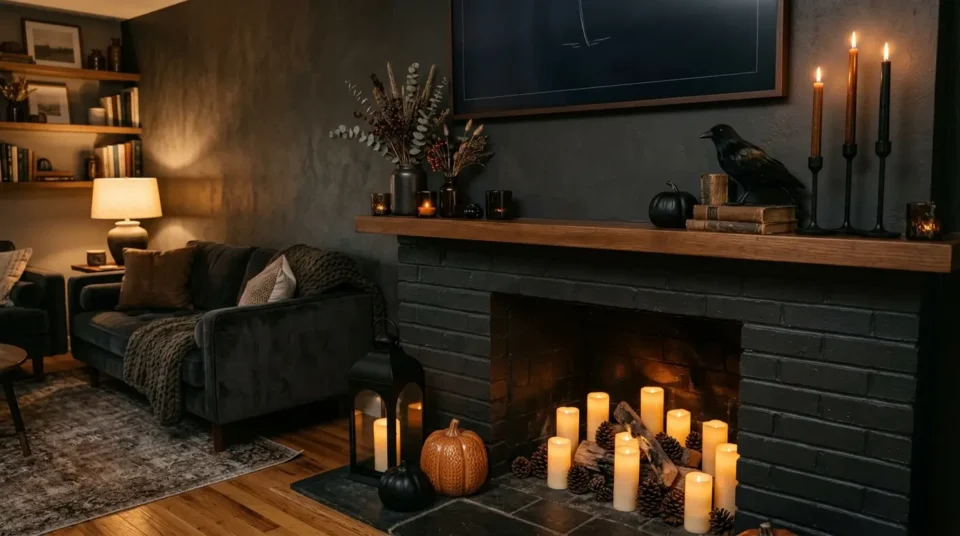
Candles are the faceless workhorse of the whole pillar, and the arithmetic decides how you buy them. Source Note: General Wax’s taper guidance puts a traditional taper at roughly one hour of burn time per inch of height, and advises against burning any candle longer than four hours at a time.
Run those numbers against a six-week display. A 10-inch taper gives about ten hours, which is three or four evenings, so a single holder would eat twelve to fourteen tapers across the season. Build the standing display from flameless tapers and keep four real ones for the nights you are actually in the room.
Safety Note: The National Candle Association’s fire-safety guidance sets three numbers worth memorizing for a Halloween tray — 12 inches of clearance from anything flammable, 3 inches between one candle and the next, and a wick trimmed to a quarter inch before each burn.
That 3-inch spacing shapes the group. Set them on one tray in threes or fives, keeping 3 inches of gap side to side and at least 2 inches of difference in height. Wicks at matching heights line up flat; stepped heights give the tray cluster a shape. This is a tray rule rather than a mantel rule — a long shelf is composed differently. The same layering approach behind these cozy bedroom lighting ideas applies here, since candlelight is a light source before it is a decoration.
Ghosts, Black Cats, Spiders and Bats
This family splits neatly along the face line. A ceramic ghost with painted eyes and a seated black cat figure are characters and count against the sightline. A flat bat silhouette, a wire spider and stretch webbing are pure texture and can repeat freely.
Wall scatters need direction to look styled. Start a run of 3D bats dense in one corner — six or seven within a foot of each other — then thin the spacing as they travel across the wall, so the group has a start and an end rather than an even sprinkle. Put them on glass, tile, a mirror or painted trim rather than a painted wall, because autumn temperature swings are exactly when adhesive lifts emulsion. Webbing should be pulled until you can see the wall through it; thick webbing looks like cotton wool and collects dust. Wall placement follows the same balance rules as these living room wall decor ideas.
A Pumpkin Becomes a Face Object the Moment You Carve It
An uncarved pumpkin is a shape. Group nine of them on a hearth in three sizes and the arrangement stays quiet, because nothing in it is looking at you. Cut two eyes and a mouth and that pumpkin joins the skeleton column, so one carved pumpkin in a sightline is the whole allowance. Our pumpkin decorating ideas cover which methods keep a pumpkin faceless and which do not.
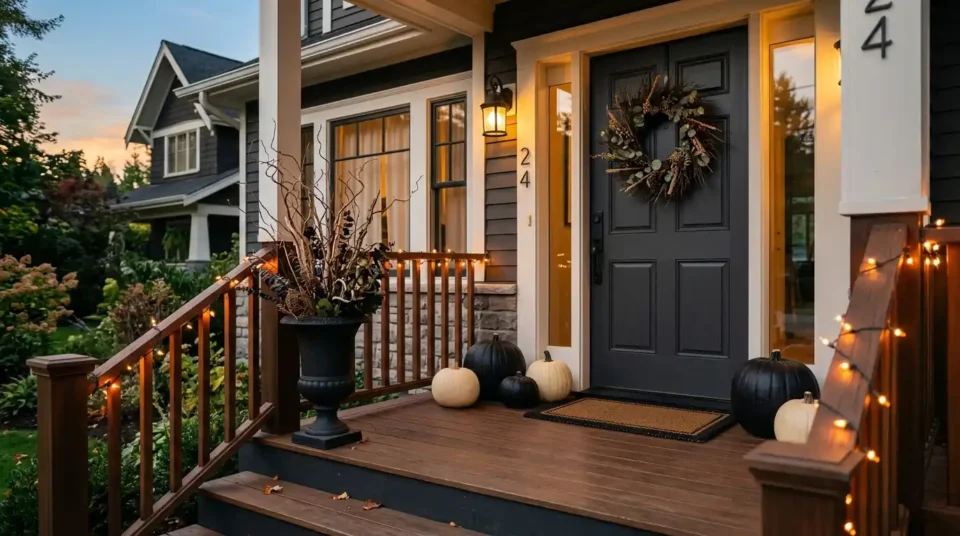
That gives you a clean way to mix seasons. Uncarved white, green and pale orange pumpkins belong with your existing fall and autumn decor ideas and can sit out from early September without touching your face allowance. A carved one spends it. So if a skeleton already holds the living room sightline, put the carved pumpkin on the porch instead of the hearth.
The Halloween Tree and Other Whole-Object Displays
A black Halloween tree, a lit cloche cluster and a glass apothecary shelf all behave as one object rather than many. A 4-foot black tree hung with faceless ornaments — smoked glass drops, matte black leaves, brass bells — takes a corner without spending your face allowance at all.
Hang faces on it and the maths changes instantly. Twelve small ghost ornaments turn a quiet anchor piece into twelve competing characters, which is the fastest way to make a good tree look cheap. Keep the ornaments abstract and let one skeleton somewhere else in the room be the character.
How to Bring Halloween Props Indoors Without the Clutter
Five moves turn a bin of Halloween props into a display. Work them in order, because the first one changes what you buy and saves the most money.
- Count your sightlines before you count your budget. Stand in each doorway and each main seat, note what you can see without turning, and write the number down. That number is how many face objects you are allowed this year.
- Shop the 18 to 36-inch band, and measure first. Take your shelf opening and your console-to-art gap on your phone. Anything under 8 inches is an accent purchase, not a centerpiece purchase.
- Put the face at seated eye level. A character is looked at from the sofa, not from a standing crowd, so aim for 42 to 48 inches from the floor — the second shelf of a bookcase, a console top, a mantel. That is lower than the standing sightline a party or an entry hall works to. Below knee height or above 6 feet, a face stops making eye contact and turns into wallpaper.
- Build the candle layer flameless and keep four real tapers back. The battery run carries the six weeks; the real ones come out for evenings you are in the room, and go out before you leave it.
- Space and step every faceless group. Three or five pieces on one tray, 3 inches apart, with at least 2 inches of height difference between each. This is the move that makes a $12 set of holders look chosen rather than collected.
DESIGNER TIP: Photograph each sightline on your phone before you commit. A still image flattens the room the way a visitor sees it in the first second, and two faces fighting each other show up immediately in a photo when they are easy to miss in person.
Your Indoor Halloween Prop Checklist
- Walk each doorway and seat, count your sightlines, and cap face objects at that number.
- Measure your shelf opening and console-to-art gap before shopping, then buy in the 18 to 36-inch band.
- Place every face object between 42 and 48 inches from the floor.
- Use flameless tapers for the standing display and keep four real ones for evenings at home.
- Group faceless accents on one tray in threes or fives, 3 inches apart and 2 inches different in height.
- Keep any live flame at least 12 inches from webbing, dried stems and paper.
KEY TAKEAWAY: The count is the decision that matters most, because a room with one well-sized character and a full faceless layer beats the same room holding four characters and nothing else.
What Goes Wrong Once the Props Come Inside
- Most people buy at tabletop scale for a surface that needs three times the height. A 6-inch figure on a 32-inch console is not a small choice, it is an empty one — the surface still looks bare and the object looks lost. Measure the opening first and buy one piece sized to fill it.
- Two face objects end up in one sightline, usually because they were bought on separate trips. The fix is subtraction, not rearrangement: move one character to a different room rather than pushing it to the far end of the same shelf.
- Real tapers get bought for a six-week display and burn out in the first ten days. Ten inches of wax is roughly ten hours of light. Anything meant to glow every evening from late September has to be battery, with real flame kept back for nights you are home.
- Stretch webbing goes on thick because the bag looks small. Pulled properly, one bag covers a whole banister and stays near-transparent. Thick webbing looks like cotton wool, holds dust for the whole season, and turns into a genuine hazard within a foot of a candle.
- Face objects get left on the floor, where nobody meets their eye. A skeleton slumped in a corner looks like something dropped. The same skeleton sitting on a chair at 42 to 48 inches becomes the character the room was missing.
- A weatherproof yard prop gets carried indoors to save money. Blow-molded plastic and coated foam are sized and lit for thirty feet of distance, so at arm’s length the mold lines, seams and spray texture are all anyone sees. Leave those outside and buy resin, ceramic or wood for interior surfaces.
If You Rent, Have a Toddler, or Live in One Room
Three situations change the plan, and none of them makes it harder.
Rental Note: Nothing here needs a nail — trays, mantel ledges, bookshelf tops and window sills carry every accent, and the bats go on glass, tile or trim rather than painted plaster.
Small children and pets move the rule up the wall. Keep face objects above 48 inches or behind glass, skip open flame completely, and leave webbing out of the plan — it looks like something to eat and it is not. Weighted or wide-based holders beat tall slim ones anywhere a tail can reach.
A single open-plan room is the simplest case of all, because it holds one sightline and therefore one face object. That is the whole character budget, and every remaining dollar goes to candles, glass and branches. Renters working within that limit will recognize the same editing habit in these rental bedroom ideas.
What an Indoor Halloween Display Costs
Element-level decor is the cheapest part of the season to get right, because the faceless layer does most of the work and almost none of the spending. The ranges below reflect typical craft-store and big-box pricing for the pieces described.
| Project | Estimated Cost | Impact Level |
|---|---|---|
| Wall and window scatter — 3D bats, silhouettes, one bag of webbing, removable hooks | $15–$40 | Medium |
| Faceless accent layer — 5 flameless tapers, two brass holders, one glass cloche, bare branches | $35–$80 | High |
| One mid-size face object, 18–36 in. — poseable skeleton, resin figure or ceramic ghost | $45–$120 | Very High |
| Hosting candle setup — iron candelabra or three stepped holders, plus a box of real tapers | $50–$110 | Medium |
| Indoor statement piece — 4 to 5-foot figure, or a black tree with lights and ornaments | $150–$400 | Medium |
Under $80 the faceless layer is where the money belongs, and it is the only tier that keeps working in December once the Halloween pieces come off — brass holders and glass cloches carry straight into these Christmas table settings. Between $45 and $120 you get one properly sized character, which is the single biggest jump an indoor display makes. Above $150 you are buying scale, and scale only pays off in a room with a genuinely open sightline to fill.
Best First Upgrade: One face object sized to its opening, somewhere in the 18 to 36-inch band. It fixes the empty-surface problem that no amount of small pieces solves.
Skip for Now: A second character in the same room. Buy the candle and glass layer first, then decide next October whether you actually miss it.
Will the Indoor Prop Still Be Up Next October?
The move indoors is not a passing season. Displays now run for weeks, interiors are photographed far more than yards, and both of those push toward objects that survive close inspection rather than objects that startle once.
What will settle is the character count. The current instinct is to buy every figure that looks good in a store aisle, and homes are quietly discovering the ceiling on that. The pieces holding their value are the faceless ones — brass holders, glass cloches, black branches, good candles — because they carry through December and February without looking like leftovers.
Designer’s Verdict: Buy one character you genuinely like at proper interior scale, then put every remaining dollar into the faceless layer — that split survives a change of taste, while a shelf of small figures rarely survives two Octobers.
Related Decorating Ideas:
- Bedroom Decor Ideas: Furniture, Accents and Styling
- Nightstand Decor Ideas for a Styled Bedroom
- 9 Moody Boho Bedroom Ideas for a Dark, Dreamy, and Cozy Retreat
- 11 Bold Black Christmas Decor Ideas for a Modern Holiday
- Browse all our seasonal decorating ideas