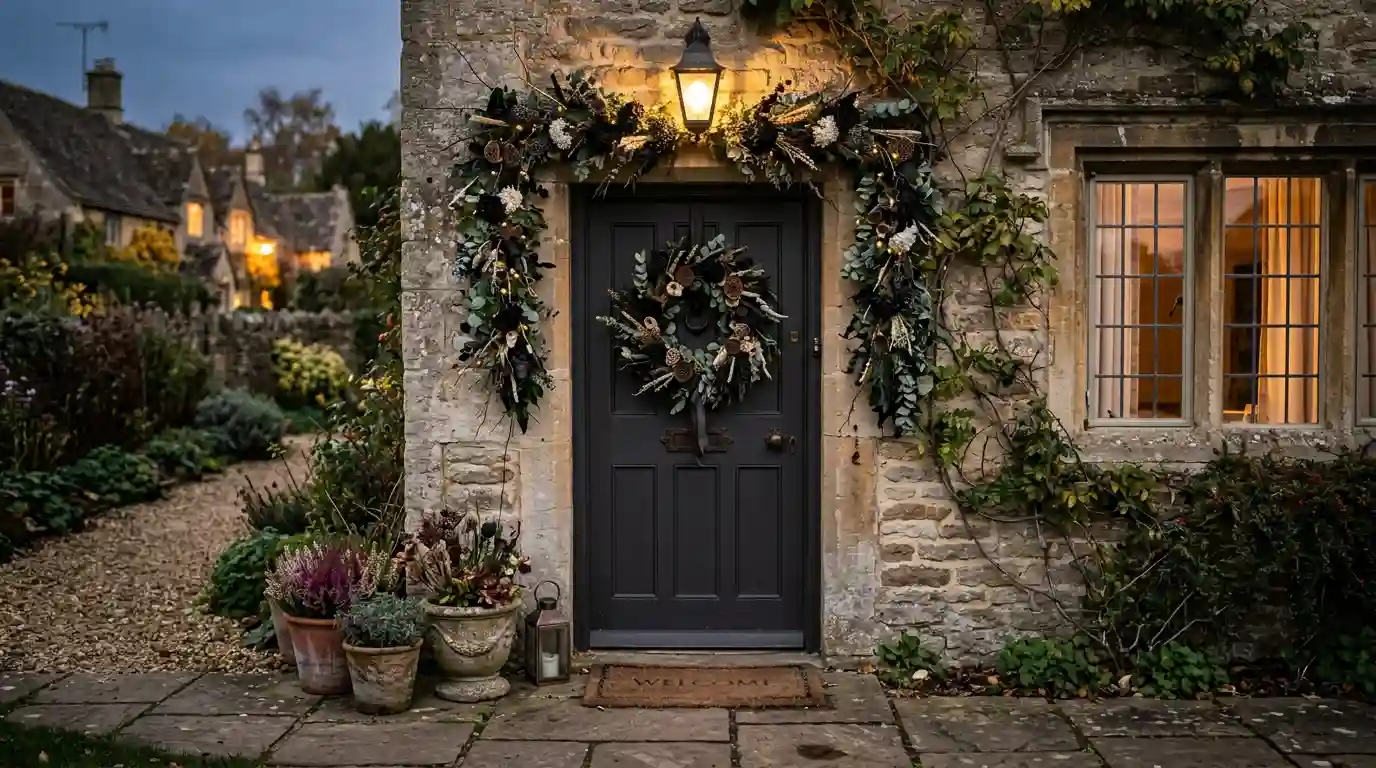
TL;DR
- The split: Prop wreaths are built around one object; material wreaths are built from texture, and only the second kind holds up for a month on a door.
- Sizing: Door width minus 12 inches gives the wreath diameter — 24 inches on a standard 36-inch door.
- Garland: Mantel width multiplied by 1.5 gives a soft drape; add four feet instead when you want tails at each end.
- Spend: A reusable dark base costs $12 to $20 and outlasts every themed set you attach to it.
Two Halloween Wreaths Can Cost the Same and Land Differently
You spend forty dollars, hang the wreath, step back to the sidewalk — and it looks like a party-store bag stapled to a ring. Two doors down, a wreath that cost about the same reads like it belongs on the house. Nothing about the budget explains the gap, and that is the part most people find frustrating.
Looking for more ideas? Explore our full guide to Halloween Ideas.
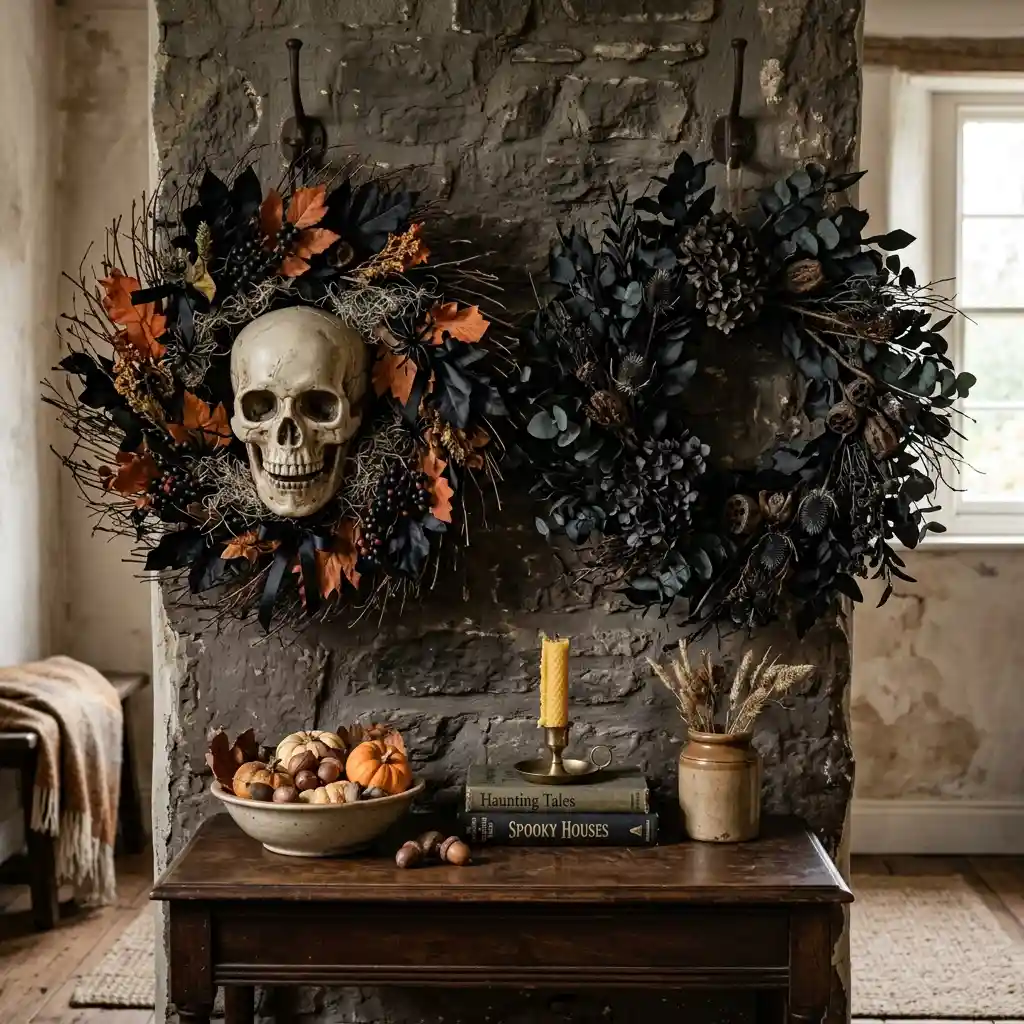
Halloween wreath ideas divide into two camps. A prop wreath is built around one object — a spider, a skull, a witch hat, a ghost face — and everything else on the ring is filler. A material wreath has no single object to point at; the whole effect comes from what it is made of, such as black-dyed eucalyptus, tarnished silver berry, bone-white ruscus or matte black feathers. Prop wreaths peak on October 31. Material wreaths hold up from mid-September through November.
Editorial field note: A plain black grapevine ring hung on a dark green door with three plastic bats glued to it looks flat from the street, because the bats disappear and the ring blends into the paint. Take the bats off, wire in a single sweep of bone-white ruscus and one length of pewter velvet ribbon, and the same ring suddenly has an outline. Nothing was spent. One material replaced three objects, and that is the whole idea running underneath our home decor inspiration.
This guide covers the pillar-level decisions: which camp to buy into, how to size a wreath to your door and a garland to your mantel, which materials survive a wet October, and what to spend. For everything beyond the door itself, see our outdoor Halloween decorations guide.
Why Is Black Replacing Orange on the Front Door?
Halloween decorating used to be an evening. It is now a display that sits outside for six or seven weekends, and that single change has quietly rewritten what sells. An object that is funny on October 31 becomes wallpaper by October 10. A texture does not wear out the same way.
The second driver is the door itself. A front door is the most photographed surface on a house, and a novelty prop photographs badly — the eye goes straight to the plastic. Retailers noticed before homeowners did, and the color story moved with them.
Signs This Is Catching On:
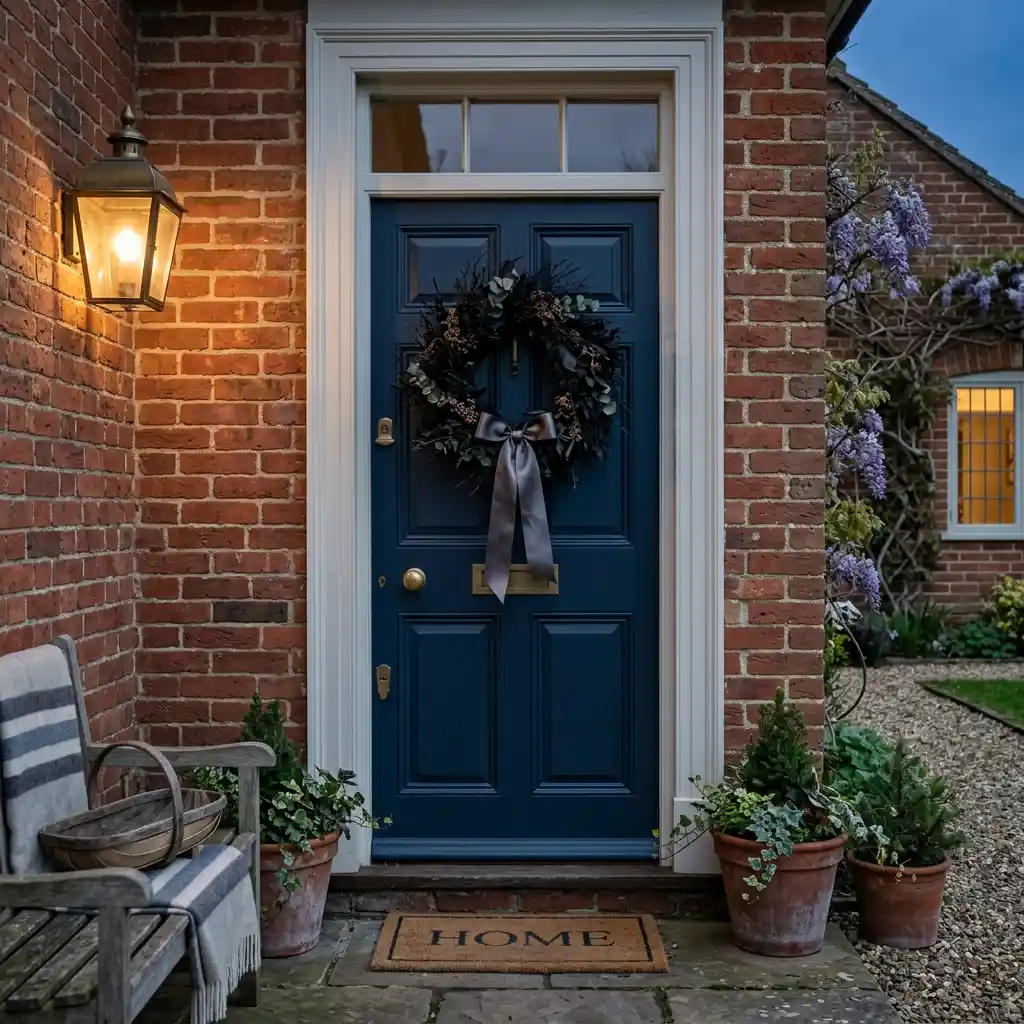
Wreaths made from black feathers turned up across showrooms at Christmasworld in Frankfurt this February, alongside glittery black garland and black-and-white checkerboard motifs. The ring itself is now the dark object, rather than a plain frame you hang a dark object on.
Bare wreath forms — black grapevine rings, wrapped wire frames, dyed twig bases — now sit in the seasonal aisle beside finished wreaths. The same rings carry the harvest palette in our fall wreath ideas once October is over. Retailers stock the base on its own only when people are re-dressing rather than rebuying.
Pastel pink, which dominated Halloween ranges last year, has thinned out, and darker shades such as aubergine and oxblood have taken the shelf space.
Faux-neutral Halloween is not a rejection of orange. It is a shift in where the orange sits — burnt or clay orange as an accent inside a dark scheme, instead of safety orange as the base. The same move happened to the winter palette a few seasons ago, which is why these bold black Christmas decor ideas feel adjacent rather than unrelated.
What the Two Camps Actually Look Like

Naming the two camps is the fastest way to shop, because it tells you what to ignore. A prop wreath is judged by whether you like the object. A material wreath is judged by texture, palette and how much light it catches. Both turn up all over the Halloween decorating archive, so it helps to know which one you are looking at before you spend anything.
The Prop Wreath: One Thing to Look At
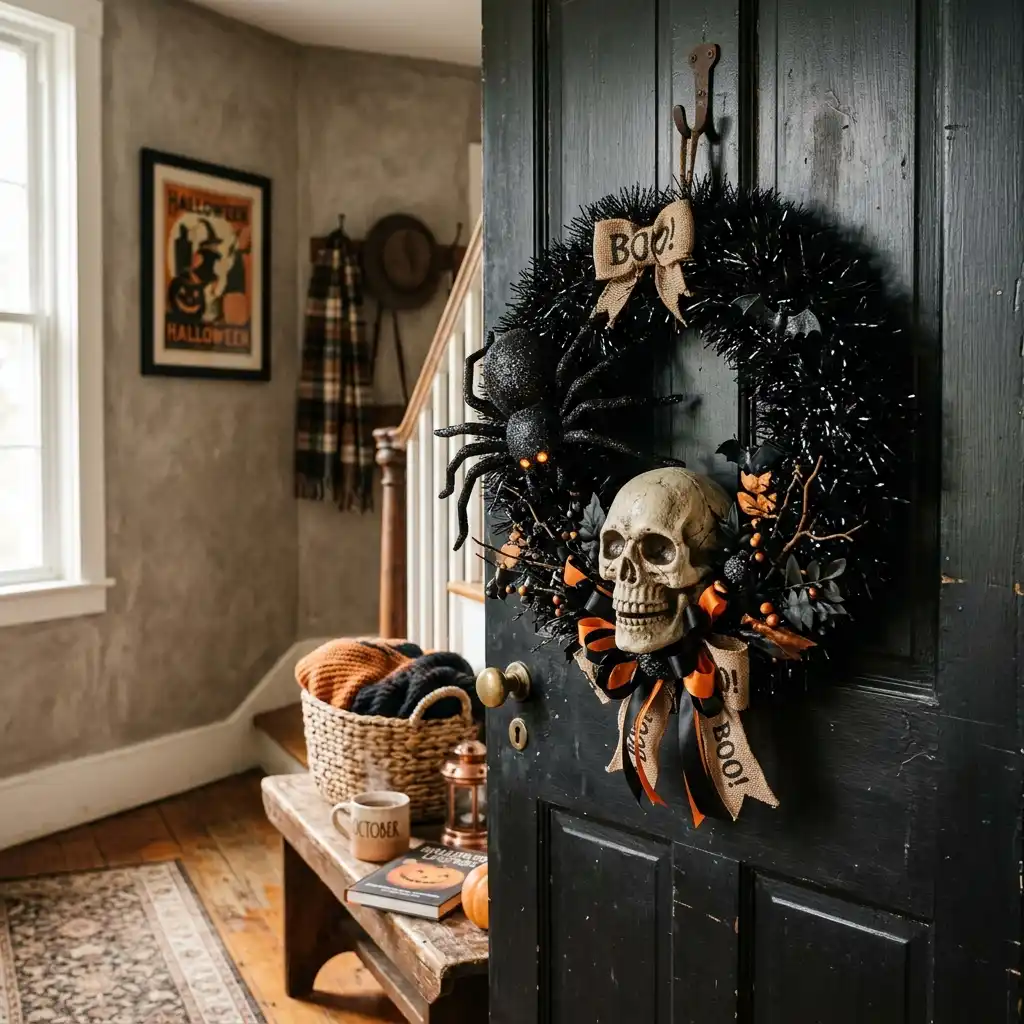
A prop wreath carries one object and treats the ring as a mount. Common versions include a plastic spider on a black tinsel ring, a foam skull surrounded by glitter picks, a witch hat tipped over a bow, or a printed ghost face on a felt disc. The base is usually tinsel, foam or a wrapped wire frame.
Prop wreaths have a real job. They are loud, they photograph well for kids, and they cost very little — most sit between $15 and $30. They also have a short attention span: once you have seen the joke, the wreath stops giving you anything. Glitter sheds after two weeks of wind, foam yellows in sun, and the object often outweighs its own frame, so the ring hangs crooked by mid-October.
The Material Wreath: Texture Instead of a Punchline
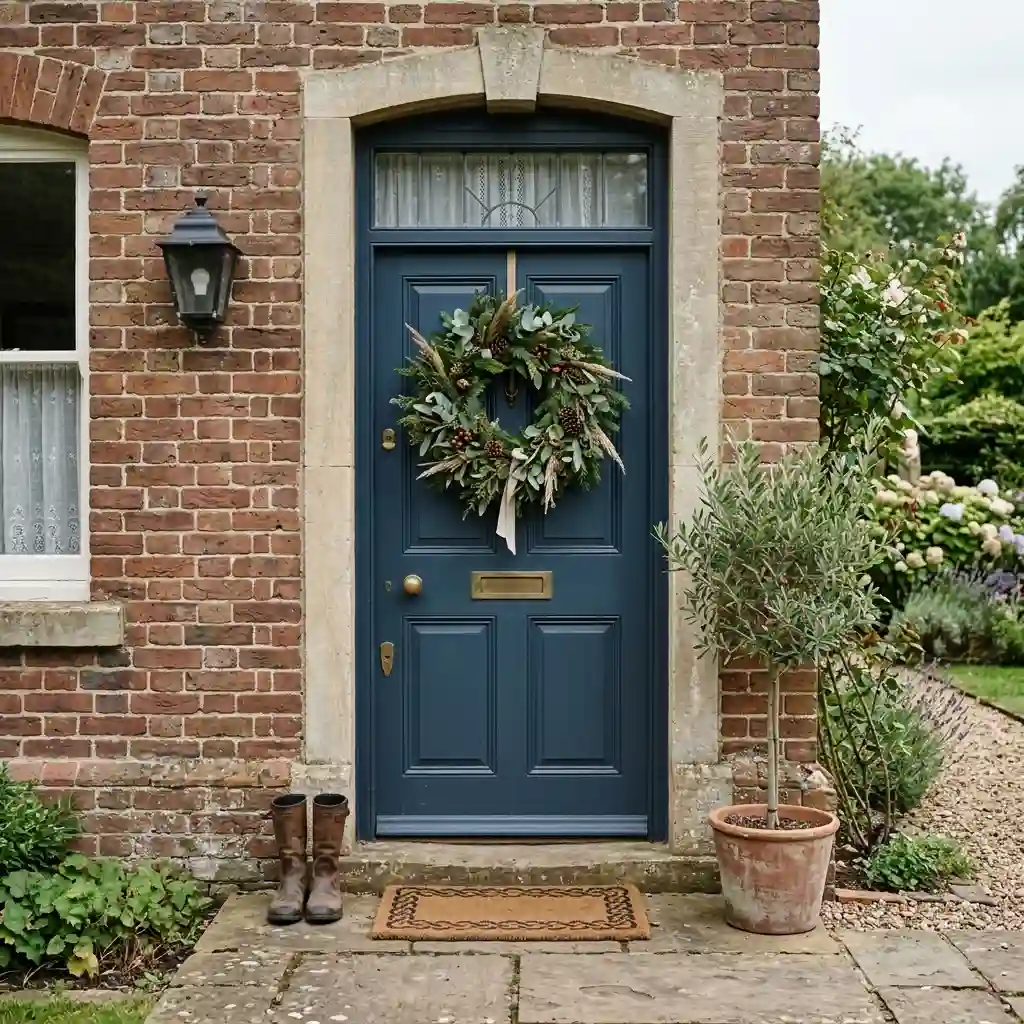
A material wreath has nothing you can point at, which is exactly why it works for weeks. The look comes from a small set of surfaces used repeatedly: black-dyed preserved eucalyptus, dried black wheat, tarnished silver berry sprays, bone-white ruscus, oxidized brass bells, smoked glass beads, matte black feathers and aged velvet ribbon.
Keep a wreath to two colors plus one metal. A wreath is a small object taken in all at once, so it needs a tighter palette than a whole room does — three colors plus two metals is the point where a ring starts to look assembled from a clearance bin. Black and bone with pewter is the safest version, and it sits comfortably under almost any Halloween scheme, so you can settle the wider style later and this wreath will still belong. The five lanes are set out in our guide to Halloween decor styles.
Where the Garland Fits
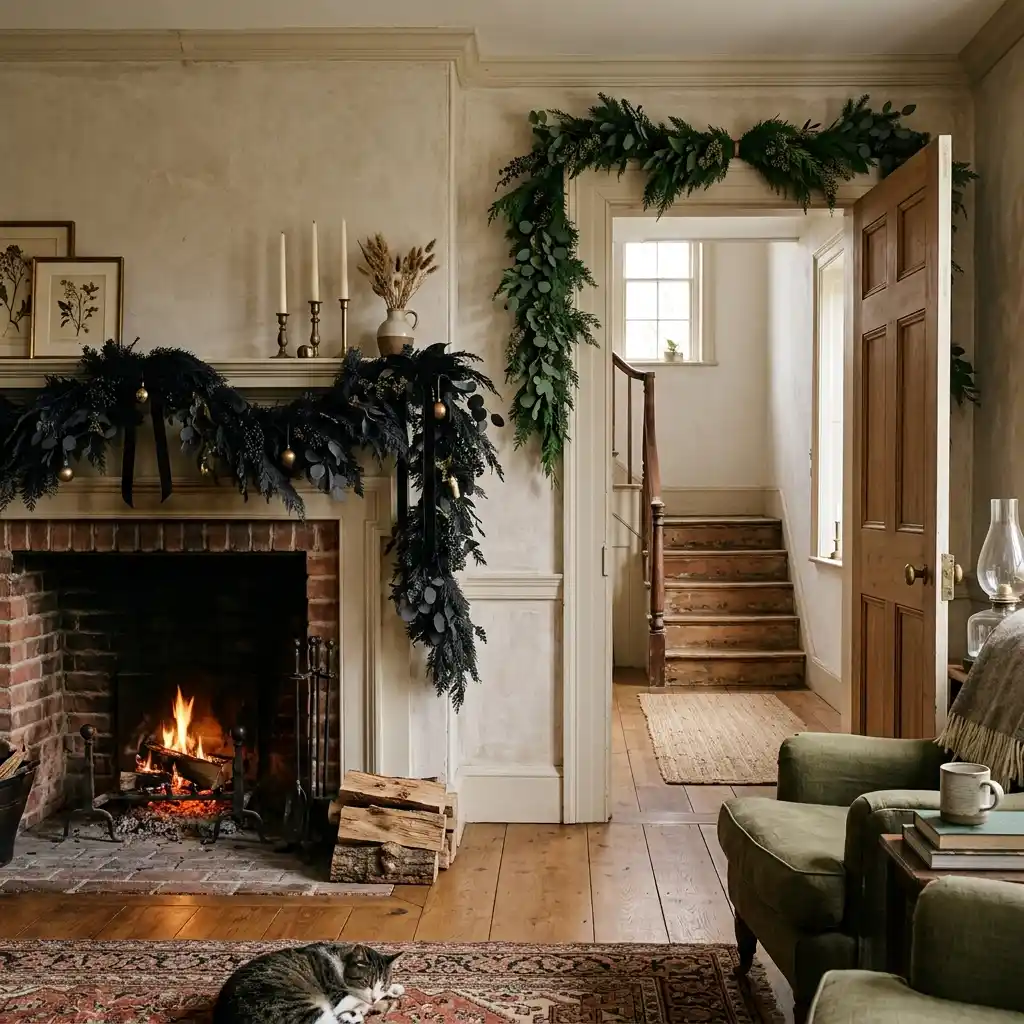
A garland is the same idea in a straight line, and it solves places a wreath cannot reach. A wreath needs a ring-shaped opportunity: a door, a gate, a window centre. A garland works along a mantel, a stair rail, the top of a door frame, a console shelf or a window head — the horizontal surfaces where Halloween decorating usually stalls.
Most homes need both, and the two pieces should carry one shared material. If the door wreath uses bone-white ruscus, run bone-white ruscus through the mantel garland too, even when everything else differs. A visitor crosses from door to mantel in about ten seconds, and that repeat is the only thing linking the two views. The same carry-through shapes these refreshing spring entryway decor ideas.
| Quick Takeaways | |
|---|---|
| The split | Prop wreaths carry one object; material wreaths carry a texture. |
| Palette | Two colors plus one metal covers almost every scheme. |
| Wreath size | Door width minus 12 inches gives a good diameter. |
| Garland length | Mantel width times 1.5 for a soft drape. |
| Reuse | A dark base survives past October 31; the attachments do not. |
Those five lines settle most of the shopping. The numbers behind two of them are worth a closer look, because sizing is where good material still lands badly.
How Big Should a Halloween Wreath or Garland Be?
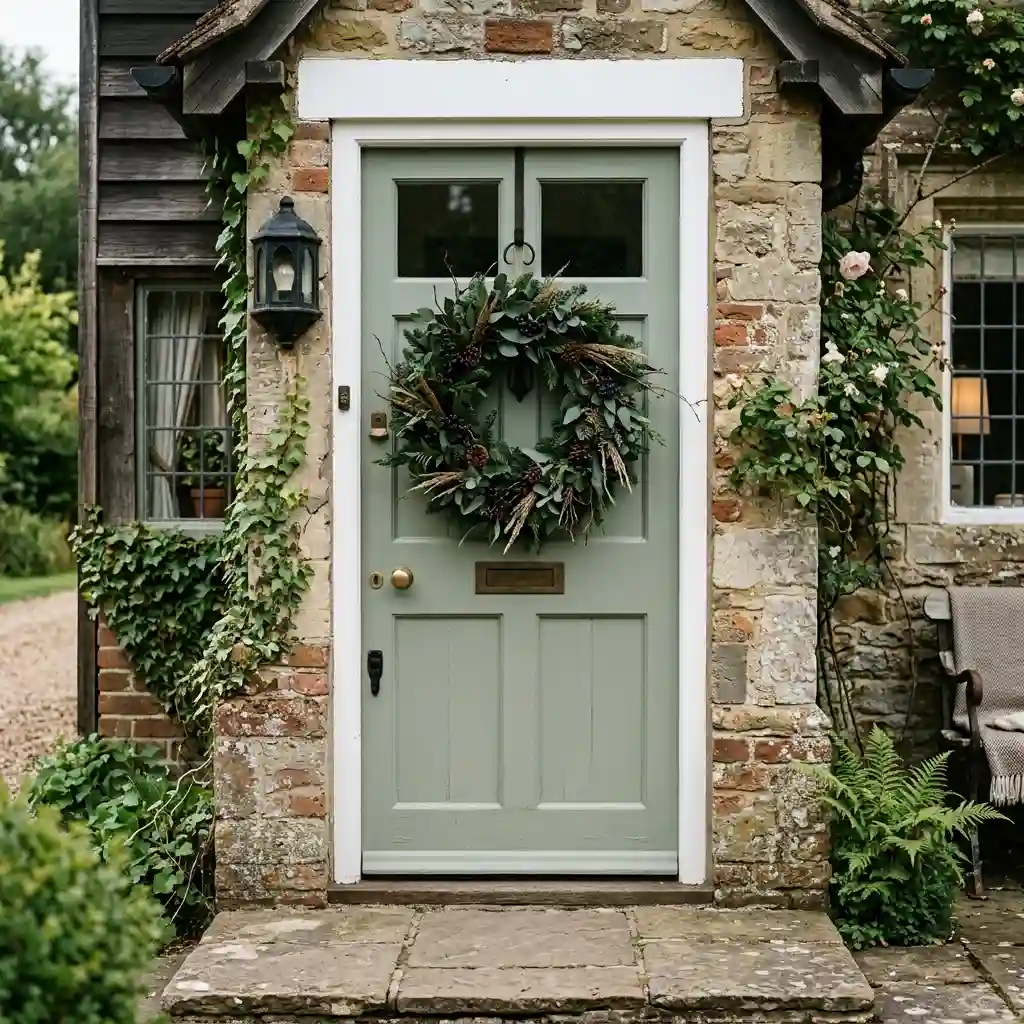
Wreath and garland sizing follows proportion, not preference. A standard US exterior door measures 36 inches wide by 80 inches tall, and both the ring and the drape are sized off those two numbers. Most Halloween wreath ideas fail here rather than at the shopping stage. Get the proportion right and a $30 wreath looks chosen carefully. Get it wrong and a $150 wreath looks borrowed from a smaller house.
Sizing a Wreath to a Standard Door
Designer Rule of Thumb: subtract 12 inches from the door width to get the wreath diameter. A 36-inch door takes a 24-inch wreath, which fills roughly 60% to 70% of the width and leaves about six inches of clear paint on each side. The comfortable band runs 22 to 26 inches. Push to 28 or 30 inches when you want the door to be the loudest thing on the house, and go to 30 to 36 inches on oversized or double doors.
Height matters as much as diameter. Hang the ring so its top sits roughly 12 to 14 inches below the top of the door, which puts the centre a little above eye level and stops the wreath from looking like it slid down. Those two numbers hold all year, which is why these spring wreath for front door ideas sit at the same height on the same doors.
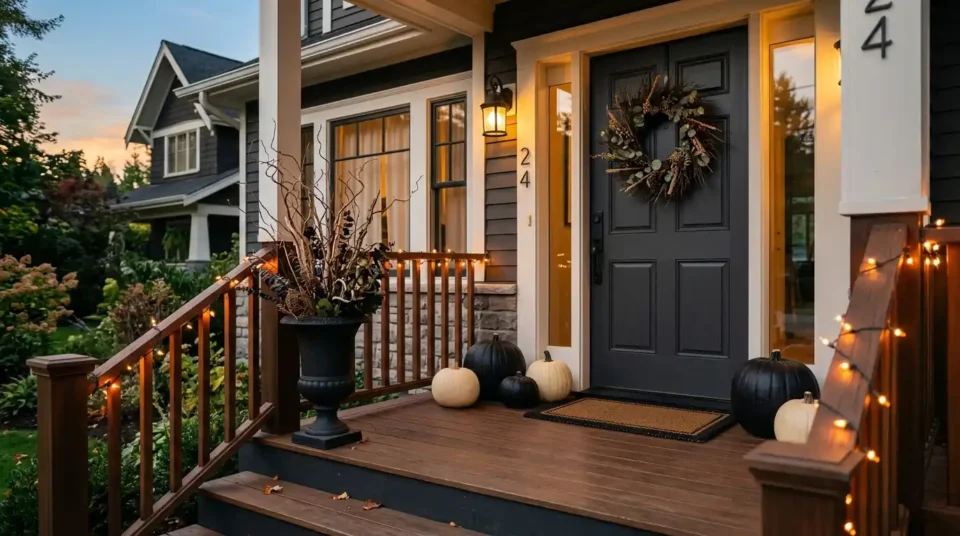
Halloween adds one rule the other seasons do not need. Black absorbs light, so a black wreath on a charcoal, navy or deep green door loses its outline the moment the sun goes down. On a dark door, either go up one size — 26 inches instead of 24 — or build in one pale material that holds the edge.
DESIGNER TIP: Photograph the door with your phone at dusk, standing at the sidewalk. Anything that vanishes in that photo will vanish for every visitor from mid-October onward.
Sizing a Garland to a Mantel or Door Frame
Garland length equals the mantel width multiplied by 1.5 for a soft drape. A 6-foot mantel takes 9 feet of garland; a 5-foot mantel takes about 7.5 feet. If you want tails hanging down each side, use the second formula instead: mantel width plus four feet, which gives roughly two feet of fall at each end. Multiply by 2 when you want a deep swag in the centre.
Door frames need more than people expect. A 36 by 80-inch frame measures about 196 inches around three sides, so a full surround needs roughly 16 feet of garland — usually two 9-foot lengths rather than one. Stair rails run longer still, and a garland pulled tight along a rail always looks cheaper than one allowed to dip. A little slack is the whole look, and the same rule shapes these cozy winter decor ideas when the greenery changes over in December.
Which Halloween Wreath Ideas Actually Hold Up?
The material that looks best in a photo is often the one that fails first in real weather. A Halloween display sits out through the wettest, windiest stretch of autumn, and the door and the mantel test completely different things — moisture and UV outside, radiant heat inside.
On an Exposed Front Door
Material Note: Paper die-cuts, untreated cotton ribbon, loose feathers and foam props are the four things that reliably fail on an exposed door, usually within the first heavy rain or the first sustained wind.
What holds instead: UV-treated faux foliage, wired polyester ribbon, resin, powder-coated metal and wood beads. Wired ribbon holds a shape after rain; unwired cotton ribbon collapses and stays collapsed. Preserved eucalyptus — real foliage treated with glycerin so it stays soft rather than shattering — is beautiful, but it belongs under a covered porch, not on a door that catches weather side-on.
Climate Note: In coastal or high-humidity areas, dried stems soften and drop within two to three weeks outdoors, so faux or preserved material is the more practical choice for a long display. Doors that sit in full afternoon sun fade dyed black foliage toward a dusty brown, which is the same exposure problem behind these cozy winter front porch decor ideas.
On a Mantel That Gets Lit
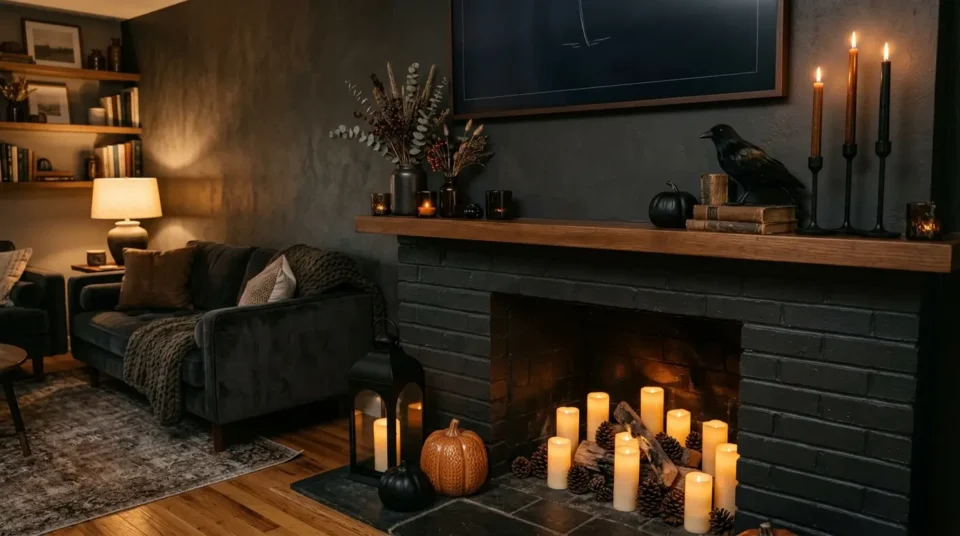
A mantel garland is the piece most likely to become a real hazard, because late October is also when people start lighting the fireplace again. Dried wheat, feathers, paper and loose ribbon tails are all fuel, and they sit directly above a heat source.
Safety Note: The National Fire Protection Association’s heating safety guidance advises keeping anything that can burn at least three feet from fireplaces and other heating equipment.
The practical version: clip the garland up and back against the mantel face rather than letting it drape over the front edge, skip tails entirely on a working firebox, choose faux or flame-resistant material over dried stems, and use battery LED candles instead of open flame anywhere the garland could reach. Metal clips and floral wire hold better than adhesive here, because adhesive softens under radiant heat.
How to Move From Props to Material This Season
Five moves get you there without replacing everything you own. Work them in order — the first one saves the most money over three seasons.
- Buy the base, not the wreath. A 22 to 24-inch black grapevine ring costs $12 to $20 and lasts years. Grapevine is a woody vine base that holds wire without splitting, so you can re-dress it every autumn instead of rebuying.
- Cap the palette at two colors plus one metal. Write the three down before you shop and refuse anything outside them. This one habit does more for the finished look than any single material.
- Add one surface that catches light. Tarnished silver berry, smoked glass beads, oxidized brass bells or a pewter velvet ribbon. Matte-on-matte is what makes a black wreath disappear at dusk.
- Carry one material from the door to the mantel. Same ruscus, same ribbon, same bells. Pick the cheapest of the three to repeat — a $6 spool of ribbon does this job as well as a $30 spray of berries.
- Fix the hardware before you fix the wreath. A weight-rated over-the-door hanger or a magnetic hanger costs under $15 and prevents the crooked, sliding, scratched-paint problem entirely.
DESIGNER TIP: Attach heavy elements at the four and eight o’clock positions on the ring rather than the sides. Weight low keeps the wreath hanging straight when the door swings.
Reusing one base across seasons is also how the wreath habit stops being expensive, and it is the logic behind these modern spring wreath ideas as well.
Mistakes That Flatten a Halloween Wreath
Instead of replacing the whole wreath every October, Try keeping one dark base and swapping only the attachments — the base is the expensive part and the least seasonal.
Instead of matching a black wreath to a black door, Try one clear step of contrast: bone white, tarnished silver or a pale ribbon that holds the outline after dark.
Instead of a nail or a bent wire hook, Try a weight-rated over-the-door hanger, or a magnetic hanger if your door is steel — magnets hold on steel only, not fiberglass or wood.
Instead of one small wreath centred on a wide or double door, Try two matching rings at the same height, or a single oversized 30 to 36-inch ring.
What You’ll Spend on a Wreath or Garland
A re-dressed base beats most ready-made wreaths at roughly half the money, so the cheapest tier here is not the compromise tier. The figures below are typical retail ranges for the materials named above.
| Project | Estimated Cost | Impact Level |
|---|---|---|
| Build-your-own — 22 in. black grapevine base, dyed foliage, wired ribbon | $25–$55 | High |
| Ready-made material wreath, 22–26 in., plus a 9 ft mantel garland | $70–$160 | Very High |
| Preserved-foliage wreath with a pre-lit garland run | $180–$400 | Medium |
On a budget under $60, the build-your-own route wins outright — the grapevine base runs $12 to $20 and the fillers do the rest. In the $70 to $160 mid range you get a matched door-and-mantel pair, which is the single biggest jump in how finished a house looks. Above $180 you are paying for preserved botanicals and built-in lighting, both lovely and both fragile; that tier makes sense only if the pieces live under cover.
Best First Upgrade: The matched wreath-and-garland pair. Coordinating the door with the first surface you see inside does more visible work than any third piece.
Skip for Now: Pre-lit garland in your first season. Battery micro-LEDs threaded through a plain garland cost a fraction of it and let you decide whether you actually want the glow.
Will the Material Wreath Still Look Right Next October?
The dark, textured wreath is not a one-year trend, because it is being pushed by two forces that are not reversing. Displays now run for weeks rather than a night, and novelty does not survive that length of exposure. Retail ranges have followed, and they take years to turn back.
What will settle is the intensity. The full gothic-library scheme — emerald, black, antique brass, dark florals — is having its loud moment and will calm into a quieter version, in the same way moody interiors did. The pieces that hold value are the plain bases and the neutral materials, not the themed sets.
Designer’s Verdict: Buy the base and the neutral materials once, and treat everything explicitly Halloween as a cheap, replaceable layer — that combination survives a palette change, while a themed set rarely survives two seasons.
If You Rent, or Your Door Says No
Some doors rule themselves out. Apartment corridors ban anything projecting into the walkway, many buildings prohibit nails or adhesive on fire-rated doors, and a fair number of HOAs have a rule about seasonal decor on the street-facing elevation.
Rental Note: An over-the-door hanger with a felt-backed hook leaves no mark and satisfies most lease terms; magnetic hangers work on steel doors and leave nothing at all.
If the door is genuinely off limits, move the piece inside. A wreath hung on an interior wall, a mirror or the front of a bookcase works perfectly well, and a garland along a console or a stair rail is often the better display anyway, because it gets seen from the sofa every evening. Small apartments benefit most from this, since one styled surface does more than three scattered ones — the same editing logic runs through these creative small apartment ideas.
Your Halloween Wreath and Garland Checklist
- Measure the door width, subtract 12 inches, and shop that diameter first.
- Write down two colors and one metal, then reject anything outside them.
- Add one light-catching material so a dark wreath keeps its outline at dusk.
- Multiply your mantel width by 1.5 for garland length, or add four feet for tails.
- Buy a weight-rated or magnetic hanger before you buy the wreath itself.
- Keep dried and paper material at least three feet from any working fireplace.
KEY TAKEAWAY: The base and the hardware are the two purchases worth getting right, because everything attached to them is cheap enough to change every year.
Related Seasonal Ideas:
- 21 Front Porch Decor Ideas That Make Your Home Feel Inviting
- Creative Fall and Autumn Decor Ideas for a Seasonal Refresh
- Magical Christmas Window Decor Ideas You’ll Wish You Had Tried
- 16 Charming Felt Christmas Decorations for a Cozy Handmade Holiday
- Beautiful Wall Hanging Craft Ideas to Elevate Your Gallery Wall
- Browse all our seasonal decorating ideas
Frequently Asked Questions
Conclusion
If your door is dark, north-facing or overshadowed by a porch roof, ignore every palette suggestion and start with one pale material — that single choice does more than any other Halloween wreath ideas you will read this month. Everything else on the ring is cheap enough to change your mind about next year. Our home decorating ideas pick up wherever the front door leaves off.