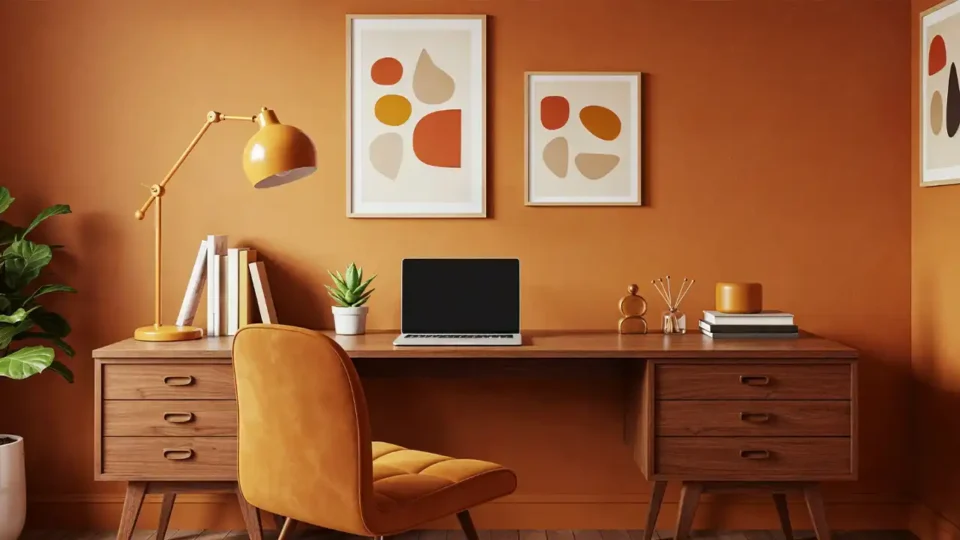
TL;DR
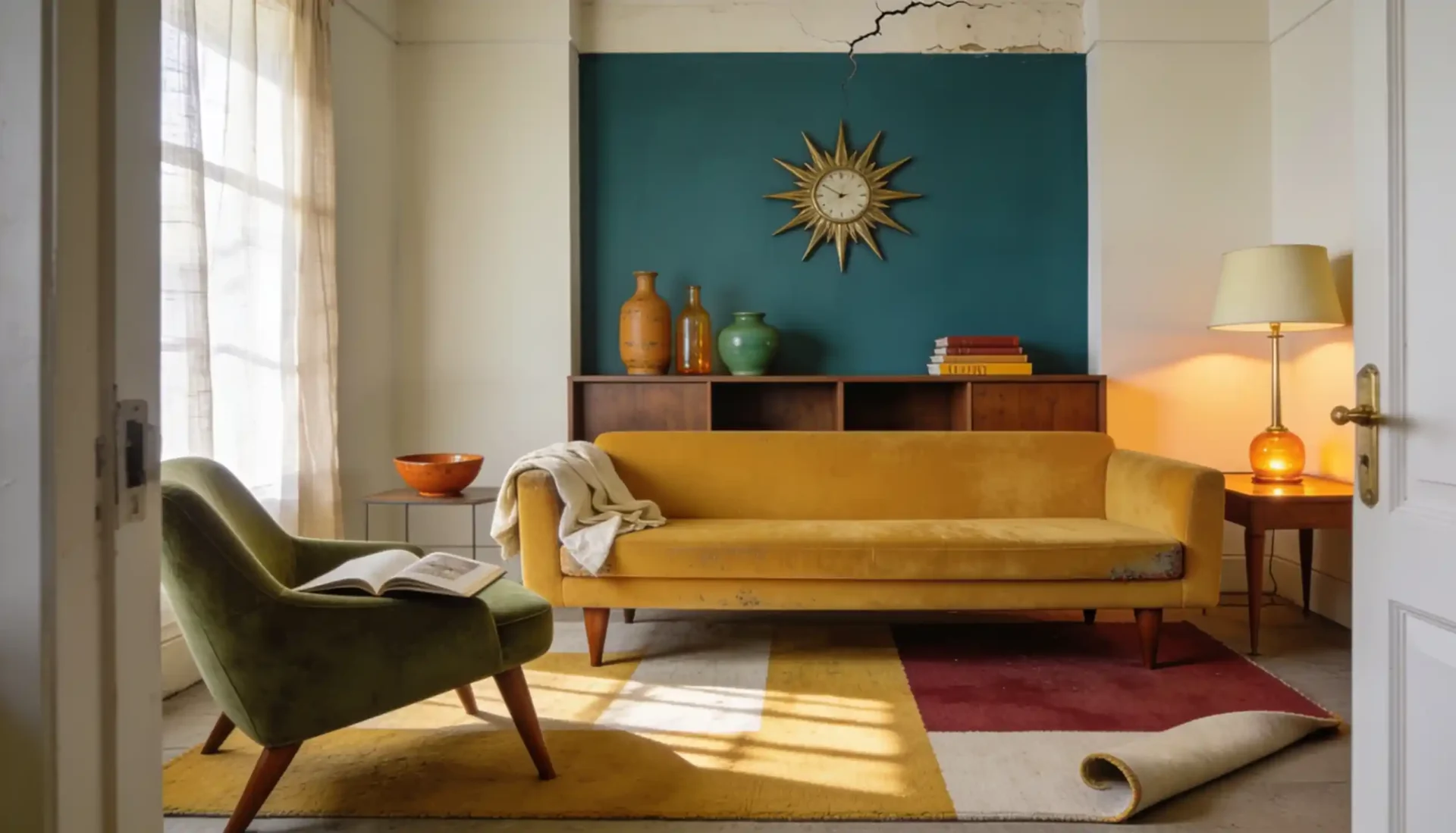
A colorful mid century modern living room starts with one saturated anchor piece — mustard, rust, olive, or peacock blue — and builds outward with walnut wood, warm cream, and brass accents. The palette is warm and bold, never pastel. Color plays a structural role in mid-century design, not a decorative one. Two or three hues against a warm neutral base is the right ratio for most rooms.
Why Color Belongs in Mid Century Modern Design
Mid-century modern rooms were never designed to be neutral. The original practitioners — Charles and Ray Eames, George Nelson, Arne Jacobsen — used mustard yellow, burnt orange, avocado green, and peacock blue as deliberate structural choices. These weren’t accents thrown in after the furniture was placed. Color was part of the plan from the start, chosen to feel optimistic and forward-looking in postwar homes that had reason to want both.
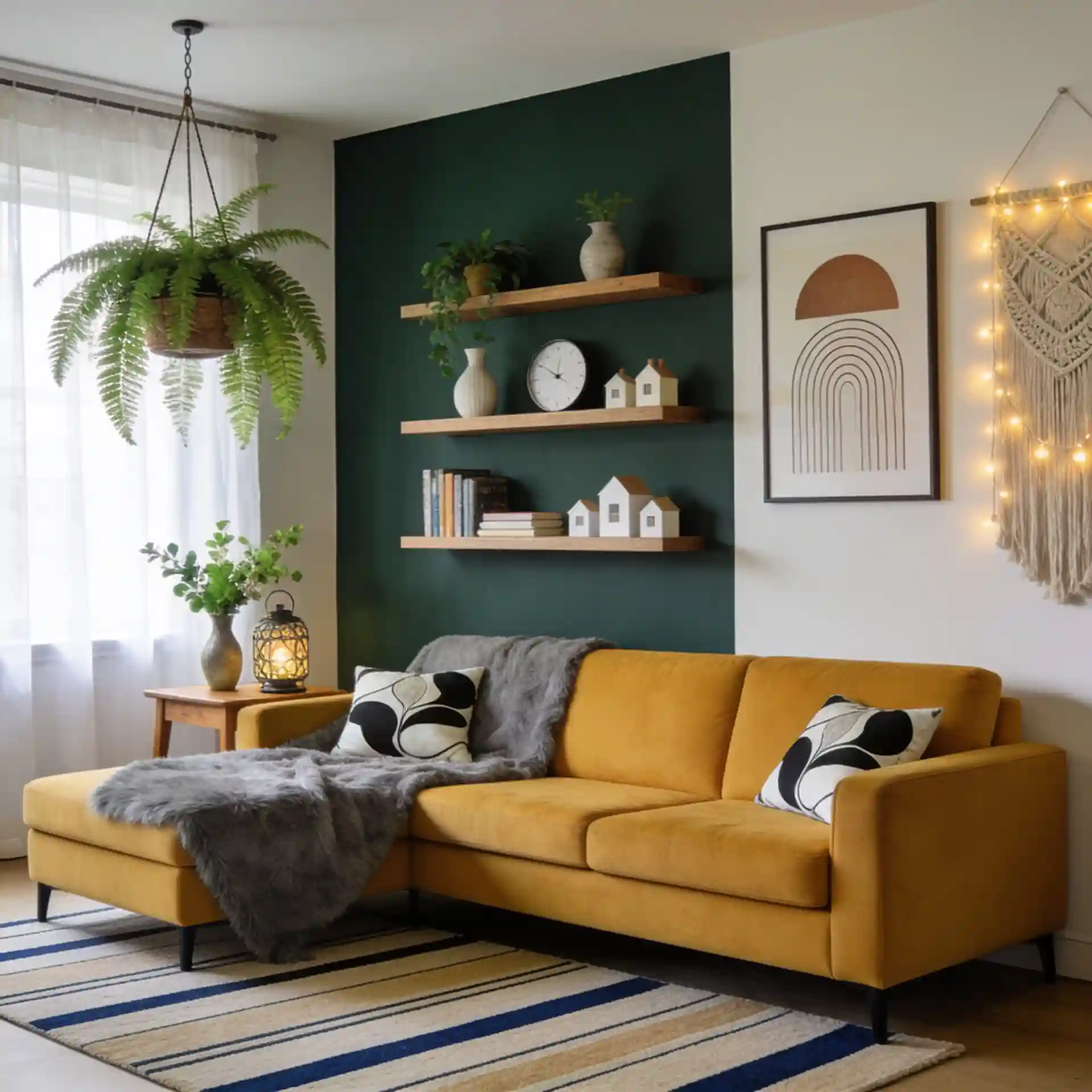
A colorful mid century modern living room works because the palette is contained, not chaotic. Two or three saturated hues against walnut wood, warm cream linen, and brushed brass — that is the formula. One or two pieces carry the color. The rest of the room stays calm and grounded. The result feels curated rather than busy, and that balance is what keeps the style relevant decades later.
Editorial field note: A living room that switched from a warm greige sofa to a rust velvet sofa with walnut tapered legs stopped feeling like a placeholder overnight. The color made every other decision click — the rug, the art, the curtains. In mid-century rooms, color is the thing that finishes the space.
For the full picture of what makes a luxurious living room come together across styles, see our living room ideas for a luxurious designer look. And if you want to see how color and mood combine in a darker, moodier take on this aesthetic, the moody mid-century modern living room design guide is a strong companion to this one. Find even more inspiration across every room at 101homedecor.com.
Bookmark this guide for quick reference.
KEY TAKEAWAY: Mid-century modern color works because it is selective — one or two saturated pieces against warm neutrals and walnut wood keep the room settled, not overwhelming.
| Quick Takeaways | |
|---|---|
| Palette | Mustard, rust, olive, and peacock blue — warm and saturated, never pastel. |
| Anchor Piece | One bold sofa or armchair carries the main color. Everything else supports it. |
| Wood Tone | Walnut is the pairing standard — it grounds warm hues and softens cool ones. |
| Pattern | Geometric and atomic prints belong here — in wool rugs, cushions, and art. |
| Balance | Cream linen and warm brass hold bold colors together without dulling them. |
Colorful Mid Century Modern Living Room Checklist
- Pick one bold anchor piece — sofa, armchair, or accent wall — in mustard, rust, olive, teal, or peacock blue
- Ground it with walnut or teak furniture featuring tapered, angled legs and clean-lined silhouettes
- Lay a geometric or abstract wool rug at least 8 by 10 feet so front legs of all seating land on it
- Add brushed brass or copper accents in lamp bases, side table frames, and mirror frames
- Layer two coordinating cushion prints — one geometric, one abstract — without a third competing pattern
- Keep walls in warm cream or warm white; use one saturated accent wall at most, never two competing painted walls
- Finish with vintage-inspired ceramics, colored glass, or abstract art as shelf and surface styling
KEY TAKEAWAY: Every item on this checklist has a structural purpose — follow it and the palette takes care of itself.
12 Colorful Mid Century Modern Living Room Ideas
Mid-century modern is the perfect backdrop for bold, saturated color. These twelve ideas — mustard velvet, olive green, and deep teal against warm walnut — show how to bring vibrant hues into a MCM living room.
1. Anchor With a Mustard Velvet Sofa
A mustard yellow velvet sofa is the defining anchor piece in a colorful mid century modern living room. Mustard was among the most widely used hues in American and Scandinavian interiors from the late 1950s through the early 1970s, and it remains the most recognizable MCM color today. Look for a sofa with a low-slung profile, straight tight arms, and walnut or teak tapered legs — the silhouette matters as much as the color. Pair it with a cream wool area rug and warm walnut side tables. A mustard sofa grounds every other color decision in the room. Start here and build outward from that anchor.
2. Pair an Olive Green Armchair With Warm Walnut
Olive green is mid-century modern’s quieter earthy hue — richer than sage, less vivid than avocado, and far more versatile than either. An olive velvet or boucle armchair with a walnut frame and angled legs works as both a color accent and a functional seat. Place it at a 30-to-45-degree angle to the sofa rather than directly parallel. The slight diagonal creates a more conversational layout and gives the chair its own visual presence. Olive pairs well with rust, mustard, and cream linen. It also works alongside matte black if you want sharper contrast without introducing another warm hue.
DESIGNER TIP: Angling an accent chair 30–45 degrees from the sofa opens the seating zone and makes the room feel gathered rather than grid-arranged.
3. Lay a Bold Geometric Wool Rug as the Color Foundation
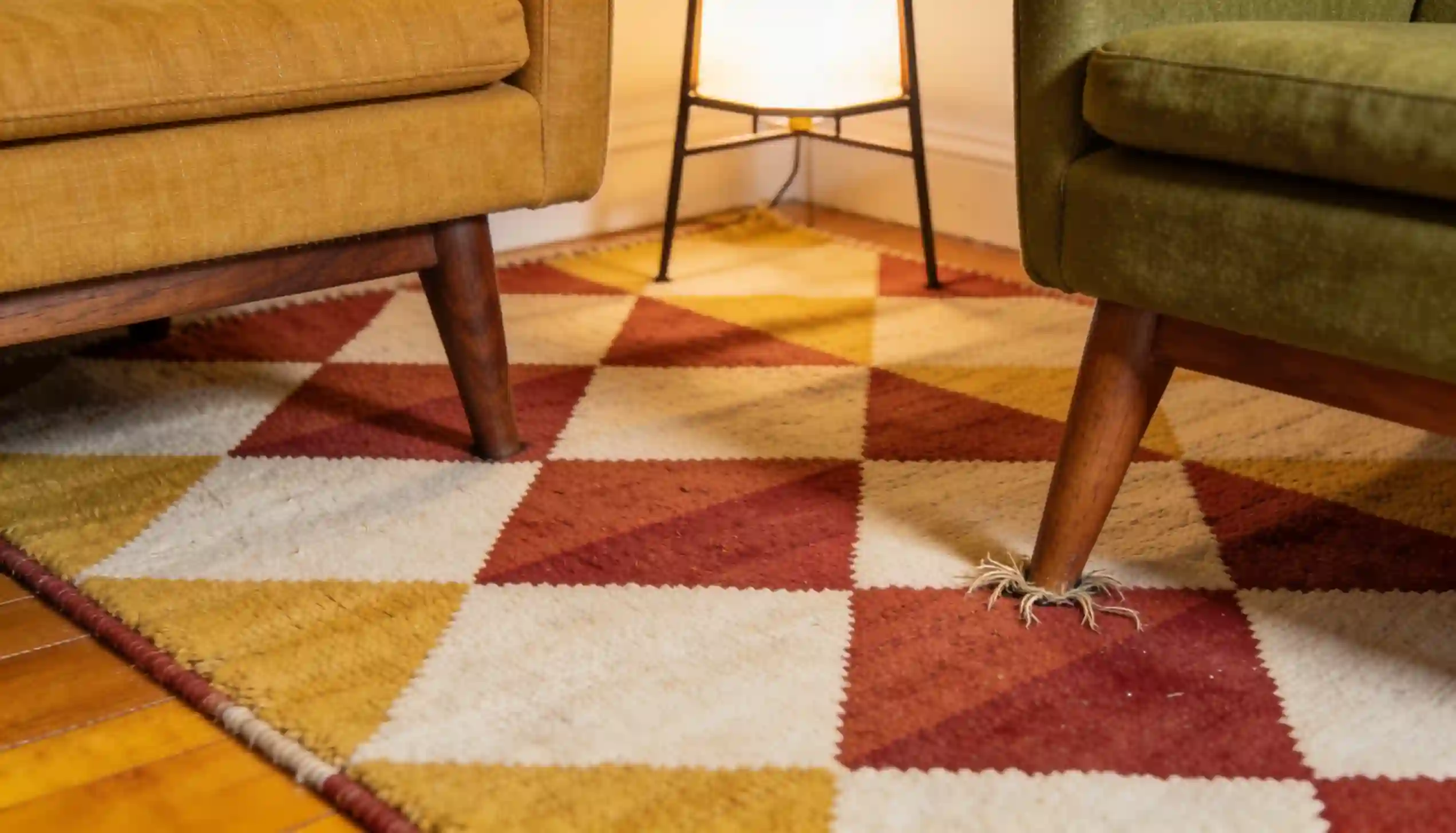
The rug in a colorful mid century modern living room does double work: it anchors the seating area and introduces pattern. A geometric wool rug in two or three coordinating colors — mustard and rust, or teal and cream — gives the room its color vocabulary before any furniture is placed. The pattern can be simple (a diamond repeat, a bold stripe) or more complex (an abstract tessellation). Designer Rule of Thumb: the front legs of all seating should sit on the rug — this creates one cohesive zone rather than furniture islands. Size minimum for a standard living room: 8 by 10 feet. A 9 by 12-foot rug reads better in rooms over 200 square feet.
4. Paint One Wall in Deep Teal or Warm Terracotta
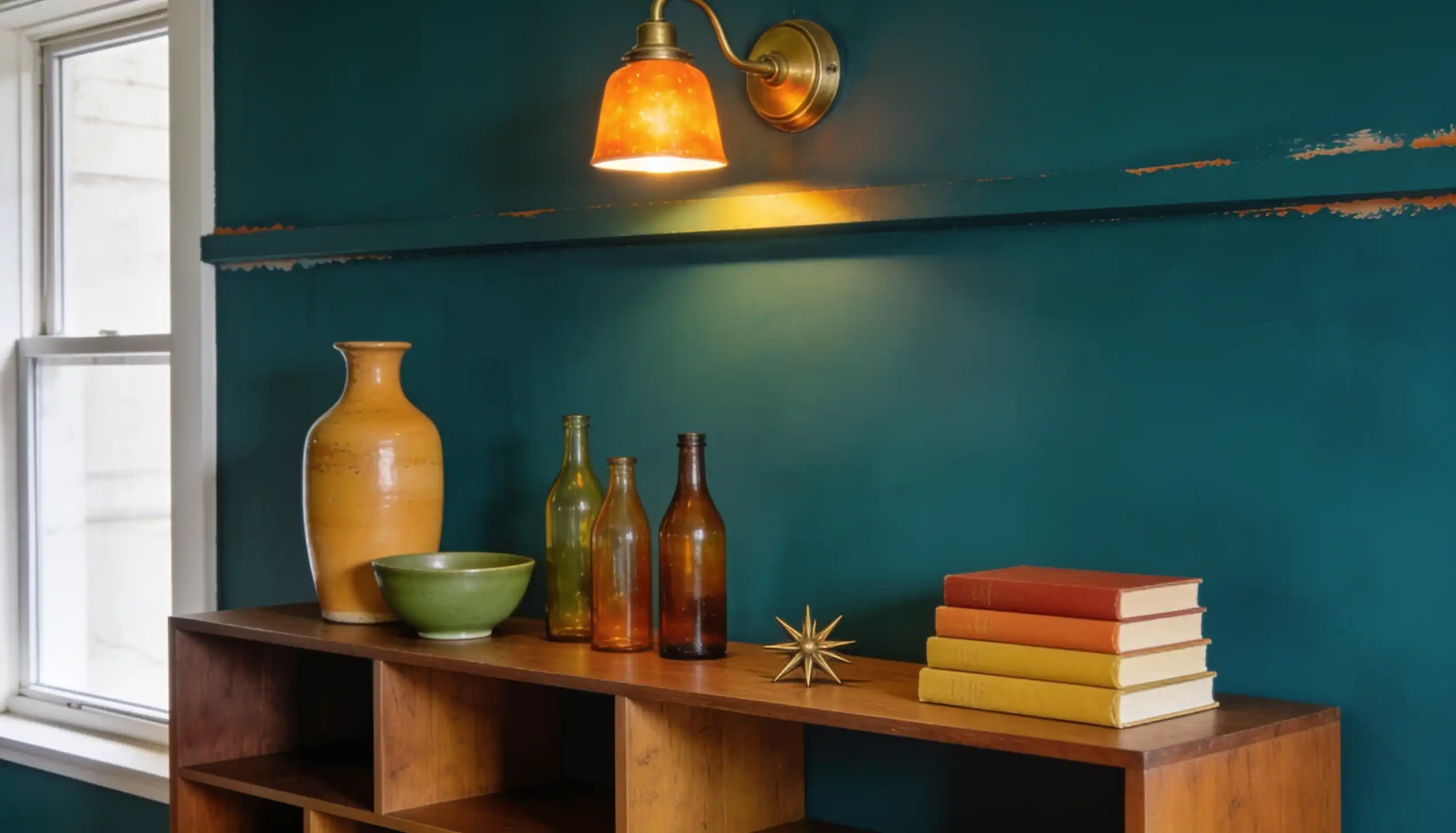
An accent wall changes the temperature and tone of the whole room in a way that furniture alone cannot. Deep teal reads cool, confident, and retro — it pairs well with mustard, brass, and walnut. Warm terracotta reads earthy and sun-baked, slightly more current, and pairs naturally with cream linen and rust upholstery. Either works in a colorful mid century modern living room. What does not work is a wall color that ignores the upholstery palette. Paint the wall behind the main seating arrangement or primary architectural feature — a fireplace surround or a built-in shelving unit. One wall is enough. Two competing painted walls fragment the room’s focus. For more color selection guidance, browse all our color ideas.
5. Add a Peacock Blue Armchair or Large Pouf
Peacock blue — a saturated blend of teal and deep navy — is one of mid-century modern’s signature jewel tones. Used as an accent chair or large floor pouf, it provides a counterpoint to the room’s warmer hues without shifting the palette fully cool. Peacock blue is the color that makes a mustard-and-rust room feel like a designed space rather than a warm monochrome. The key is repetition: use the hue at least twice — in the chair and a small ceramic on a shelf, or in a cushion and a piece of abstract art. An isolated color always looks accidental. Repeated color looks like intention.
6. Style Open Shelves With Vintage Ceramics and Colored Glass
Open shelving in a colorful mid century modern living room becomes a color engine. Vintage pottery in warm ochre and avocado, colored glass in amber and bottle green, and hardback books arranged by spine color can carry significant palette energy without adding another furniture piece. Use the shelf as a curated display — mix tall and low objects, leave empty space between groupings, and repeat at least one color from the main seating. Odd-numbered groupings (three ceramics, five books, one sculptural piece) hold together better than even-numbered pairs. If the shelf looks styled instantly, it usually needs one more edit — take something away, then stop.
DESIGNER TIP: Repeat a single shelf color — an ochre ceramic, an amber glass vase — in at least two other spots in the room so the shelf reads as connected, not isolated.
7. Hang Floor-to-Ceiling Curtains in Deep Ochre or Forest Green
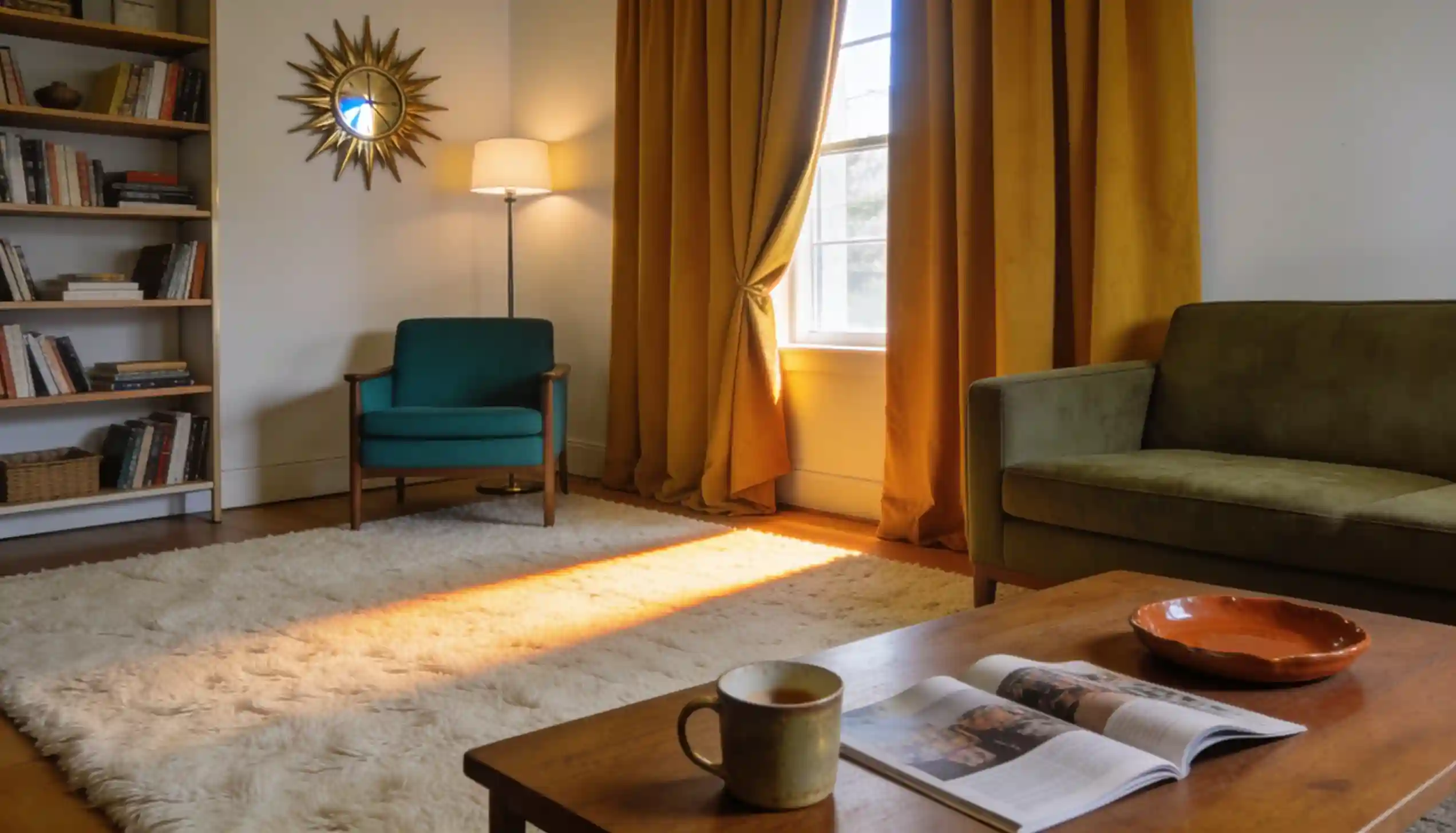
Floor-to-ceiling curtains in a saturated hue add height, warmth, and color volume without touching the floor plan. Deep ochre curtains frame a window wall and blend naturally with mustard and rust tones throughout the room. Forest green curtains pull the palette slightly earthier and pair well with walnut and brass. In a colorful mid century modern living room, jewel-toned curtains also serve a practical function: they absorb ambient light and make the room feel more intimate after sundown. Hang the curtain rod at ceiling height — or as close as molding allows — and let the panels fall to the floor. A heavyweight linen or velvet curtain in a deep color reads far more expensive than it typically costs. For scale-aware tips in smaller MCM spaces, these small living room ideas cover proportion and color volume clearly.
8. Mix Warm Brass and Copper Accents Throughout
Brass and copper are the metal standards for a colorful mid century modern living room. Chrome reads too cold; brushed nickel belongs in a different aesthetic entirely. Brass reads warm and slightly vintage without tipping into ornate or glamorous. Copper reads richer and earthier. Use one as the dominant finish — in floor lamp bases, swing-arm wall sconces, side table frames, and mirror frames — and let the other appear in smaller doses as decorative objects. A brushed brass floor lamp next to a mustard velvet sofa is a classic MCM pairing: the warm metal amplifies the warmth of the yellow without competing. Mixing metals can work, but only when one is clearly dominant.
9. Hang Large-Scale Abstract or Geometric Wall Art
Art in a colorful mid century modern living room is a color source, not filler. A large abstract canvas in rust, mustard, and cream pulls the room’s palette together in one place. A bold geometric print in teal and matte black gives a cooler counterpoint to warm upholstery. Either approach works, but scale matters significantly: art that is too small above a sofa looks tentative. A single piece or gallery grouping that spans at least 60–80 percent of the sofa’s width reads as chosen carefully. Source Note: Interior stylists generally recommend hanging the center of a framed piece at 57–60 inches from the floor — standing eye level for most adults — for balanced wall proportions.
10. Layer Atomic and Geometric Print Cushions
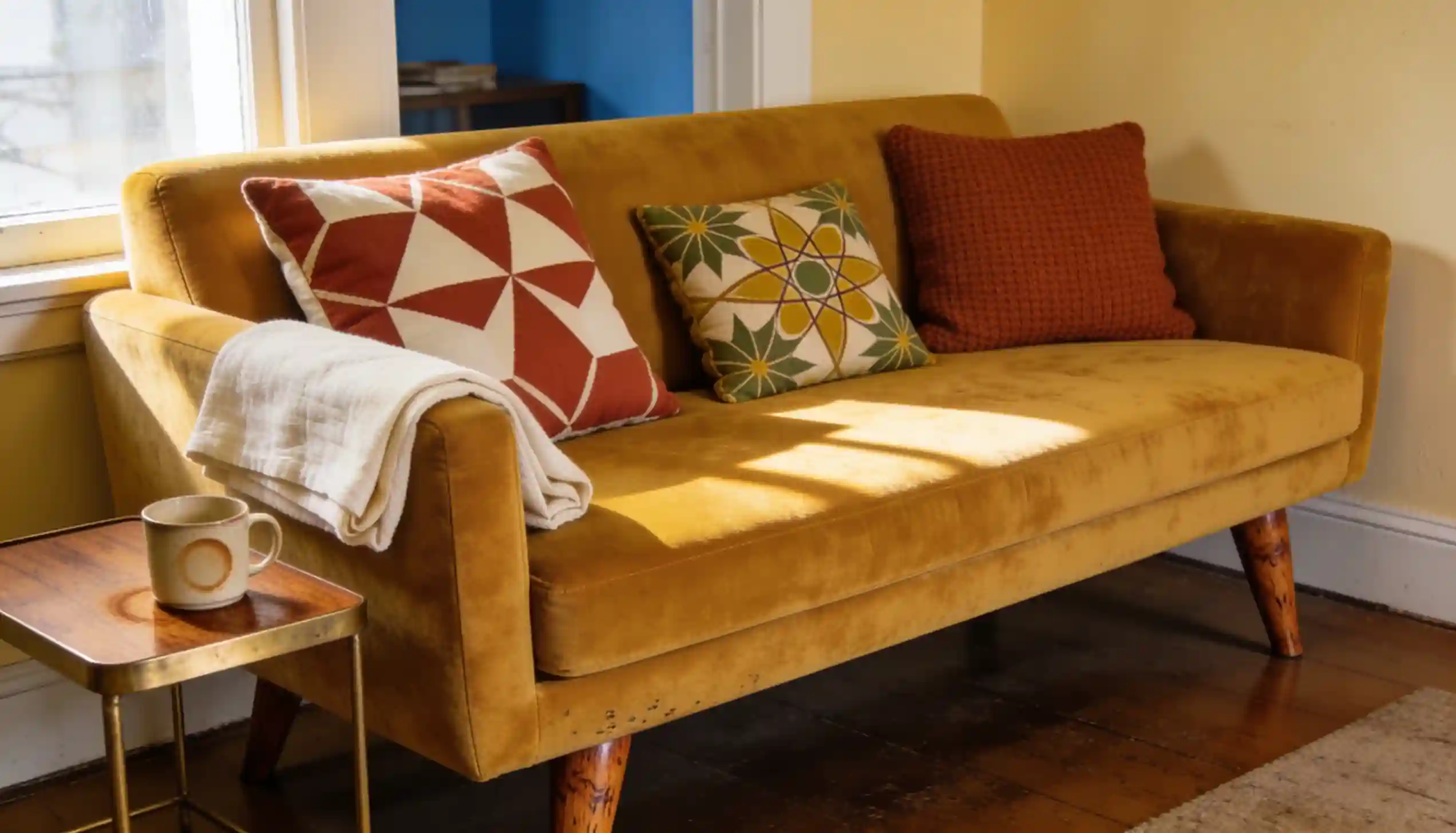
The atomic starburst, the boomerang curve, the bold geometric repeat — these prints belong to mid-century modern’s visual vocabulary. Two or three cushions in these patterns on a velvet sofa add warmth, texture, and pattern depth without adding furniture. Keep them in the room’s existing color family: a mustard sofa might carry rust, cream, and olive cushions; a peacock blue armchair might carry teal, ochre, and black. Limit competing prints to two — a small geometric alongside a larger abstract is a pairing that layers well. Three prints of similar scale compete rather than complement. Knit wool and raw cotton cushions add texture alongside the pattern for more depth.
11. Introduce a Sunburst Mirror or Starburst Wall Clock
A sunburst mirror or starburst wall clock in warm gold or aged brass is one of mid-century modern’s most recognizable signatures. Hung alone on a bare wall, it acts as a focal point and sculptural piece without the visual weight of a full gallery arrangement. It also solves a common problem in colorful MCM rooms: what to do with a wall that isn’t large enough for a painting but too prominent to leave empty. A sunburst mirror reflects light and amplifies the brass tones already in the room; a starburst clock adds graphic interest and a sense of movement. Either piece should measure at least 24–30 inches across to register as a deliberate design statement rather than a small decorative object.
12. Balance Bold Colors With Walnut Wood and Cream Linen
The final idea is actually the edit: every colorful mid century modern living room needs a generous amount of walnut wood and cream linen to keep the palette settled. Walnut is warm and earthy — it absorbs competing hues and holds them together. Cream linen on a cushion, curtain panel, or draped throw provides the room’s quiet space. Without these two elements, even a carefully chosen palette can start to feel like a theme park rather than a designed room. The ratio that holds in most rooms: roughly 50 percent warm neutral, 30 percent wood tone, 20 percent saturated color. Adjust based on light — north-facing rooms need more warmth, south-facing rooms can carry more saturation.
KEY TAKEAWAY: Twelve ideas, one core rule — start with one bold anchor, support it with walnut and cream linen, and let color do the structural work.
Bringing the Colorful Mid Century Modern Look Together
A colorful mid century modern living room is finished when the palette feels coherent rather than complete. You don’t need every idea on this list. Pick the ones that match your budget and your room’s proportions, then check the overall feel before adding more.
Start with the largest surface — the sofa. If it is already bold, keep the walls and rug calmer. If the sofa is a neutral, the rug or an accent wall carries the main color. Layer in the metals, the art, and the accessories last. Use them to reinforce colors already in the room rather than introduce entirely new ones.
If your space is compact, tiny living room ideas cover how to keep scale and proportion working for a small room rather than against it. And if you want to carry the MCM aesthetic beyond the living room, the guide to mid-century modern dining tables covers exactly what to look for in a dining piece that connects both spaces.
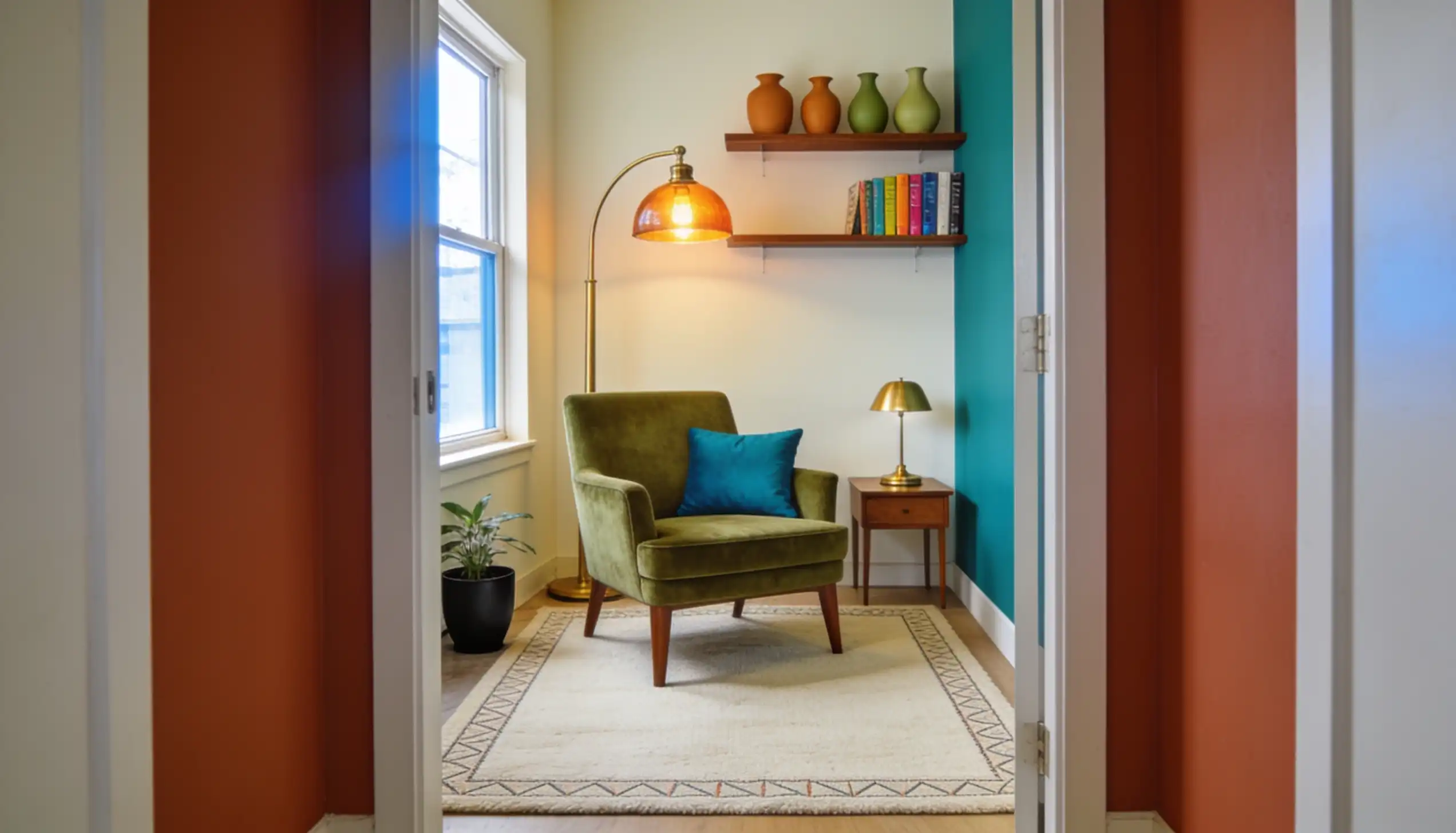
Check the room from the doorway. A colorful mid century modern living room should settle on that first glance — warm, rich, and edited, not busy or competitive. If one piece jumps out for the wrong reason, pull it back before adding anything new.
Find all our living room ideas organized by style or browse the full rooms collection for inspiration across every space in the home.
KEY TAKEAWAY: One bold anchor, warm neutrals for balance, walnut and brass to tie it all together — that is the colorful MCM formula in practice.
What to Avoid
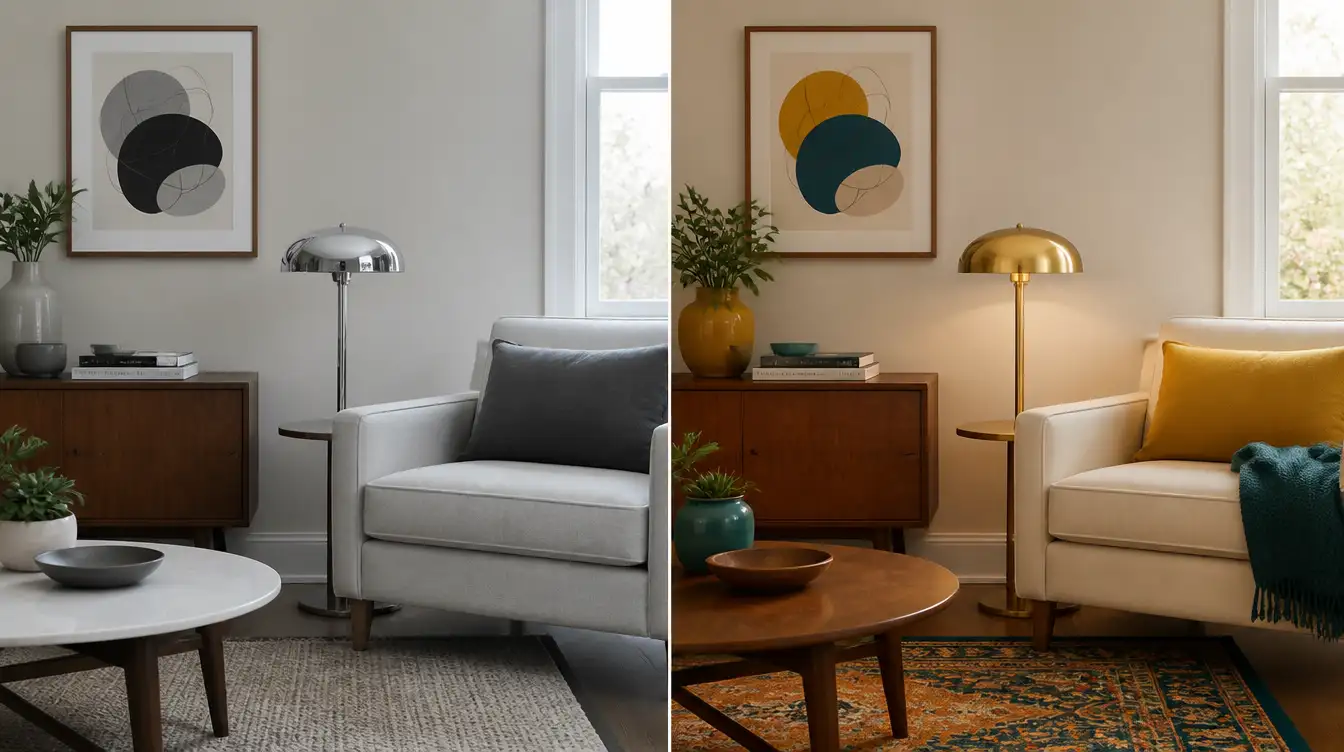
❌ Too many competing saturated colors → ✅ Limit bold hues to two or three; warm neutrals carry the rest of the room
❌ Cool grey or stark white walls behind warm MCM furniture → ✅ Warm cream, warm greige, or a single jewel-toned accent wall always reads better
❌ Chrome or brushed nickel hardware → ✅ Switch to brushed brass, aged brass, or copper — the right metal shifts the whole room
❌ An undersized rug that floats in the seating area → ✅ Go to at least 8 by 10 feet and make sure front legs of all seating land on the rug
KEY TAKEAWAY: Most MCM color mistakes come from the wrong scale, wrong metal finish, or one hue too many — all easy to fix before you commit.
Budget & Cost
Bold MCM color does not require a full room overhaul. The highest-impact changes — a statement sofa and a geometric rug — are also the clearest starting points. Paint comes first because it costs almost nothing and immediately tests whether the palette works.
| Project | Estimated Cost | Impact Level |
|---|---|---|
| Accent wall paint in teal or terracotta (DIY) | $30–$80 | High |
| Geometric wool area rug, 8×10 feet | $200–$600 | Very High |
| Bold accent armchair in olive or peacock blue | $400–$1,200 | High |
| Mustard or rust velvet sofa with walnut legs | $800–$2,500 | Very High |
Best First Upgrade: Paint one accent wall in a warm jewel tone — it is the fastest way to see whether the palette works before committing to new furniture.
Skip for Now: Replacing curtains in the first round — wall color and the rug carry far more visual weight for less cost.
For more ways to stretch a living room budget without losing style, browse our budget decor ideas.
KEY TAKEAWAY: Start with paint and one bold rug — that combination changes how the whole room feels before a single furniture piece is replaced.
Decisions Worth Making Carefully
Small apartment layout. In a compact living room under 200 square feet, one bold color is more powerful than three. A mustard sofa or an olive armchair does more work than a full palette of competing hues crowded into a small floor plan. Keep the rug in a coordinating neutral-adjacent tone — warm cream with a subtle geometric print — rather than a saturated color that fights the furniture for attention. For apartment-sized MCM rooms on a tighter budget, smart ways to decorate a small living room on a budget covers furniture scale and palette decisions that keep small spaces from feeling cluttered.
Rental-friendly version. If painting is off the table, the rug and the statement sofa or armchair carry the palette entirely. Add brass floor and table lamps, colorful ceramics on open shelving, and jewel-toned throw cushions. The room still reads as a colorful mid century modern living room without a single wall nail or hook.
Open-plan living and dining. When the living room flows into a dining area, keep the MCM palette consistent across both zones. A mustard sofa at one end and teal dining chairs at the other reads as two rooms rather than one. A shared element — warm brass hardware, a repeated walnut wood tone, or a linking area rug — ties the zones together. The right dining piece makes this connection effortless.
Mixing MCM with other styles. Mid-century modern sits naturally alongside coastal, Japandi, and warm minimalist interiors. The shared elements are clean lines, natural wood, and restrained styling. If the room already has coastal-influenced furniture, serene neutral coastal living room ideas show how to keep the palette calm enough to complement rather than compete. Boho layers — woven textures, vintage objects, layered rugs — can fold into an MCM room cleanly too; boho coastal living room ideas cover the layering approach in detail.
KEY TAKEAWAY: Small spaces, rentals, and open-plan layouts each need one adaptation — but the colorful MCM formula holds in all three contexts.
Frequently Asked Questions
Conclusion
A colorful mid century modern living room is less about following a checklist and more about understanding how the palette works together. Color in this style is structural — a mustard sofa anchors a room the way a neutral one never quite manages. A teal accent wall behind a walnut shelving unit makes the whole wall feel designed. These choices carry the room’s energy, and everything else — the brass lamps, the geometric wool rug, the shelf ceramics — supports rather than competes.
The rooms that work best in this style share one quality: they are edited down to what the space can comfortably carry. Pick two or three saturated hues, support them with walnut and warm cream, and resist the pull to keep adding. A colorful mid century modern living room is finished when it feels complete, not when every surface is filled.
Find more living room style inspiration across every aesthetic at 101homedecor.com, or browse all our living room ideas to see what direction works best for your space.