TL;DR
- Paint walls in warm white or soft sand — a cream undertone reads airy; stark cool white reads clinical.
- Choose a sofa no deeper than 34 inches with visible legs to keep the floor plan open.
- Hang sheer linen curtains from ceiling height, even if the window starts lower.
- Anchor the seating area with one jute or sisal rug — front legs of all seating on the rug surface.
- Edit every surface to one vignette: a plant, a small ceramic, nothing more.
Why Most Small Coastal Living Rooms Feel Cramped
Most small coastal living room advice tells you to add more: more blue cushions, more shell accessories, more stripe patterns. That’s exactly how compact rooms tip from calm into cluttered. The beach-house aesthetic starts reading like a souvenir shop, and the space that should feel open feels packed instead.
The actual principle behind great coastal rooms is subtraction. A small coastal living room works because of what you leave out as much as what you put in. The palette stays narrow. The furniture is scaled to the floor plan. The materials are natural but held to two or three. The most memorable coastal rooms feel like they breathe — because almost nothing in them is competing for your attention.
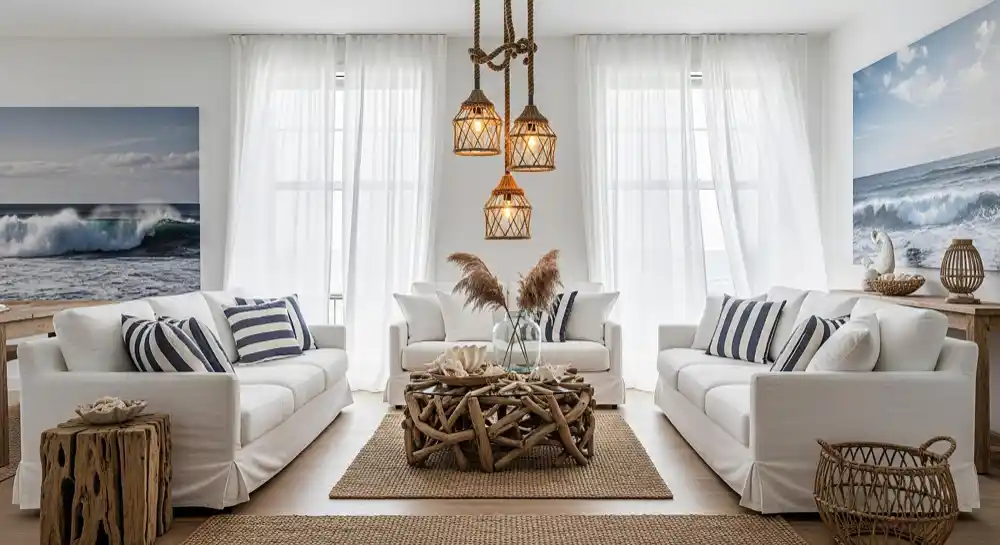
A cream boucle sofa, a jute rug, one rattan chair, and sheer curtains in front of a bright window will always look more coastal — and feel more open — than the same room stuffed with navy stripe cushions, driftwood objects, and four textile patterns. Restraint carries the look. For a broader view of what makes a living room feel designed rather than just decorated, see our living room ideas for a luxurious designer look and browse home decor ideas for every room in your home.
Bookmark this guide for quick reference.
KEY TAKEAWAY: A small coastal living room works through restraint — a tight palette, scaled-down furniture, and edited surfaces create the airy feeling, not more accessories.
A small coastal living room is a space under roughly 200 square feet where the design draws on natural materials, soft light, and a controlled palette — typically warm whites, sandy creams, and one or two muted blue or green accents. The style works especially well in compact spaces because its core rules (low furniture, light walls, natural fiber rugs, sheer windows) double as small-space principles. Getting the look right means building from the wall color outward, not layering coastal accessories over an existing scheme.
| Quick Takeaways | |
|---|---|
| Color | Warm white or soft sand walls — cream undertone, not grey or stark white. |
| Furniture | Low-profile sofa under 34 inches deep with visible legs. |
| Textiles | Linen, jute, rattan — two or three natural materials, no more. |
| Lighting | Rattan pendant or driftwood-finish lamp at 2700K warmth. |
| Rule | One vignette per surface — coastal rooms clutter faster than most. |
What Color and Light Choices Work Best?
In a small coastal living room, color and light do the heavy lifting. These choices — warm white walls, sheer linen, and one repeated accent — keep the space bright, airy, and open.
1. Warm White Walls With a Cream or Sand Undertone
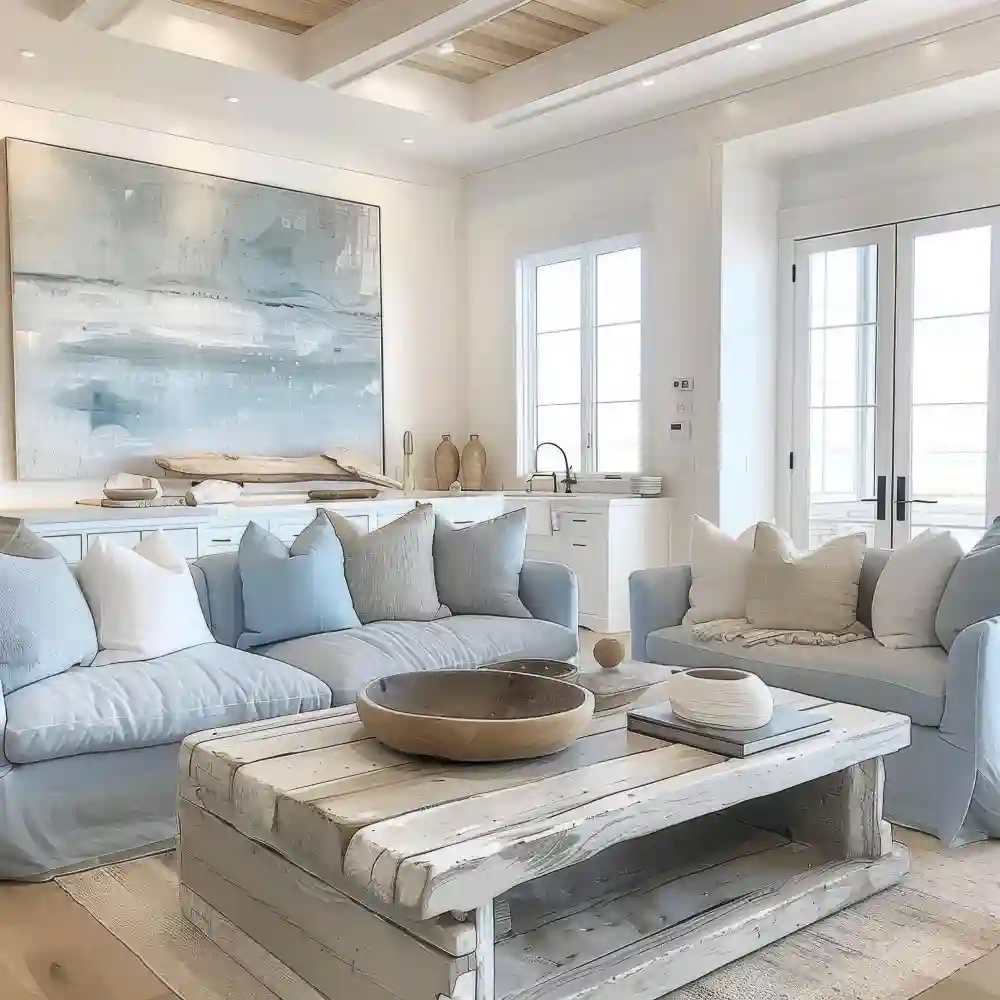
Stark cool white walls reflect glare instead of warmth. In a small coastal living room, that glare reads clinical rather than airy — the effect is closer to a bathroom than a beach house. The better choice is a warm white with a cream or sand undertone. Benjamin Moore White Dove (OC-17) and Sherwin-Williams Alabaster (SW 7008) are reliable starting points — both catch natural light without turning yellow or beige. Test the color in the afternoon when the light is warmest, not at midday when it reads harshest.
2. Sheer Linen Curtains Hung at Ceiling Height
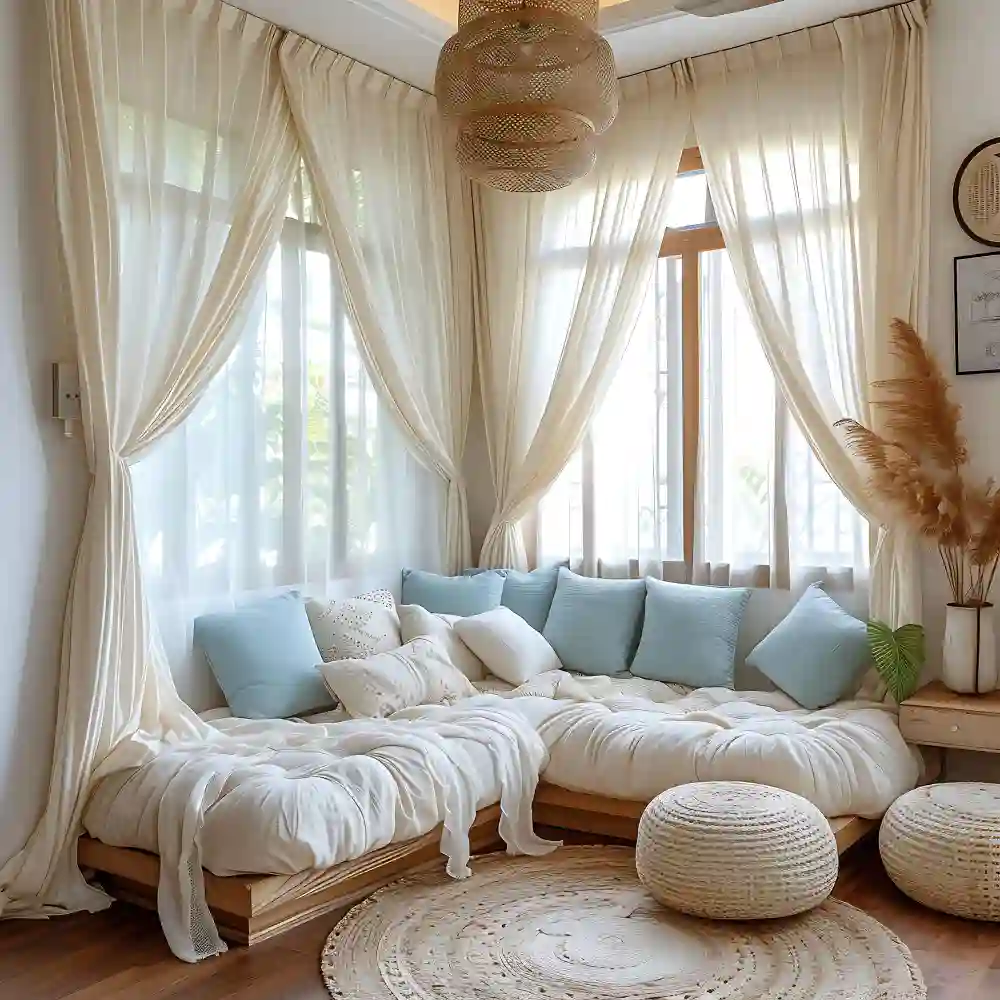
Curtains hung at ceiling height — even when the window starts 18 inches lower — make the ceiling appear taller and the window appear larger. In a small coastal living room, this single change does more for the sense of openness than almost any furniture swap. Use unlined linen or cotton voile in natural ivory or warm cream. The sheerness passes light through while softening harsh midday glare. A pair of 96-inch cream linen sheers costs under $80 and carries more visual impact than a new throw pillow collection.
DESIGNER TIP: Mount the curtain rod 4–6 inches below the ceiling — not just above the window frame. The extra height tricks the eye into reading the ceiling as taller than it is.
3. One Muted Accent Color, Repeated in Exactly Two Elements
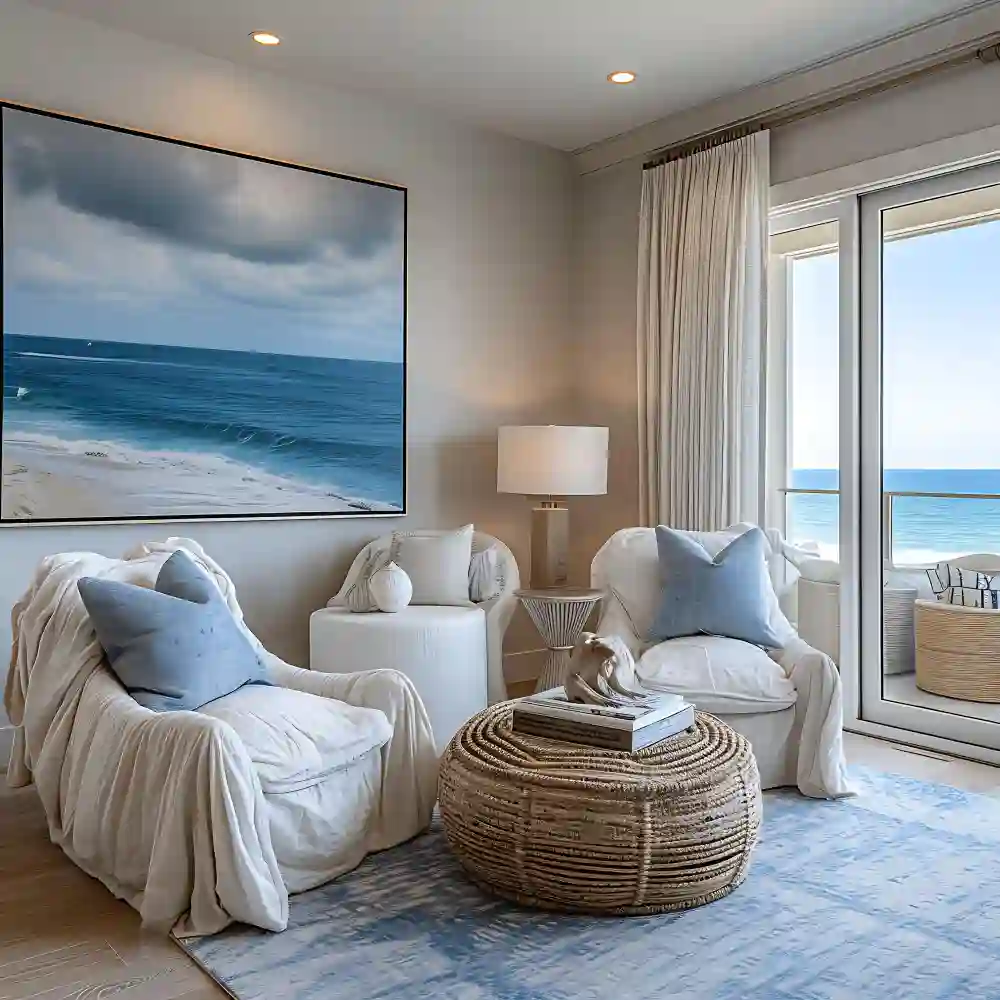
The temptation in a small coastal living room is to layer washed navy, sage, and muted aqua all at once. The result feels busy rather than calm. Pick one accent — washed linen navy or soft sea glass green — and carry it through exactly two elements: a pair of cushions, or a throw and one ceramic object. Everything else stays neutral. One accent color used twice always reads more purposeful than three colors used once each. Repetition is what makes a palette look chosen rather than collected.
4. What Paint Color Works in a North-Facing Small Coastal Room?
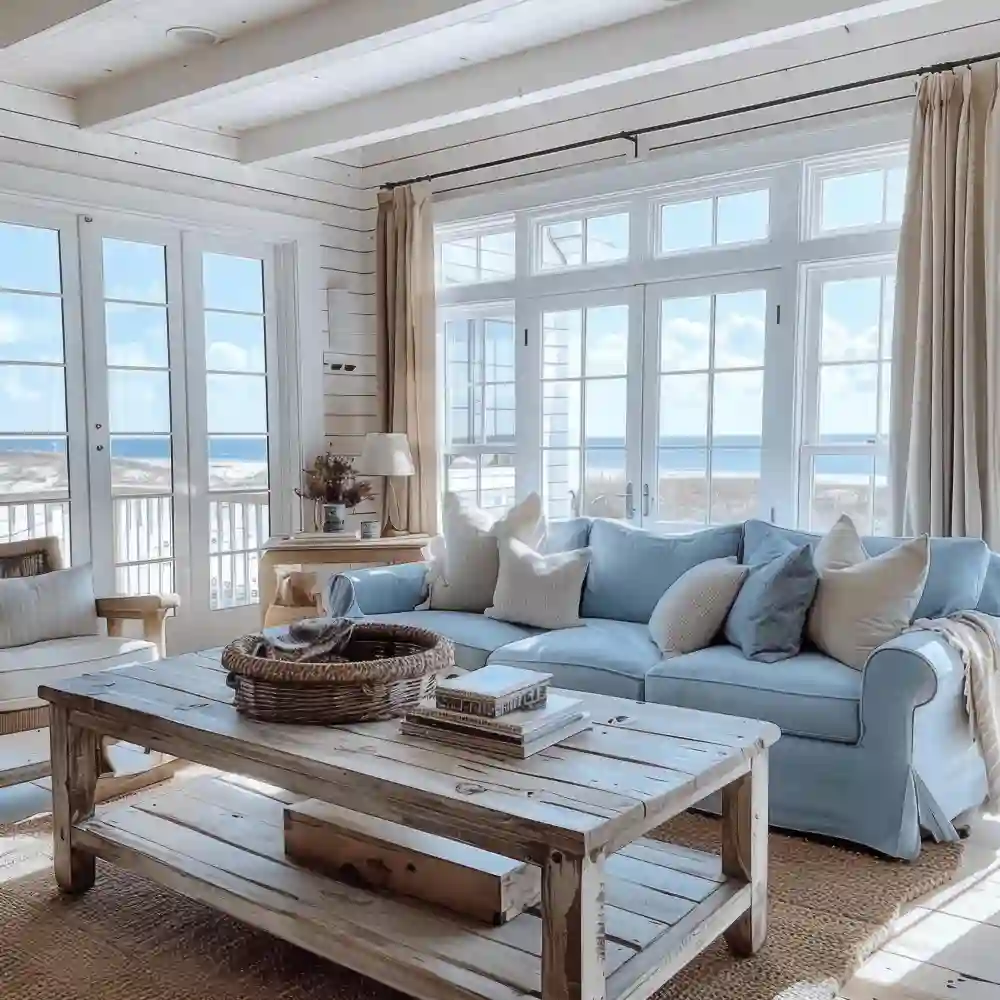
Climate Note: North-facing small coastal living rooms receive cool, indirect light all day. In these rooms, warm white walls with a cream or sand undertone — and warm-toned artificial light at 2700K — compensate for the coolness without making the room feel dark. Avoid sage green accents in north-facing rooms; the cool daylight pushes sage toward grey. Washed linen, natural jute tones, and soft cream carry the coastal palette without the grey cast. South-facing rooms can carry a slightly cooler white because warm afternoon sun does the warming work naturally.
KEY TAKEAWAY: Wall color, curtain height, and accent color restraint determine whether a small coastal living room feels bright or flat — these three choices matter more than any accessory.
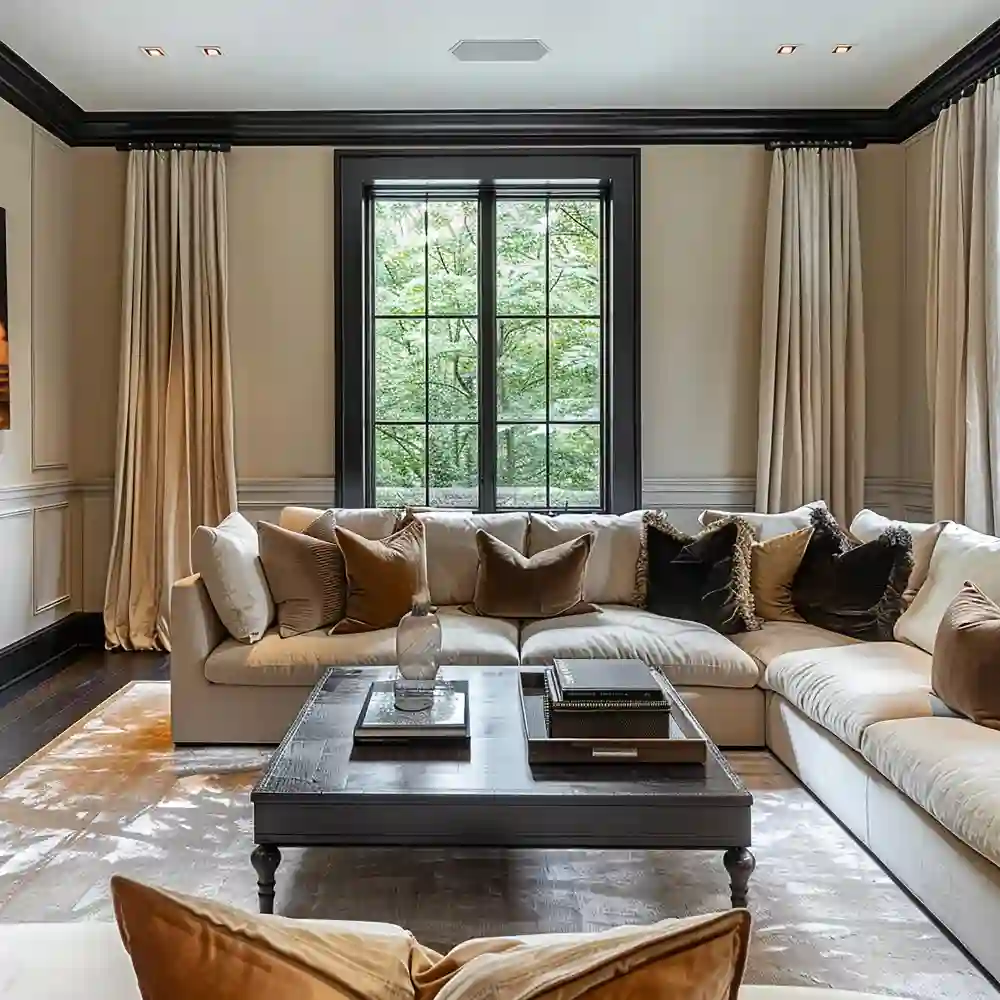
What Furniture Scale Keeps a Small Coastal Living Room Open?
Furniture scale makes or breaks a small coastal room. These pieces — a leggy low sofa, cane chairs, and light-wood or glass tables — keep sightlines open and the room feeling airy.
5. A Low-Profile Sofa With Visible Legs
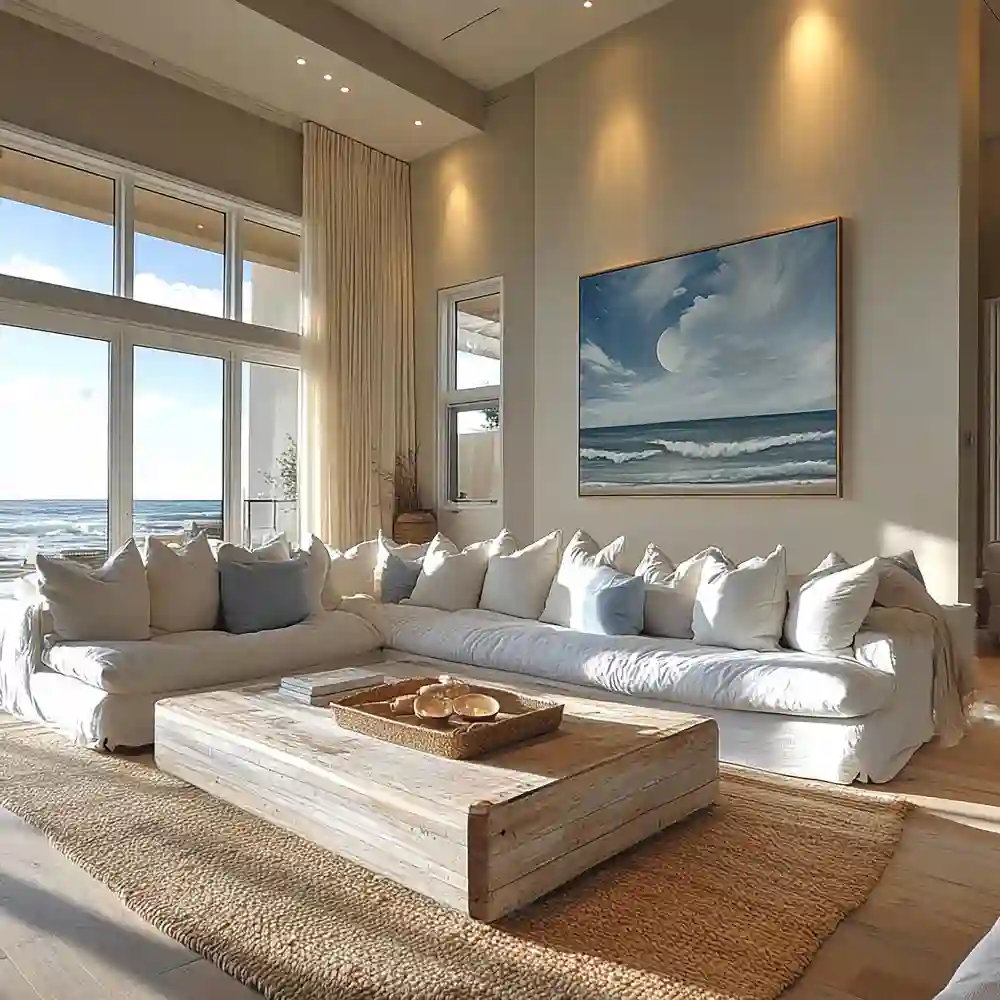
Sofa selection is the most consequential furniture decision in a small coastal living room. A sofa over 36 inches deep or with a back over 36 inches tall blocks sightlines and compresses the room. A low-profile option — arm height under 28 inches, back height under 34 inches, seat depth around 32–34 inches — keeps the wall visible behind it and the floor visible around it. Cream boucle, natural linen, or warm oatmeal fabric carries the coastal palette without adding a separate color decision on top of a scale decision.
Designer Rule of Thumb: A sofa should cover no more than two-thirds of the wall it sits against. In a 12-foot room, that’s roughly an 8-foot sofa. A 9-foot sofa in the same room traps the space at both ends.
6. Rattan or Cane Accent Chairs
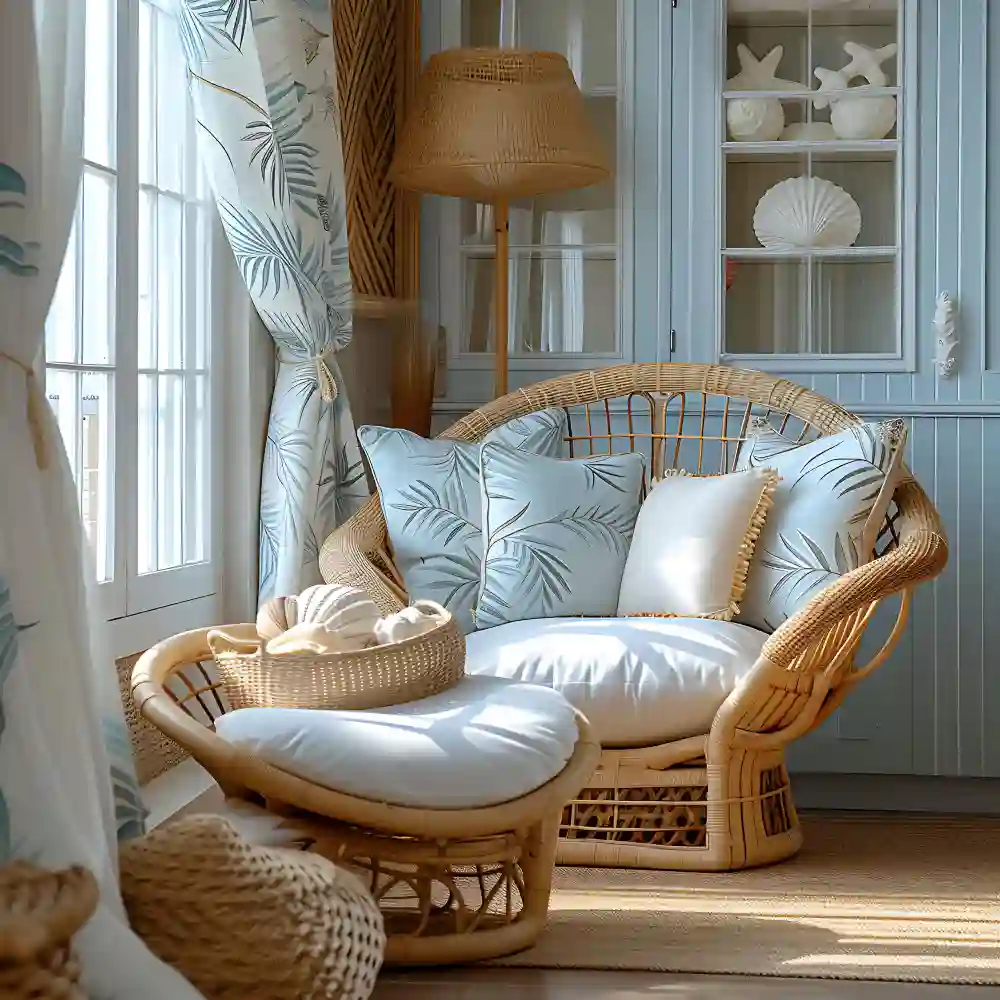
Rattan and cane chairs have open frames and visible legs — both qualities make them sit lightly in a compact space. A pair of rattan chairs provides accent seating without the visual mass of upholstered armchairs. A single rattan armchair in a corner reads as curated rather than crowded. Keep cushions tone-on-tone in natural cotton or warm cream so the chair doesn’t become the room’s loudest element.
7. A Glass or Light Oak Coffee Table
A solid upholstered or dark wood coffee table fills the center of a small room even when it’s not in use. A glass-top table disappears visually, making the floor feel continuous. A light oak or cane coffee table sits lightly without vanishing entirely. Either works for a coastal palette. The rule: if the coffee table has visible legs and a light or transparent surface, the room can breathe around it.
DESIGNER TIP: Leave at least 18 inches between the sofa edge and the coffee table. Anything closer makes the seating feel cramped even when the room is empty.
8. Wall-Mounted Shelves Over a Freestanding Bookcase
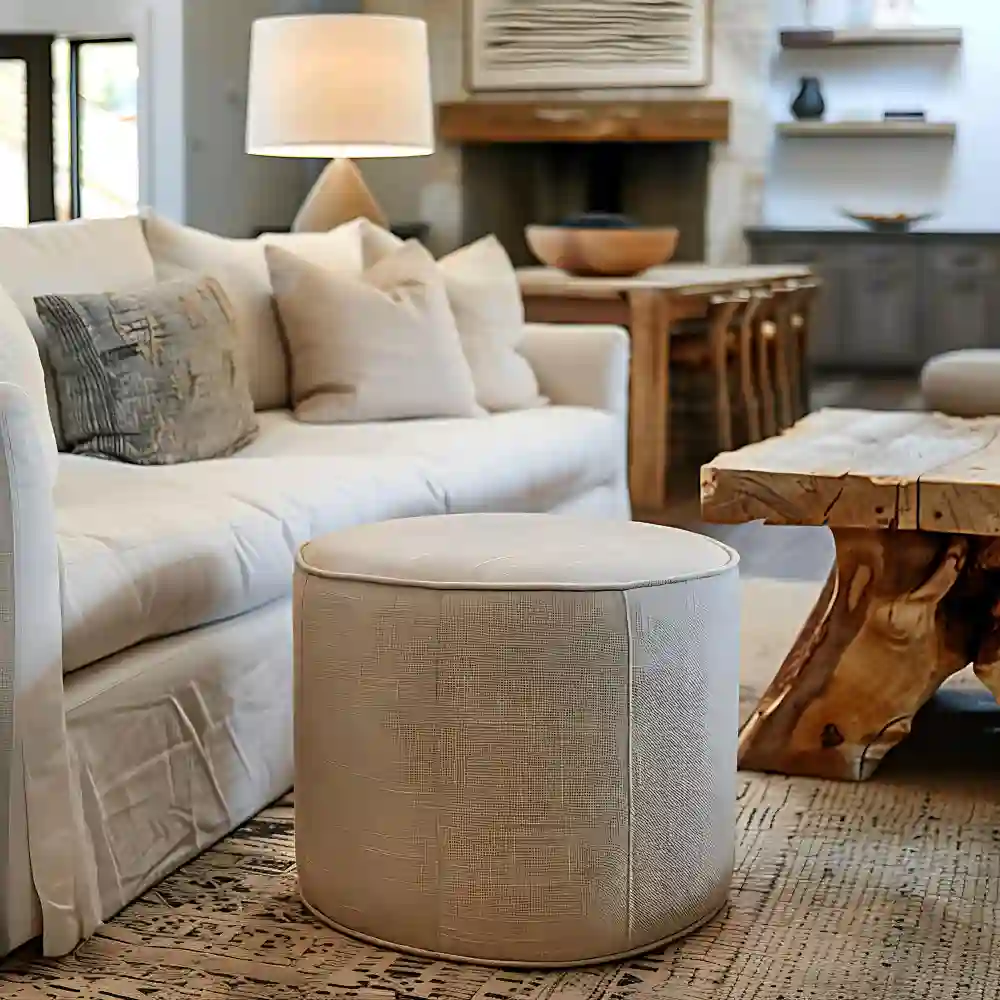
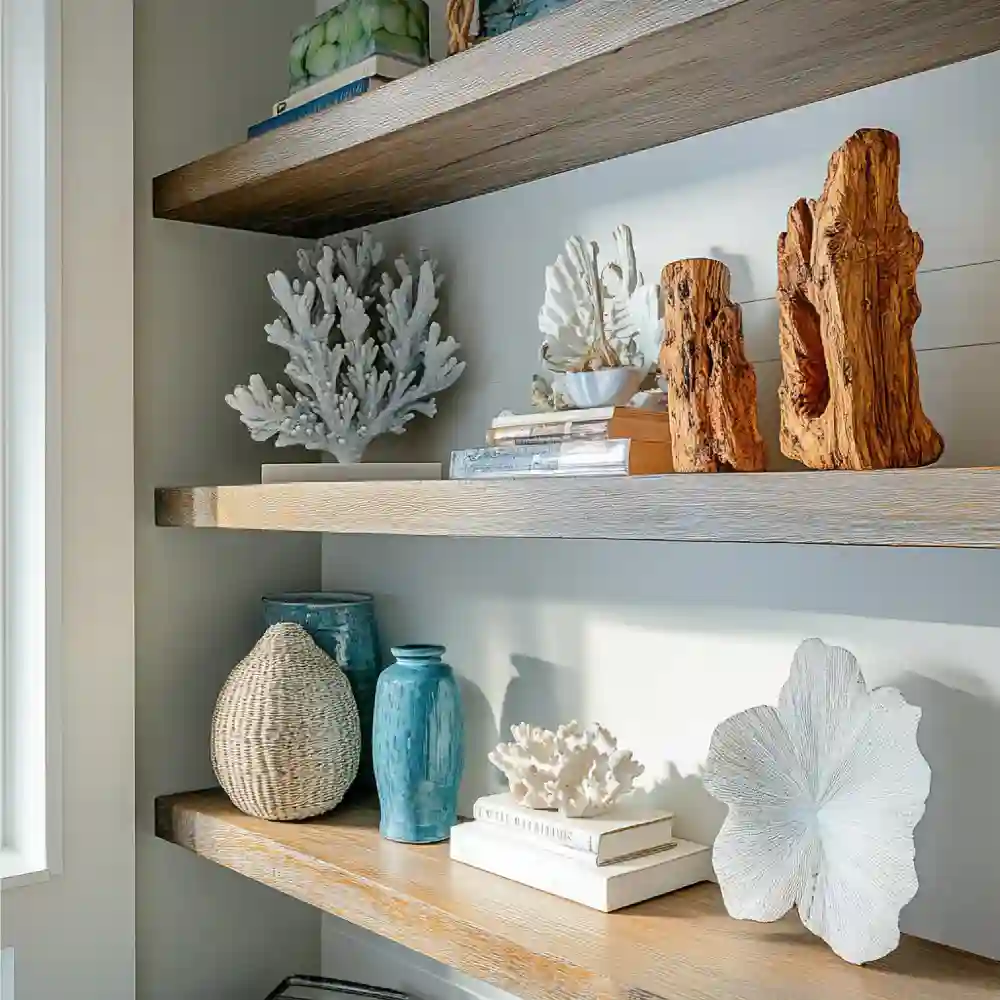
A freestanding bookcase — even a slim one — anchors the floor plan and adds visual mass in a small room. Wall-mounted floating shelves provide the same storage and display purpose without taking floor space. In a small coastal living room, keep shelves sparse: a plant, a small ceramic, and one or two books with clear space between them — two or three objects per shelf at most. The open space between objects is part of the look.
For more ways to make a compact living room feel open without bulky furniture, see these small living room ideas for a luxurious, spacious feel.
KEY TAKEAWAY: Furniture with visible legs, a low profile, and a light or transparent surface keeps the floor plan open — the most important rule in any small coastal living room.
Which Textures and Materials Read as Coastal Without Cluttering?
The right textures signal coastal without adding clutter. These materials — a natural-fiber rug, a light-bouncing mirror, and edited surfaces — bring the beach in while keeping things calm.
9. A Jute or Sisal Rug Sized for All Front Legs
A jute rug does more work than almost any other single element in a small coastal living room. It anchors the seating area, adds natural texture, and defines the room’s center without adding weight through color. The sizing rule: the front legs of all seating — sofa and chairs — should sit on the rug surface. In most small coastal living rooms, that means an 8 by 10-foot rug or a 9 by 12-foot rug depending on the room’s footprint.
Material Note: Natural jute softens and lightens slightly with regular use. It performs well in dry living rooms but is not suited for frequently wet areas. Sisal offers a slightly more durable alternative with a similar natural-fiber appearance.
10. A Large Mirror on the Wall Opposite the Window
A mirror placed on the wall directly opposite the primary window doubles the natural light by reflecting it back across the space. In a small coastal living room, this is one of the highest-impact changes per dollar. A simple rectangular mirror in a thin light oak or brushed brass frame — 36 to 48 inches wide — transforms how bright the room reads at all times of day. The frame should be light rather than ornate; a heavy carved frame adds visual mass that cancels the mirror’s optical effect.
11. Layered Warm-Toned Lighting at Two Heights
A single overhead ceiling fixture makes a small coastal living room feel flat and one-dimensional. One light source casts consistent shadows and removes the sense of depth. Layering a rattan pendant or driftwood-finish fixture with one or two warm table lamps at 2700K creates pools of light at different heights — that variation is what gives coastal rooms their calm, warm character after dark. For lighting approaches that balance warmth with a clean coastal look, see how neutral coastal living room ideas use ambient layers to add depth.
DESIGNER TIP: A rattan pendant positioned 60–66 inches from the floor at its lowest point — over a coffee table — anchors the ceiling and adds natural texture at eye level without taking up floor space.
12. Edited Surfaces — One Vignette Per Table or Shelf
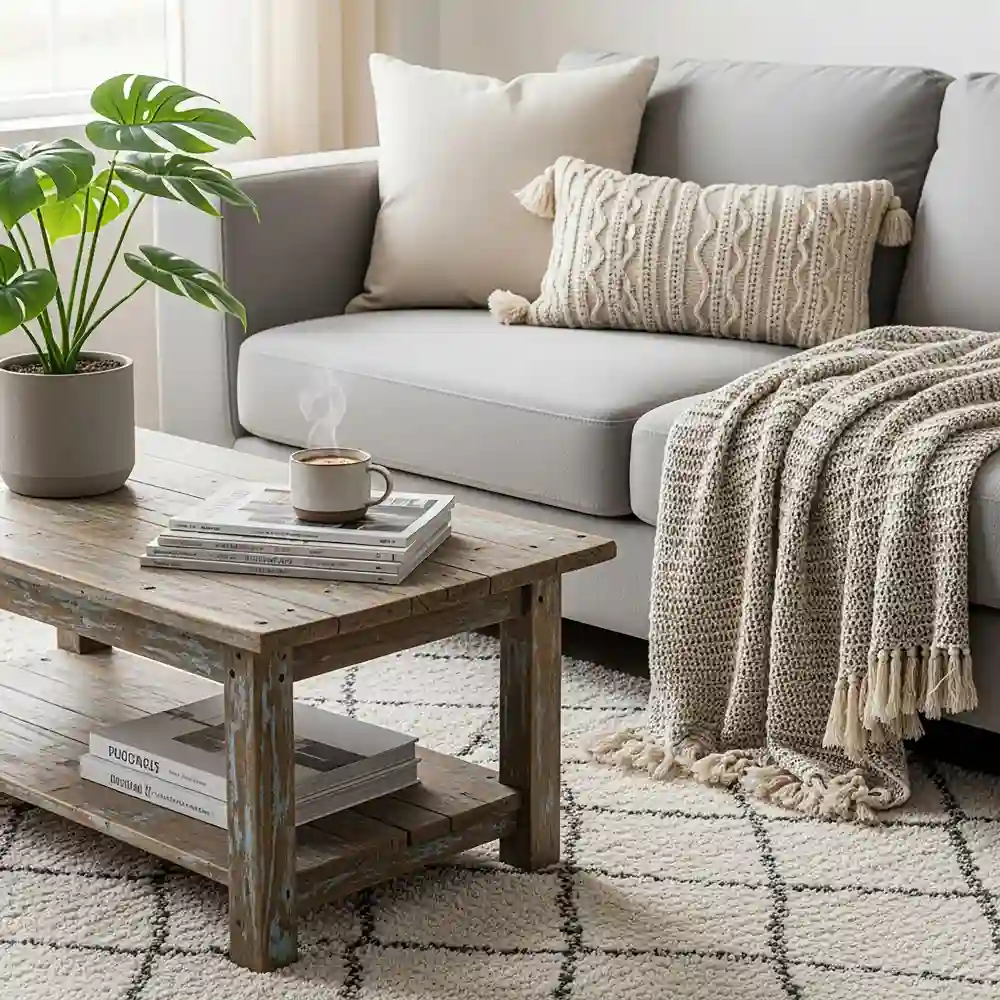
Coastal accessories accumulate faster than almost any other decor category. Shells, candles, driftwood objects, small ceramics — each individually fine, collectively overwhelming in a compact room. The rule: one curated vignette per surface. On the coffee table, a small plant, a tray, and one candle. On a shelf, a plant and one object. The empty space between objects is part of the aesthetic — it’s what makes a small coastal living room feel settled rather than stocked.
For a full approach to styling coastal rooms with restraint and warmth, see coastal living room aesthetics for year-round summer.
KEY TAKEAWAY: Jute underfoot, a mirror opposite the window, layered warm lighting, and edited surfaces are what make a small coastal living room feel like it’s breathing.
Small Coastal Living Room Checklist
- Paint walls before buying furniture — warm white or soft sand (Benjamin Moore White Dove, Sherwin-Williams Alabaster, or equivalent cream-undertone white).
- Measure the sofa wall first; choose a sofa no wider than two-thirds of it and no deeper than 34 inches.
- Size the rug so all front sofa and chair legs sit on it — usually 8 by 10 feet for rooms up to 200 square feet.
- Hang sheer linen curtain panels from ceiling height, even when the window starts 18 inches lower.
- Pick one accent color — washed navy, soft sage, or muted aqua — and carry it through two elements only.
- Replace any freestanding bookcase with wall-mounted floating shelves; keep each shelf to two or three objects.
- Place one large mirror (36 to 48 inches wide) on the wall directly opposite the primary window.
- Limit each coffee table and shelf to one curated vignette — a plant, a ceramic, nothing more.
KEY TAKEAWAY: Build the room in sequence — wall color, furniture scale, rug, curtains — then add accessories last.
How Should You Arrange Furniture in a Small Coastal Living Room?
A small coastal living room should have one clear focal point — typically the window or the lightest wall — with all seating oriented toward it. Push the sofa as close to the wall behind it as the baseboard allows. Float accent chairs slightly inward rather than pinning them to a wall — that small gap makes the arrangement feel deliberately placed rather than furniture-along-every-edge.
In a narrow room, a single sofa along the long wall with one rattan chair at a slight angle creates movement without crowding. Avoid placing furniture against all four walls. That outline-the-room approach makes compact spaces feel smaller, not larger. The center floor should feel clear when someone walks through the doorway.
For a coastal living room that also functions as a dining zone, a loveseat or two-seater instead of a full three-seater frees up enough room for a small round table with two rattan chairs at the opposite end. Nesting tables replace a fixed coffee table when floor space is critical. For small apartment layouts that need to work harder, see tiny living room ideas that actually make space feel bigger.
The boho coastal variation — macramé, layered textiles, vintage finds — works in a small space when you apply the same editing rule: two or three statement pieces, not ten. See boho coastal living room ideas for a layered take on the palette that still reads calm. For a more polished, design-forward approach, modern coastal living room ideas show how to keep the airy feel with cleaner lines.
KEY TAKEAWAY: Push seating near the walls, leave the center floor open, and orient everything toward the natural light source — that’s the layout logic behind a small coastal living room that feels spacious.
Pitfalls to Skip
❌ Too much navy → ✅ Use navy in one or two elements — two cushions or one throw. Dominating the room in navy makes it read dark, not coastal.
❌ Stark cool white walls → ✅ Warm white with a cream or sand undertone. Cool white in low-light conditions reads grey and clinical.
❌ Oversized sofa that spans the full wall → ✅ Measure first. The sofa should leave at least 6–12 inches clear on each side to avoid trapping the space.
❌ Too many accessories on every surface → ✅ One curated vignette per surface. Shells, candles, and ceramics all competing reads as clutter, not coastal.
KEY TAKEAWAY: Over-accessorizing, too much navy, and furniture that fills the wall are the most common small coastal living room mistakes — fix one and the others become obvious.
What Does a Small Coastal Living Room Refresh Cost?
A small coastal living room update can cost very little or quite a bit depending on which element you tackle first.
| Project | Estimated Cost | Impact Level |
|---|---|---|
| Wall paint in warm white, one room (premium paint + supplies) | $50–$130 | Very High |
| Sheer linen curtain panels, ceiling height (pair) | $60–$200 | High |
| Natural jute or sisal area rug (8×10 feet) | $120–$450 | High |
| Low-profile linen or boucle sofa (mid-range) | $900–$2,400 | Very High |
Best First Upgrade: Paint the walls in warm white. Under $130 for a small room, and it changes how every other element reads — furniture looks lighter, curtains read crisper, and the space opens up before you spend on anything else.
Skip for Now: Coastal accessories — shells, nautical prints, ceramic anchors, driftwood objects. These don’t improve the room’s openness and add clutter risk. Wait until the palette, furniture, and rug are settled before adding anything to the surfaces.
For ideas on making a coastal update work on a smaller budget, see how to decorate a small living room on a budget.
KEY TAKEAWAY: Paint first, sofa second, rug third — this sequence gives you the biggest visible return before spending on accessories or accent pieces.
When Your Small Coastal Room Has Special Challenges
No natural light: A small coastal living room with a small or north-facing window relies on layered artificial light to feel open. Use three sources at different heights: a rattan pendant overhead, one warm table lamp at sofa level, and a small spot or uplight on a shelf. Three heights remove the flatness of a single ceiling fixture and give the room the sense of depth that natural light would otherwise provide.
Rental restrictions: If you can’t paint, large-format peel-and-stick white paneling or temporary wallpaper in a warm neutral removes the visual weight of a mid-tone wall without permanent changes. Rental Note: Test any removable adhesive product in an inconspicuous spot before covering a full wall — some adhesives pull paint on older or poorly-primed surfaces.
Open-plan living and dining layout: In an open-plan small coastal space, the jute rug alone defines the living zone. The rug acts as a boundary without a wall. Keep the dining furniture in a similar natural material palette — light oak, rattan, cream linen — so both zones read as one cohesive space rather than two competing schemes.
KEY TAKEAWAY: No natural light, rental limits, and open-plan layouts each have a practical workaround — the palette and furniture rules stay the same regardless of the constraint.
Frequently Asked Questions
Conclusion
A small coastal living room doesn’t need to be layered with blues, stripes, or seaside accessories to earn the name. The rooms that genuinely feel open — the ones that make you slow down when you walk in — get there through simple choices: warm white walls that catch light cleanly, furniture sized to the floor plan, one natural fiber rug anchoring the center, and surfaces held to what actually matters.
Editorial field note: A small coastal living room with a cream linen sofa, a single jute rug, ceiling-height sheers, and a rattan pendant routinely feels twice as open as one of the same dimensions with a navy sectional, patterned cushions, and every surface covered in accessories. The square footage is identical. What changes is the visual load — how hard the room works to hold your attention rather than letting it rest.
Start with the paint. Get the curtain height right. Then choose furniture that lets the floor breathe. The plant, the ceramic, the one piece of coastal art — those come last, and they fall into place easily once the foundation is solid. Browse our full living room decor and styling guides or explore all room inspiration across the home for more ideas room by room.