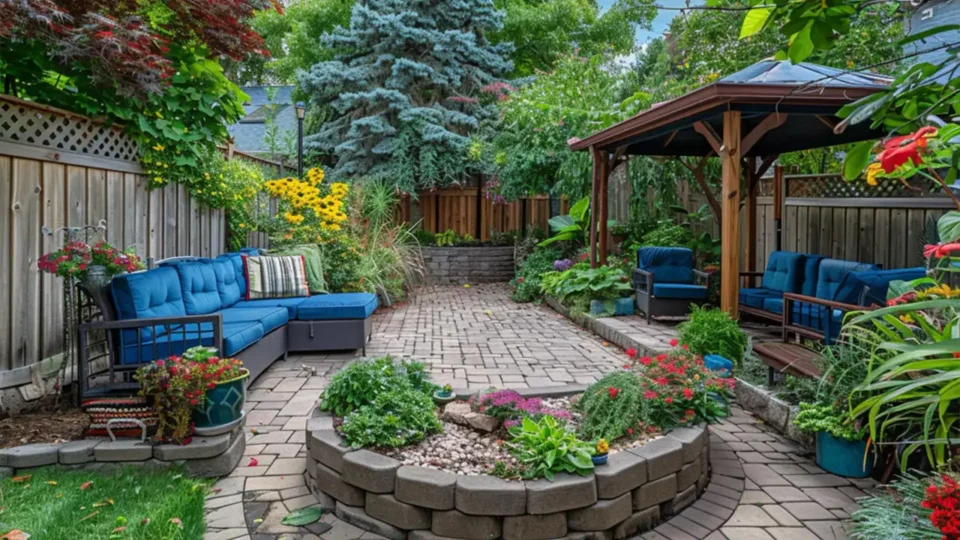
TL;DR
- Design principles: Layering, scale, and a clear focal point come before any individual purchase.
- Architecture first: A craftsman porch and a colonial porch call for different palettes, materials, and plant choices.
- Seasonal timing: March, April, and May each have a distinct porch-styling moment — stagger your updates rather than doing everything at once.
- Material durability: Fade-resistant textiles, powder-coated metal, and weather-tolerant plants carry spring decor through rain and late frosts.
- Interior continuity: The porch is the first room of your home. Its color and tone should echo what’s visible through the front door.
The Porch as a Design Problem Worth Solving
Picture standing at the end of your front path on a cool April morning. You’re looking at your own house the way a guest does — from 30 feet away, before they’ve even rung the bell. What does that view communicate? A porch that feels warm and thought-out sends one message. A porch with a sun-faded doormat, a single potted mum, and a bare overhead fixture sends another. The difference rarely comes down to budget. It comes down to knowing what the space actually needs.
I worked with a client last spring on a 1920s bungalow in a tree-lined neighborhood. The bones were beautiful — wide covered porch, original columns, a deep overhang. But the styling felt like an afterthought: a wreath that was three seasons old, two mismatched chairs, and a concrete planter that had never been filled. We spent an afternoon rethinking it from the ground up, starting with the design principles rather than the shopping list. By the time we were done, neighbors were stopping to ask what had changed. Nothing structural had.
Spring porch decor is genuinely one of the highest-return styling projects in a home. The space is small, visible to everyone, and completely changeable on a modest budget. But it rewards people who understand a few core ideas — layering, scale, color, and how architecture shapes every choice. You’ll find the full range of exterior inspiration at 101homedecor.com, but this guide goes deep on one specific discipline: the design thinking behind the decisions that make a porch feel welcoming year after year. If you’re looking for a curated list of specific ideas to try first, the companion post 14 spring front porch decor ideas that make your home inviting covers the “what to do” side of this topic. Here, we focus on the why and the how.
Bookmark this guide for quick reference.
KEY TAKEAWAY: Spring porch decor rewards design thinking over shopping — understanding layering, scale, and architecture-specific choices will outlast any single seasonal purchase.
| Quick Takeaways | |
|---|---|
| Layering | Build the porch in three layers: structure, textiles, and living elements. |
| Scale | Every piece should relate in proportion to the porch’s width and ceiling height. |
| Color | Anchor the palette to the home’s fixed tones — siding, trim, roof, and door. |
| Plants | Choose weather-tolerant varieties that hold interest from March through May. |
| Continuity | The porch palette should preview what guests see through the front door. |
What Spring Porch Decor Actually Requires
Spring porch decor is not the same as adding seasonal accessories to an existing arrangement. It is a full styling exercise that operates on three layers simultaneously.
The first layer is structure — the furniture, the overhead fixture, the door color, and the planters. These elements have weight and permanence. They define the bones of the space. The second layer is textiles — the outdoor rug, the seat cushions, the throw pillows. These carry the color and softness. The third layer is living elements — plants, wreaths, seasonal cuttings. These signal the season and add the kind of organic variation that a photograph can never fully predict.
An inviting porch works because all three layers speak to each other. Structure provides the visual hierarchy. Textiles soften it. Plants activate it. When one layer is missing or fights the others, the porch reads as unfinished — even if every individual piece is attractive on its own.
Visual Hierarchy and the Focal Point Rule
Every great porch has one dominant focal point. Usually this is the front door. Sometimes it’s a large planter arrangement or a statement chair grouping. The focal point earns that position because it is the largest, brightest, or most detailed element in the composition.
Visual hierarchy means the eye moves through the porch in a predictable sequence: focal point first, supporting elements second, accents last. A door painted in a strong color — deep navy, terracotta, forest green, or matte black — instantly becomes that anchor. Everything else on the porch should support that choice rather than compete with it.
DESIGNER TIP: Paint the door a color that appears nowhere else on the exterior. One point of controlled contrast creates instant focal tension — the single design trick that makes a porch look curated rather than assembled.
Scale, Proportion, and the Mistakes They Prevent
Scale is the relationship between a piece and the space it occupies. A 24-inch planter on a porch 12 feet wide reads as correct. That same planter on a porch 6 feet wide overwhelms the space. Proportion is the relationship between pieces — how the height of a chair back compares to the height of a side table, or how the width of a rug relates to the seating group it anchors.
The most common scale mistake in spring porch decor is buying pieces that look correct in isolation but are wrong for the actual space. Before purchasing anything, measure. The porch width, the distance from the door to the front edge, and the ceiling height all determine what will fit and what will not. A standard outdoor chair is 32-36 inches wide. A loveseat runs 48-60 inches. A two-seater arrangement needs at least 8 feet of width to breathe.
KEY TAKEAWAY: Spring porch decor requires three simultaneous layers — structure, textiles, and living elements — each supporting the others around a single clear focal point.
How Architecture Shapes Every Styling Decision
The biggest mistake in spring front porch styling is treating all porches as interchangeable. They are not. A craftsman bungalow, a colonial, a modern farmhouse, and a mid-century ranch each have distinct proportional systems, material vocabularies, and color histories. Working with the architecture produces a porch that looks intentional. Working against it produces a porch that looks decorated.
Craftsman and Bungalow Porches
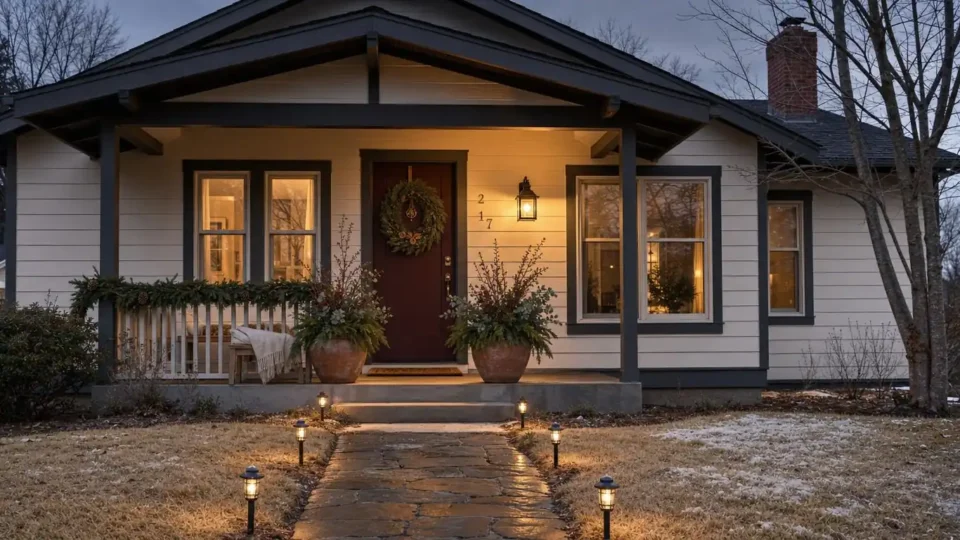
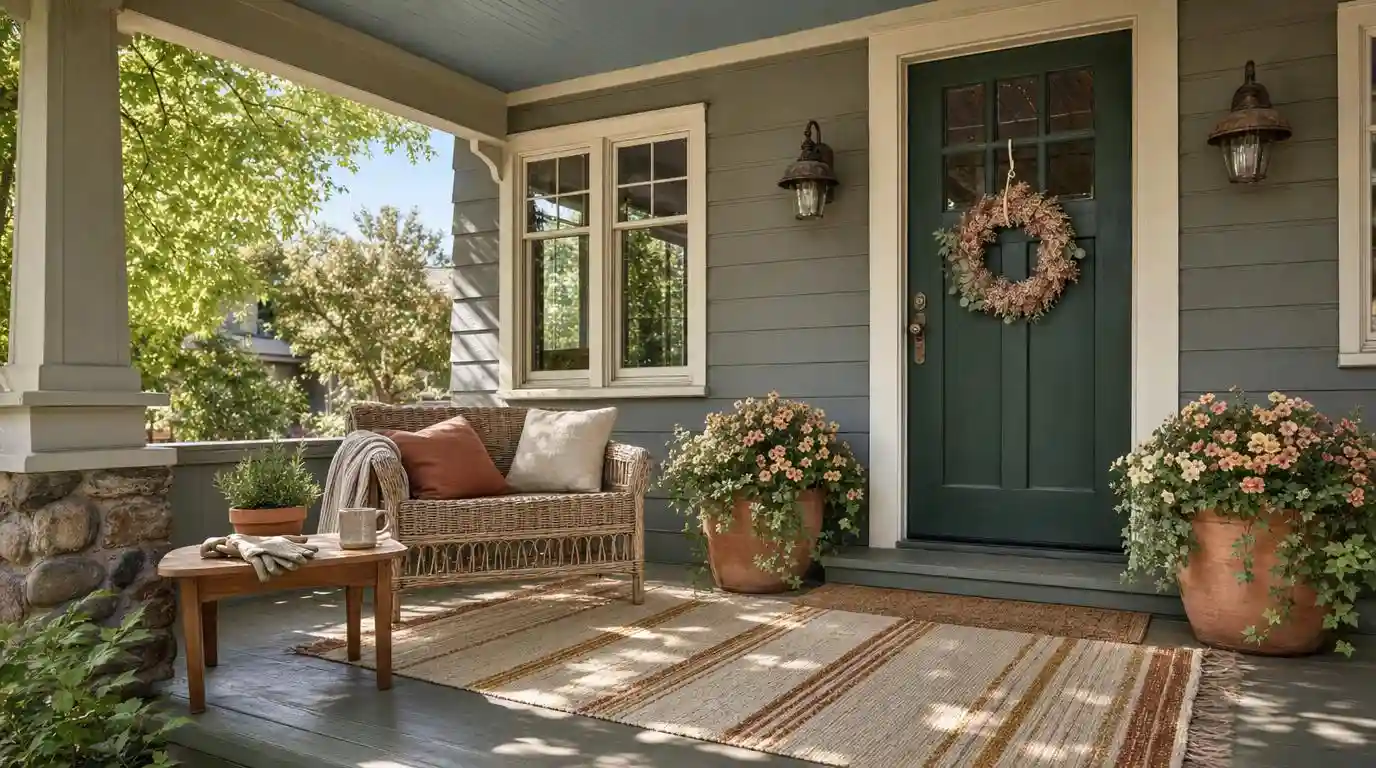
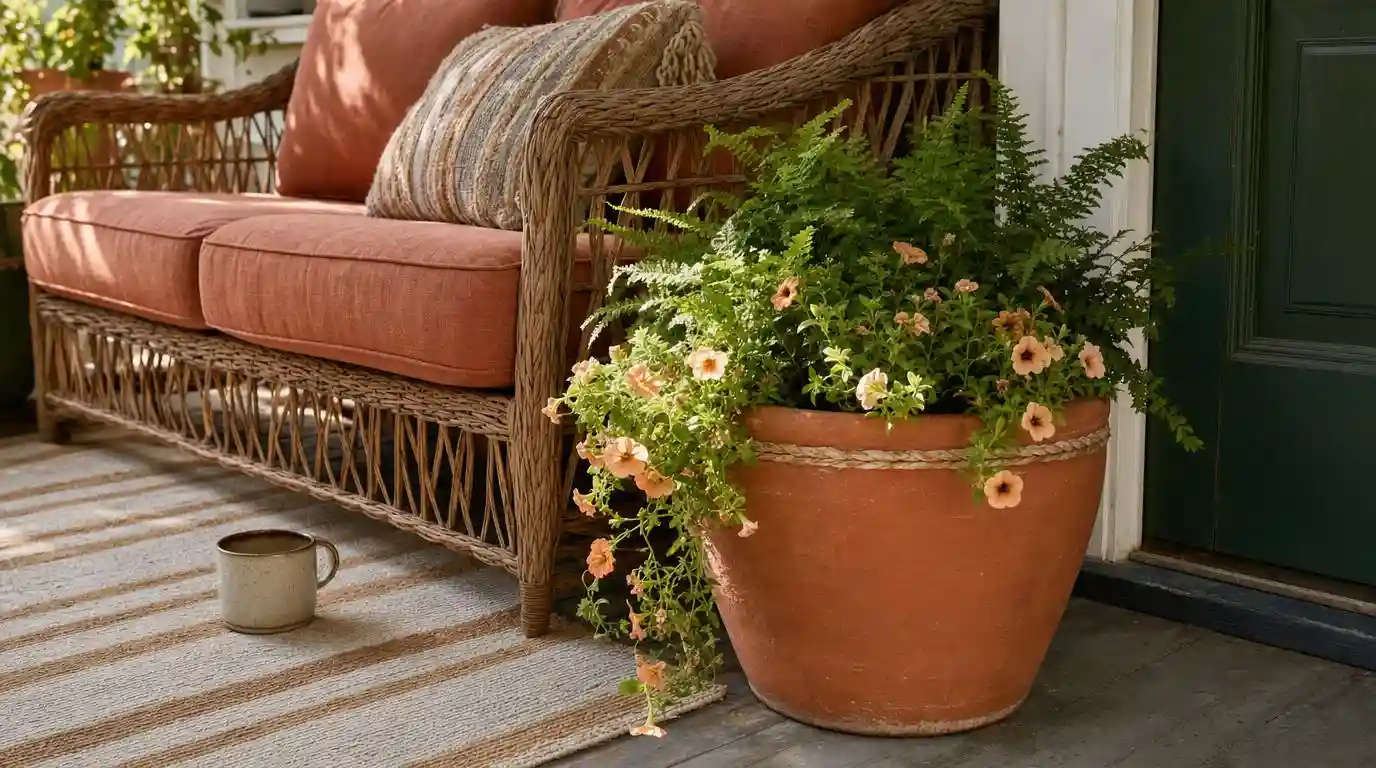
Craftsman porches have wide eaves, tapered columns, and a horizontal emphasis. The design language is warm, earthy, and handmade. Spring decor should lean into natural materials — jute rugs, raw terracotta pots, woven rattan furniture, and plants with loose, imperfect forms like ferns, trailing ivy, or heirloom geraniums. The palette works best in warm earth tones: muted clay, warm olive, aged rust, and cream linen. Dark doors in forest green or deep charcoal read beautifully against craftsman trim. Avoid anything too glossy, too symmetrical, or too modern — it fights the architecture’s inherent warmth.
Colonial and Traditional Porches
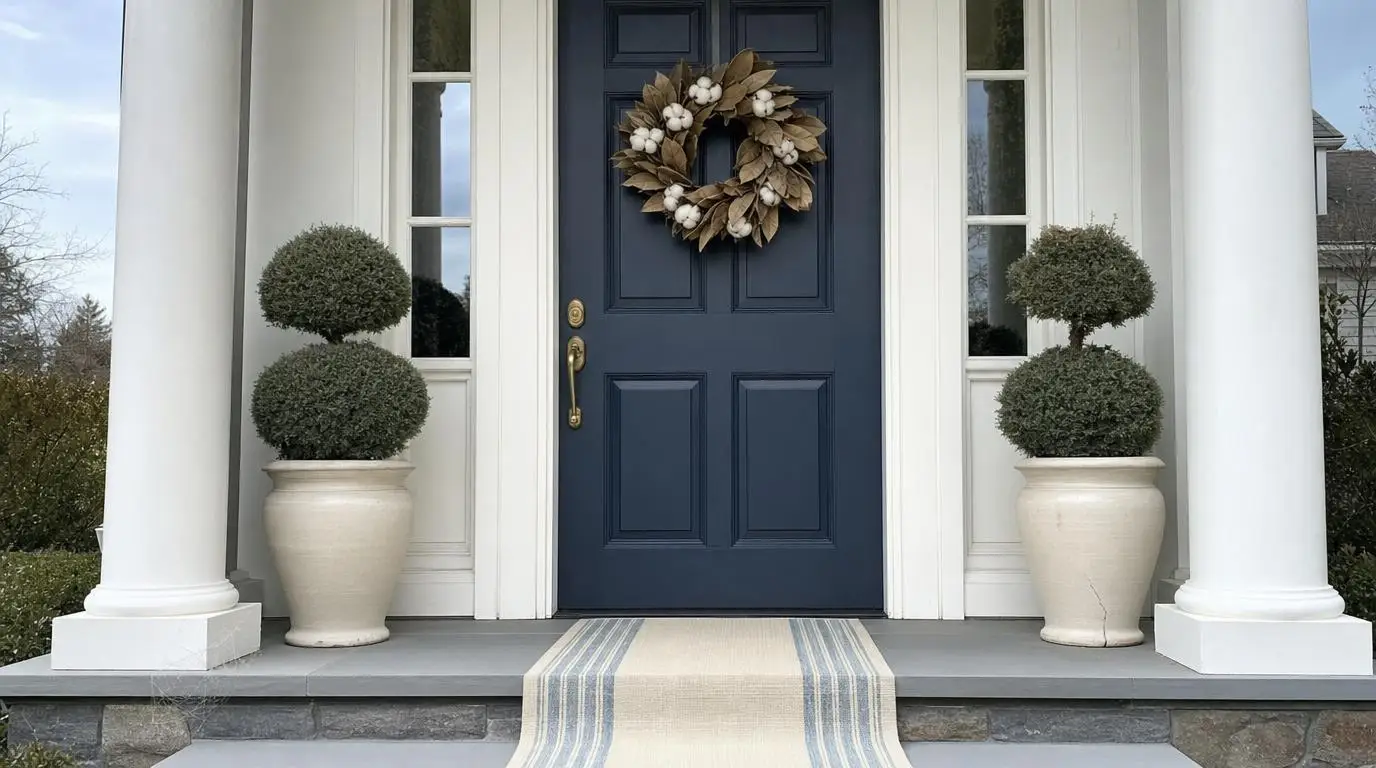
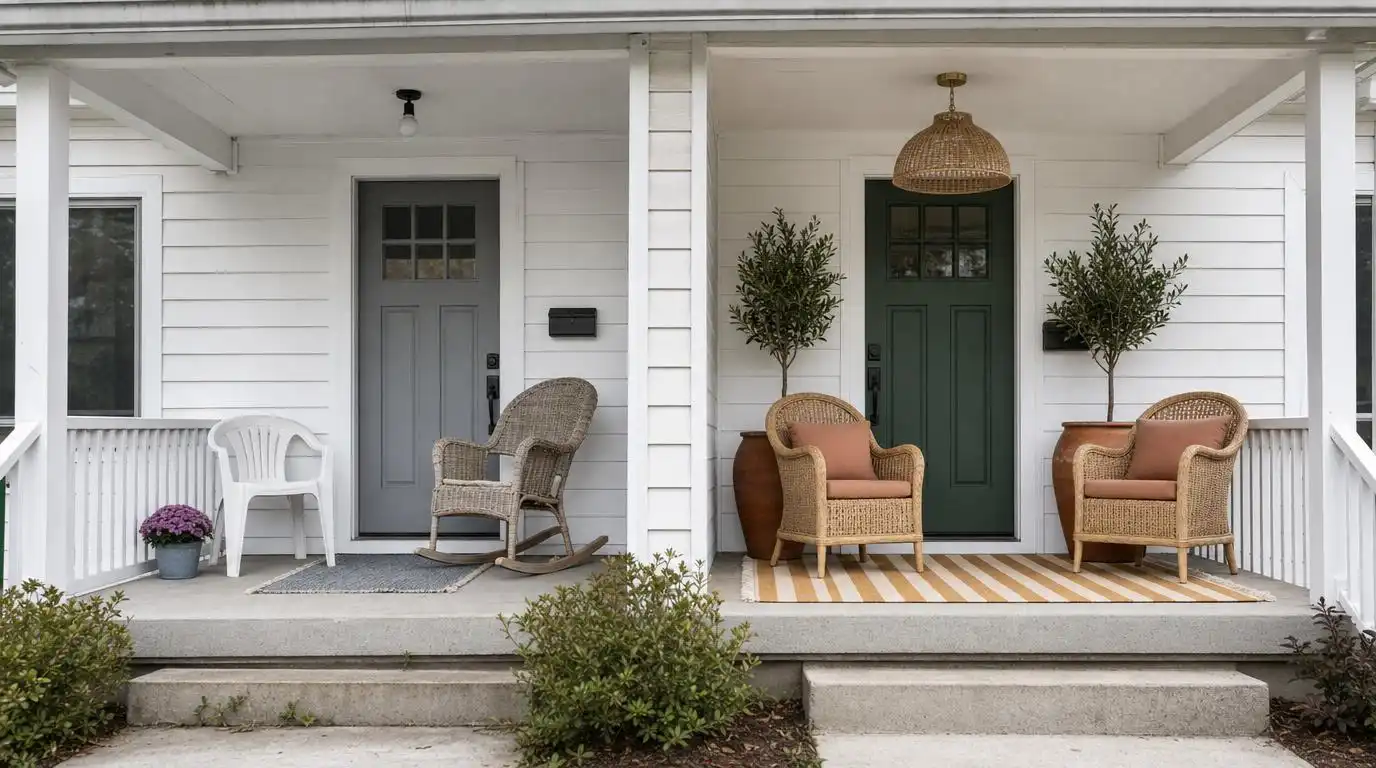
Colonial porches favor symmetry above everything else. The door sits centered, flanked by equal windows and matching light fixtures. Spring decor should honor this bilateral balance: two matching planters, a symmetrical wreath, even chair placement on both sides of the door if the porch is wide enough. The palette can be cooler — crisp white trim, dusty rose or soft blue accents, traditional black lanterns. Topiaries in white ceramic urns suit the formality. Modern front porch ideas that refresh your home’s exterior design offers a useful counterpoint if you want to soften a traditional exterior with contemporary choices.
Modern Farmhouse and Ranch Exteriors
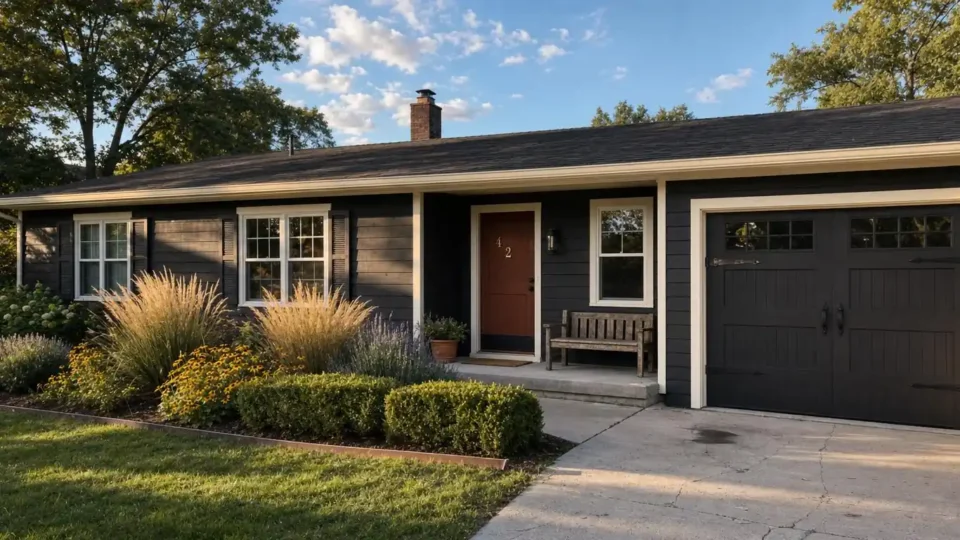
Modern farmhouse and ranch homes have flatter profiles and lower rooflines. The porch is often shallow — sometimes no deeper than a small landing. These constraints actually clarify the design problem: tall, vertical elements like slim iron lanterns, vertical plank cladding on a door surround, or a tall narrow planter create the visual height the architecture lacks. White shiplap, board-and-batten siding, and black metal hardware form the natural material system. Spring plants should have strong silhouette — ornamental grasses, alliums, or structured topiaries rather than soft trailing varieties. For homes in this category, simple barndominium exterior ideas for a modern farmhouse look and ranch style home exterior updates for better curb appeal both show how to extend the styling logic from the porch outward.
Enclosed Porches and Screened Rooms
Enclosed porches operate more like an interior room and less like an exterior transition. They can carry heavier textiles, more layered rugs, and a higher density of plants than an open porch can. The spring refresh for an enclosed space leans heavily on indoor-outdoor upholstered furniture, layered linen cushions in sage green or warm greige, and a collection of potted plants that benefit from the shelter — orchids, citrus trees, trailing pothos, fiddle-leaf figs. Enclosed porch ideas that transform your home into a private retreat covers the full design approach for these spaces.
KEY TAKEAWAY: Architecture defines the rules — craftsman homes call for warm natural materials, colonials demand symmetry, and modern farmhouses need strong vertical elements to compensate for a low roofline.
The Seasonal Timing of a Spring Porch Refresh
Most people treat spring porch decor as a single event — one trip to the garden center in mid-April, replace everything at once. Seasoned designers approach it as three distinct styling moments, each building on the last.
What to Do in March
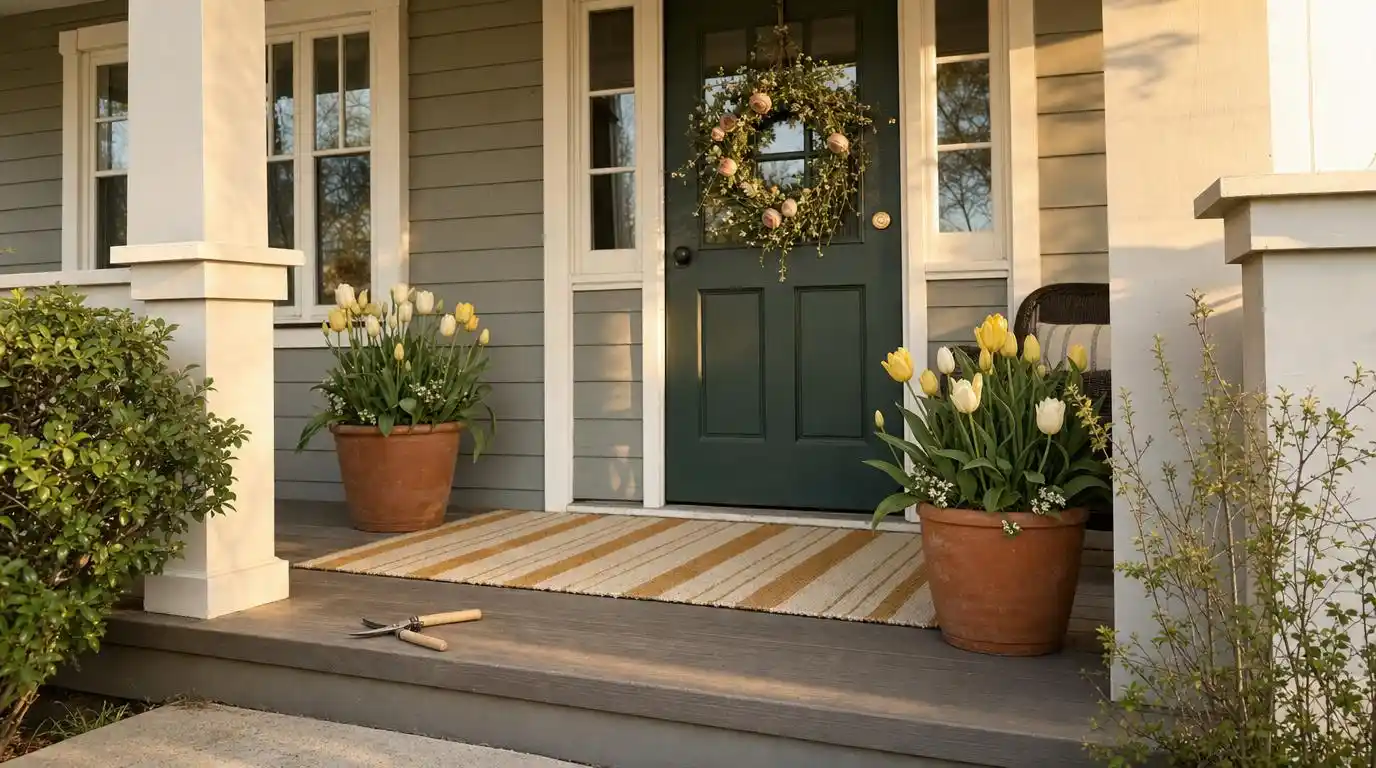
March is the setup month. Focus on the bones. Swap out any winter elements — remove holiday wreaths, stow away heavy wool blankets, pull dead plants. Clean the porch thoroughly: sweep, scrub, and pressure-wash if needed. This is also the right time to repaint the door, replace a dated light fixture, or add a new outdoor rug. The rug is the single most impactful purchase in spring porch decor. A faded or wrong-sized rug undermines everything placed above it. Choose a flat-weave or low-pile outdoor rug in a pattern that pulls from the door color — stripes in warm cream and sage green, a geometric in terracotta and natural jute tones, or a solid warm greige that lets other elements read clearly.
In March, keep plants minimal. A pair of evergreen topiaries flanking the door gives structure without the risk of a late frost damaging tender annuals. Hardy hellebores or ornamental cabbages handle cold snaps well and read as intentional rather than early.
What to Do in April
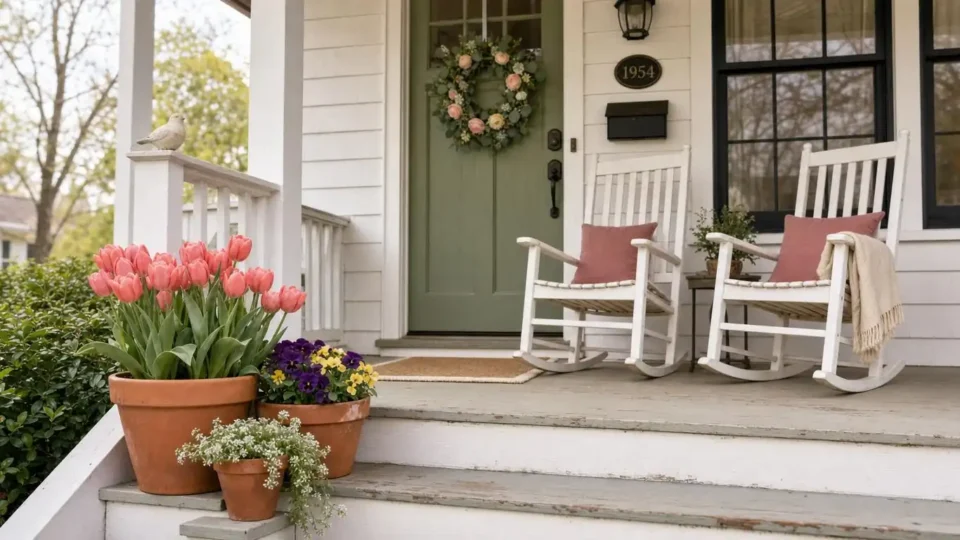
April is the color month. Soil temperatures have warmed enough for most annuals. Add the spring flower layer now: tulip bulbs planted in wide terracotta planters, snapdragons in soft pink and cream, pansies in deep violet or warm yellow, English daisies trailing over a planter edge. This is also when cushions and pillows come out — outdoor fabrics in dusty rose, sage green, or washed-denim blue replace the heavier textures of winter. Add a spring wreath for your front door at this point: one in fresh greenery, dried botanicals, or a loose peony wreath in blush pink reads as April-appropriate without feeling forced.
The outdoor rug you laid in March stays. The plants from March stay. April adds softness, color, and life on top of that structure.
What to Do in May
May is the abundance month. Spring is fully established. Planters should be at peak fullness — if you chose plants with a staggered bloom schedule, your April purchases are hitting their stride while May additions like sweet William, calibrachoa, or climbing jasmine add height and fragrance. This is the month to add the final accessory layer: a small side table, a lantern at ground level, a hurricane with a pillar candle for evening atmosphere. Spring patio decor ideas that make your outdoor space feel like home shows how the same May layering logic applies to patios and larger outdoor spaces if your porch connects to one.
By May, the porch should feel complete. Nothing should feel missing, and nothing should feel overcrowded. Negative space — the empty wall, the unplanted corner — is as important as what’s placed. Let the eye rest.
KEY TAKEAWAY: Treat spring porch decor as three separate updates — March for structure and bones, April for color and textiles, May for abundance and the final accessory layer.
How to Build a Cohesive Color Palette for a Spring Porch
A cohesive spring porch palette starts with the fixed tones you cannot change: siding color, trim color, roof material, and any brick or stone. These are the background. Every styling decision works with them.
From the fixed tones, identify the dominant neutral (usually the siding), the secondary structural color (usually the trim), and the single accent point (the door). The door color is your palette anchor. Everything added to the porch — cushions, planters, plants, the rug — should either echo that door color or complement it through contrast.
The most reliable spring palettes follow one of three approaches. The first is tonal harmony: door in sage green, cushions in warm cream and soft olive, plants in white and blush pink. Everything sits within the same color temperature. The second is warm contrast: door in terracotta or dusty rose, trim in soft white, cushions in natural jute tones, plants in deep violet or burgundy. Warm against warm but with strong value contrast. The third is cool freshness: door in deep navy or charcoal, trim in crisp white, cushions in sky blue and cream linen, plants in white, yellow, and pale lavender. This reads as clean and classic — it suits colonial and traditional architecture especially well.
10 fresh spring decorating trends to refresh your home this year tracks which palettes are gaining ground in current spring design — useful if you want to reference what’s feeling current rather than timeless.
How Many Colors Is Too Many?
Three is the working rule. One dominant color (the background — siding, rug), one secondary color (the textiles — cushions, planters), one accent (the door, the flowers). Four colors is workable if one is a neutral. Five is almost always too busy on a porch, which is a small, tightly bounded space. Every additional color competes with the focal point rather than supporting it.
Plants are the exception. A planter can carry three or four flower colors if they sit within the same temperature range (all warm, or all cool). Mixed warm-cool flower combos — orange marigolds next to purple petunias — tend to read as unresolved on a porch unless deliberately designed around a complementary scheme.
KEY TAKEAWAY: Build the porch palette from the fixed tones you cannot change — siding, trim, door — and limit variable styling colors to three for a cohesive result.
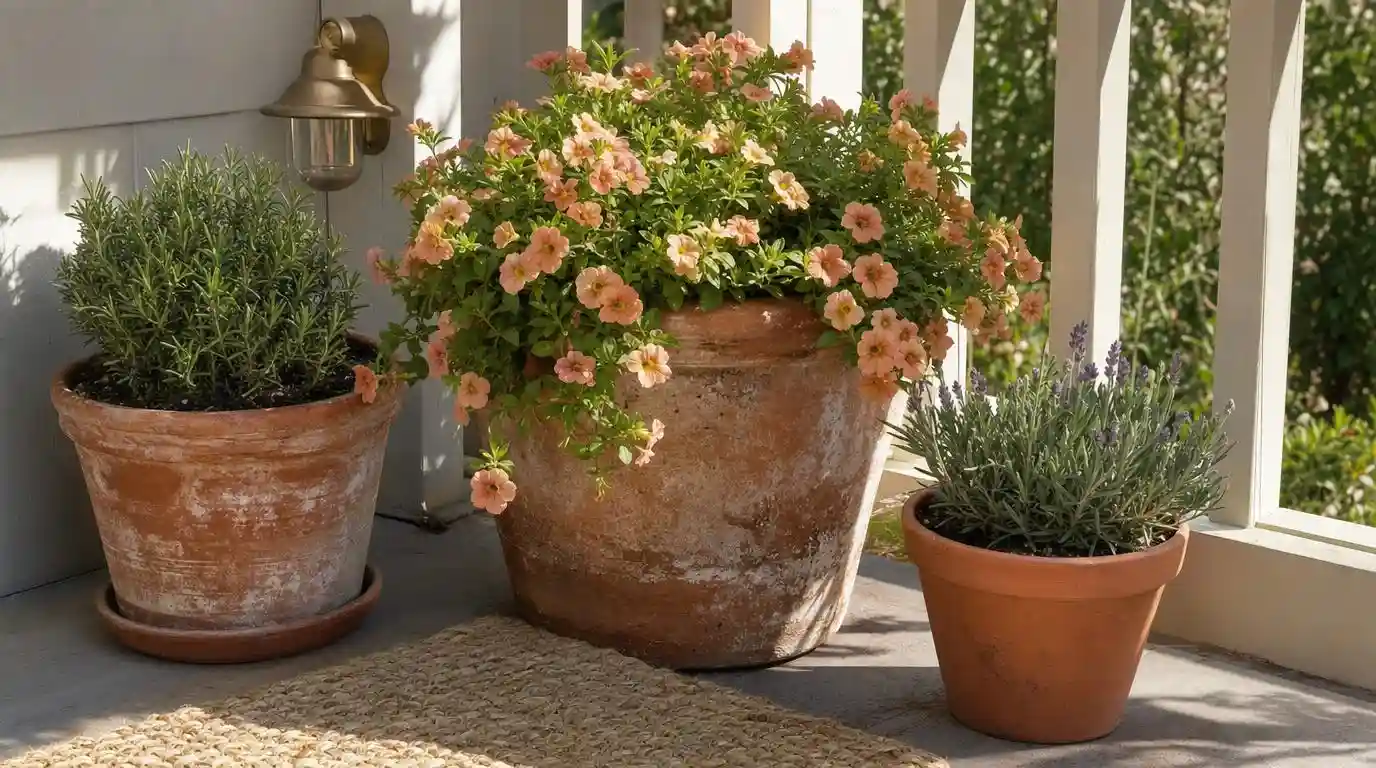
Material and Plant Choices That Last the Full Season
Spring porch decor that looks good in April and fades by May is a common frustration. The fix is choosing materials and plants with durability built in.
For textiles, solution-dyed acrylic outdoor fabric — the type used by brands like Sunbrella — holds color through UV exposure and rain far better than standard polyester outdoor cushions. It costs more upfront (expect $40-80 per cushion insert) but holds its appearance through an entire season. Fade-resistant outdoor rugs in polypropylene or recycled PET fiber handle rain and foot traffic without breaking down. Avoid natural-fiber rugs like jute outdoors — they absorb moisture and develop mold within weeks in most climates.
For structure, powder-coated steel and aluminum furniture resist rust and maintain finish through wet spring weather. Teak and eucalyptus age gracefully outdoors but require annual oiling to prevent graying. Rattan and wicker furniture suited for outdoor use carries a UV-stabilized coating; indoor rattan will deteriorate within one season outside. If you’re scaling furniture choices across a larger outdoor area, simple outdoor patio ideas shows how the same material logic applies from the porch outward.
For plants, the best spring porch performers are those that handle fluctuating temperatures and varied moisture. Calibrachoa (also called million bells) blooms continuously from April through frost, tolerates both sun and part shade, and resists rain damage better than petunias. Ferns thrive in sheltered covered porches where direct sun is limited. Cordyline and ornamental grasses add structural height that holds from March through May without requiring deadheading. Herbs — rosemary, lavender, thyme — add fragrance and visual interest while tolerating dry spells. For inspiring plant arrangement ideas beyond the porch, creative ways to decorate a balcony with hanging plants shows vertical planting strategies that work equally well on a covered porch with a beam or railing.
KEY TAKEAWAY: Solution-dyed acrylic textiles, powder-coated metal, and continuously-blooming plants like calibrachoa are the material choices that carry spring porch decor through a full season without fading.
Where Spring Porch Styling Goes Wrong
A few common mistakes can make even a well-stocked porch fall flat. Here’s where spring styling usually goes wrong — scale, overhead space, over-accessorizing, and a disconnect from your interior — and how to avoid it.
Using the Wrong Scale
Undersized furniture is the most common structural mistake. A loveseat that is 42 inches wide on a 10-foot-wide porch leaves awkward empty space on both sides that no accessory can fix. Two chairs that are 28 inches wide each, with a side table between them, fill the same width more naturally and allow guests to face each other. Scale everything to the actual measurements before committing to a purchase.
Ignoring the Ceiling and Overhead Space
The porch ceiling is part of the design. A bare overhead fixture from 1987 undermines a carefully styled floor-level arrangement. A ceiling painted in a classic porch blue-grey (a traditional American porch ceiling treatment) or a warm cream makes the ceiling an asset rather than something to overlook. Pendant lanterns or outdoor wall sconces in brushed brass or matte black bring the overhead zone into the composition without requiring an electrician — many outdoor pendant styles install with a standard fixture swap.
Overdoing Seasonal Accessories
A porch with too many seasonal items — multiple wreaths, an excess of Easter or spring-themed signs, competing prints in cushions and rug — loses the calm quality that makes a porch feel welcoming. The most inviting porches have fewer pieces, each chosen carefully. One statement wreath. One rug. Cushions in one print and one solid. Two or three planters rather than eight. Restraint is a design decision, not a budget constraint. 12 modern spring wreath ideas for interior and exterior styling shows how a single thoughtfully chosen wreath does more than a collection of average ones.
Disconnecting the Porch from the Interior
A navy-and-white coastal porch that opens to a warm-terracotta Southwestern interior creates a jarring transition. The porch should preview the interior, not contradict it. If your entryway uses oak flooring and warm cream walls, the porch palette should reach toward warm tones — not pivot to a completely different color story. Even one shared element — a repeated material, a matching accent color visible through the sidelight window — creates enough visual continuity to make the transition feel considered. Refreshing spring entryway decor ideas for a welcoming home covers the interior-side of this transition and pairs naturally with any spring porch refresh.
KEY TAKEAWAY: The most damaging porch styling mistakes are wrong scale, an ignored ceiling, over-accessorizing, and a color story that contradicts the interior — each has a straightforward fix.
What You’ll Spend
A spring porch refresh can work at almost any budget. The key is knowing where spending more delivers lasting value versus where restraint is equally effective.
14 best privacy fence ideas for backyard seclusion and style and cheap backyard ideas to upgrade your space on a budget both show how smart material choices extend from the porch outward at modest cost — the same value-focused approach applies to every project in the table below.
| Project | Estimated Cost | Impact Level |
|---|---|---|
| Outdoor rug (polypropylene, fade-resistant, 5×8 ft) | $60–$180 | Very High |
| Front door repaint (DIY, quality exterior paint) | $30–$60 | Very High |
| Outdoor seat cushions, solution-dyed acrylic (set of 2) | $80–$220 | High |
| Spring planter arrangement (2 medium terracotta pots + plants) | $45–$120 | High |
| New overhead or wall-mount light fixture (DIY swap) | $40–$150 | High |
| Spring wreath, quality dried or greenery-based | $35–$85 | Medium |
| Outdoor side table or accent piece | $50–$200 | Medium |
The highest-return projects are always the door and the rug — both are visible from 30 feet away and set the tone before a guest registers any individual accessory. The lowest-return purchases are usually small seasonal trinkets and novelty signs: high cost per square inch of visual impact, and they date quickly.
KEY TAKEAWAY: Repainting the front door and replacing the outdoor rug deliver the highest visual return for the lowest cost — prioritize these before any other spring porch investment.
How the Porch Connects to the Entryway
The porch is the first room of your home. It is not separate from the interior — it is the opening paragraph. Guests read it before they step inside, and what they see through the front door the moment it opens either confirms or contradicts what the porch promised.
Interior continuity means the porch and the entryway share at least one visual thread. This does not require matching them — a traditional colonial interior and a lightly updated colonial porch do not need to be identical. It means the porch should borrow from the interior’s palette rather than inventing a completely new one. If the entryway has a jute runner and warm oak floors, those natural tones should appear in the porch rug or planter material. If the entryway uses a deep accent wall in warm charcoal, a charcoal-toned front door or dark lantern on the porch creates the thread.
12 modern sloped backyard ideas for landscaping on a hill shows how this interior-exterior logic extends to the broader landscape when a sloped front yard shapes the approach path — and how the same layering principles apply at a larger scale. Browse the full Exterior Decor archive for additional porch and facade ideas that extend the styling language across the whole home’s exterior.
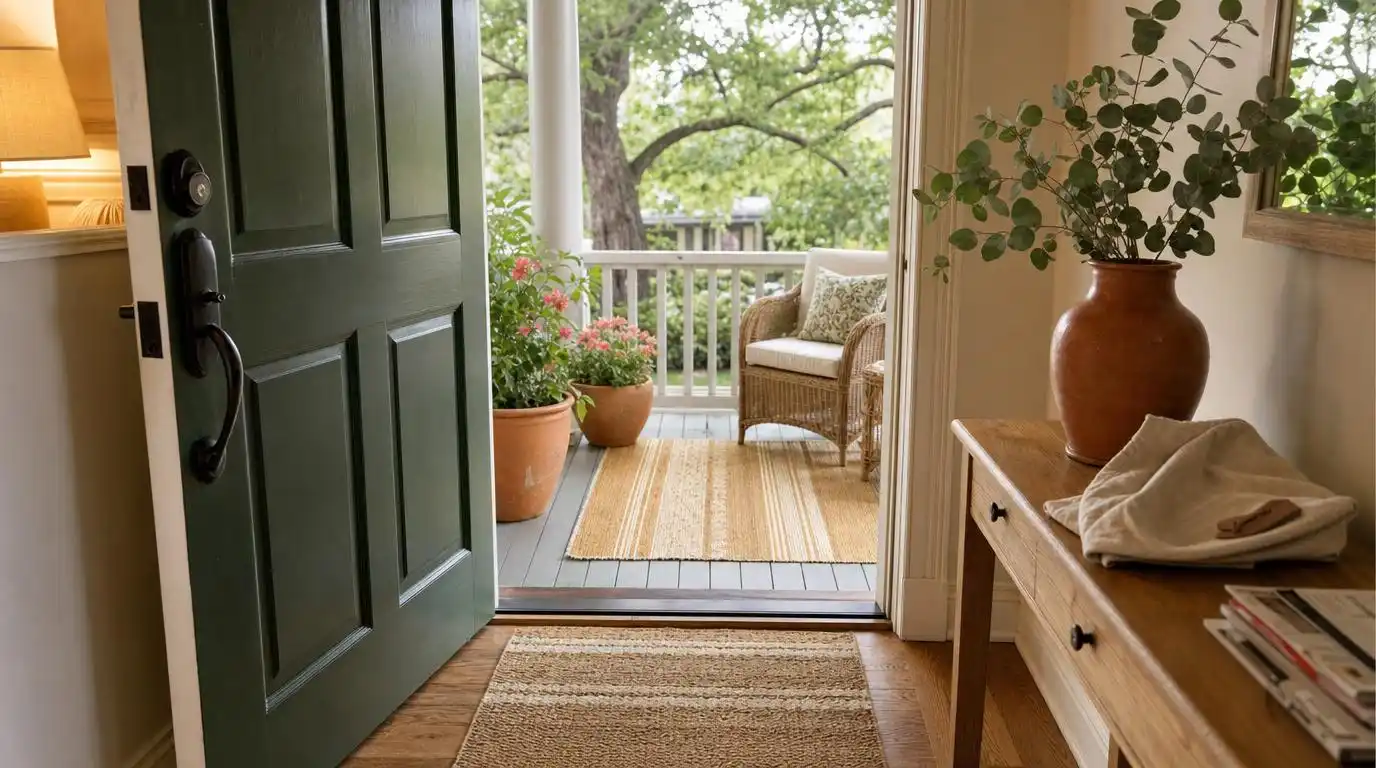
The most inviting entryways feel like a continuation of the porch — same light quality, same palette temperature, similar material language. A sheer white curtain visible through a sidelight window echoes the cream linen cushions outside. A ceramic vase on the entryway console in the same terracotta tone as the porch planters creates a subconscious connection. These details are small individually, but together they produce the feeling guests describe as “the house just felt warm from the moment you walked up.”
15 private small courtyard ideas to transform your outdoor space shows how this interior-exterior continuity extends even further when a porch connects to a courtyard or enclosed garden, and the full Outdoor category is worth exploring for anyone building a cohesive exterior design from porch to backyard.
DESIGNER TIP: Place one object that appears in both the porch and the entryway — a matching ceramic planter, a repeated textile color, or the same metal finish on hardware. This single repeated element makes both spaces feel designed, not decorated.
KEY TAKEAWAY: The porch and entryway should share at least one visual thread — a repeated material, palette tone, or finish — so the transition from outside to inside feels considered rather than abrupt.
A Recent Project: The Bungalow Porch That Came Together Slowly
A Recent Project:
Last April, I worked with a couple on a 1930s craftsman bungalow in the Pacific Northwest. The porch had original fir flooring, tapered columns, and a deep 12-foot overhang — beautiful architecture that had been functionally ignored for years. The brief was simple: make it feel welcoming without losing the original character. We started in March with a door repaint in deep forest green (Farrow & Ball Studio Green), two terracotta planters flanking the steps planted with hardy hellebores for early color, and a flat-weave outdoor rug in warm cream and ochre stripes. In April, we added a rattan loveseat with linen-blend cushions in muted clay and natural undyed cotton, a low teak side table, and a loose dried-botanicals wreath on the door. By May, calibrachoa had spilled over the planter edges in soft peach and cream, the hellebores had finished blooming and given way to trailing ivy, and the porch had developed the kind of lived-in abundance that looks effortless precisely because it was built in stages. The homeowners told me they started having their morning coffee outside for the first time since they’d bought the house.
Frequently Asked Questions
Conclusion
Spring porch decor is one of the few home styling projects that rewards patience and design thinking in equal measure. The porches that feel genuinely inviting — the ones that make guests want to sit down before they’ve even been asked inside — are almost never the result of a single shopping trip. They are built in stages, calibrated to the architecture, and resolved through a clear palette rather than accumulated through seasonal impulse buys.
I think back to that bungalow client in the Pacific Northwest every time I approach a porch project. What changed that space was not any single item — it was the decision to start with the bones in March, let the color arrive in April, and allow the abundance to develop naturally in May. The porch stopped looking decorated and started looking lived in. That is the real goal of spring porch decor: not a styled photograph, but a space that earns its warmth the way a good room does — gradually, through considered layering. Once the porch is resolved, carry the same seasonal thinking inside — elegant spring bedroom decor ideas shows how the same palette principles translate from the front of the house all the way through to the most private spaces. For more inspiration across every corner of your home’s exterior and beyond, 101homedecor.com is a good place to keep exploring.